This HFS Point of View is for CIOs, heads of application modernization, and enterprise architects deciding how to fund and govern AI-led legacy modernization programs.
Many technology and services vendors promise fast and cheap modernization through AI, and vibe-coding is a major feature in this premise. The market is promoting developer productivity boons from being able to type a prompt and watch working software appear on screen. This new phase of the software developer makes both creating new apps and tackling the multi-year COBOL albatross suddenly something that can be resolved over a weekend. This, unfortunately, is far from reality.
Vibe coding (or AI coding) produces convincing prototypes that can rapidly reveal the potential of a solution, but these prototypes are far from producing a modernized applications estate. It’s crucial for CIOs and heads of application modernization to stop funding speed and start funding context, where the value lies.
In context, teams can capture intent, ensure enterprise standards are rendered in machine or human-readable format, and embed governance throughout. The goal, after all, is not to blindly create and modernize by any means. It is about creating software that unlocks business value by building solutions using data and AI, but deliver outcomes in the context of people, processes, and technologies.
The progression and premise of vibe coding is real, and they must be acknowledged. AI-assisted development transforms the idea-to-prototype stage where a product owner and an engineer collaborate in real time through natural language using a tool like Cursor or Replit, compressing weeks of requirements ping-pong into an afternoon’s task. AI’s ability to deliver a 2x-plus productivity lift on software development, converting thousands of lines of code with greater accuracy and with less effort, is not an imaginary gain (see Exhibit 1).
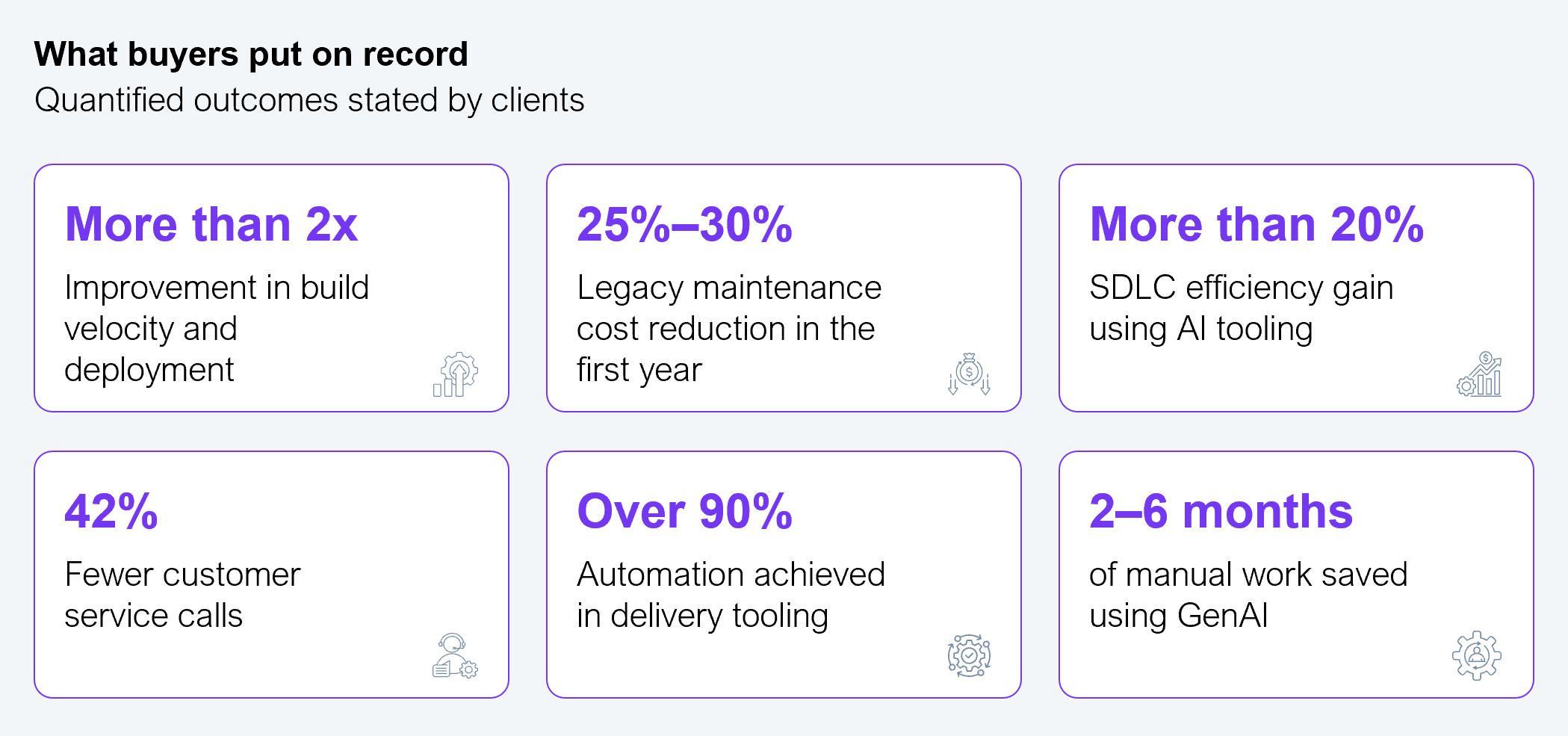
Sample size: n=57 enterprises
Source: HFS Legacy Application Modernization Horizon 2025; client reference survey
However, the results curve bends as complexity, volume, and scale increase. Connected enterprise sprawl is where AI continues to hit a wall because the model lacks context for the whole system, so it invents dependencies and burns cycles in refactoring loops. AI can encourage cognitive surrender amongst developers, where the human expert drops their guard when the first slice of generated output looks clean, but the defects and hallucinations sit in the rest that no one bothers to check.
For evidence, HFS is constantly discussing with application services companies managing millions of projects and trillions of lines of code. These providers are conceding that it is beautiful at the prototype, painful at the minimum viable product (MVP), and lacks polish for scaled production (see Exhibit 2).
Vibe-coding’s weaknesses show up in the numbers that matter. A 2025 HFS survey of 200 business and technology decision makers revealed that among firms actively using GenAI for software development, only 19% use it to replace developers. The contextual layer is where human ingenuity sits, and having context is non-negotiable in a complex modernization program.
In real examples, junior-developer productivity drops in pure prompt mode because they ship buggy code they cannot evaluate, while mid- and senior-developer productivity rises because they supply the missing context. A vibe-coded greenfield demo carries no legacy, but a modernization program is almost entirely legacy, and that is the gap that boards are not factoring in.
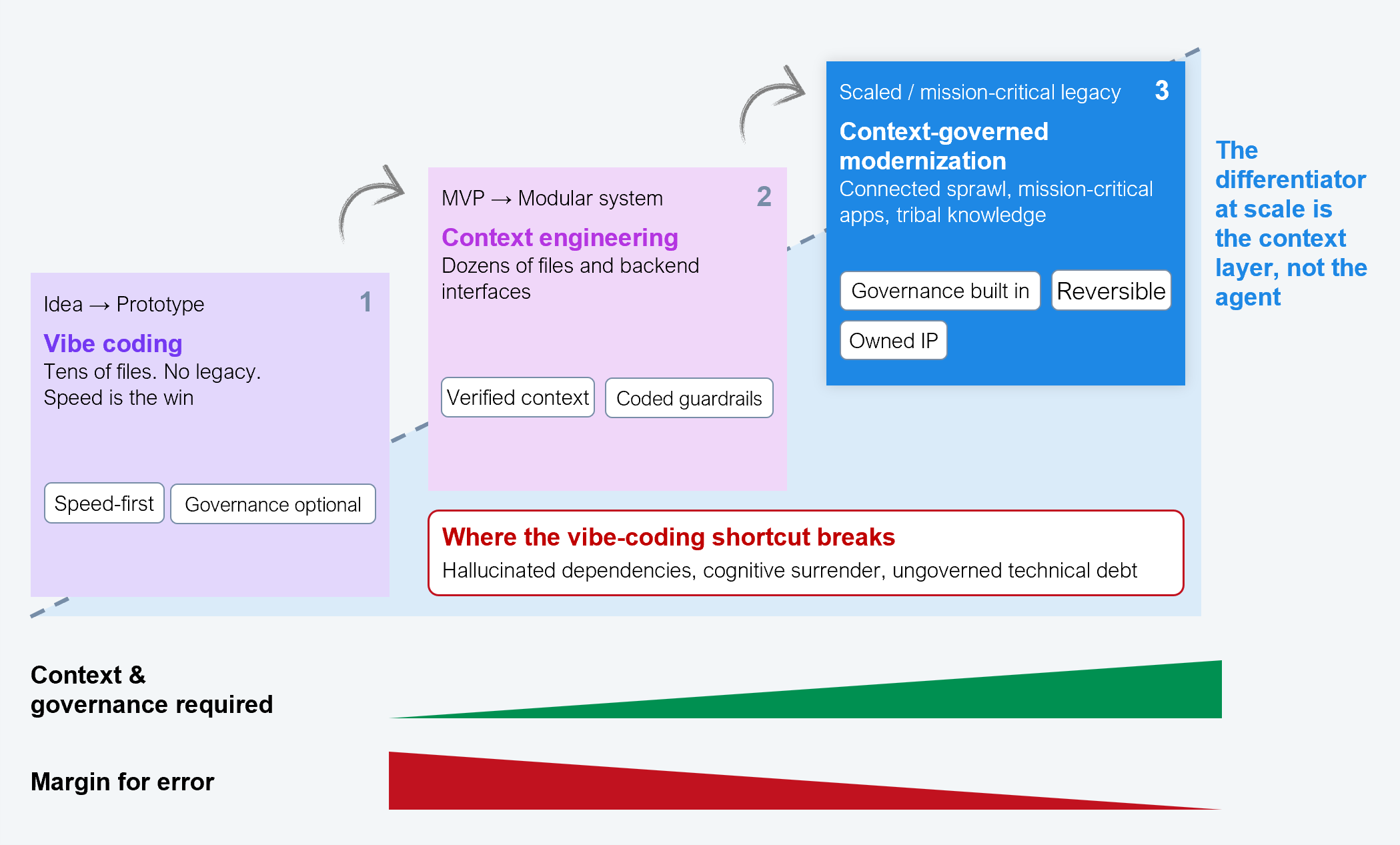
Source: HFS Research, 2026
In an everyday example, a mission-critical customer-facing application runs on Natural/ADABAS or first-generation Java. Often, the business rules exist only in the minds of three people, and the web of downstream dependencies makes any change risky. Modernization can stall in such cases, not for lack of tooling, but because the contextual knowledge is missing and advancing the program is held back due to a lack of documentation or expertise. An AI agent that cannot see the intent, rules, and dependencies will generate code that compiles correctly and demos smoothly but quietly breaks a process downstream that it could not see.
The remedy is to engineer the context before generating any code, and this is exactly where AI now shines. It can read legacy code bases from procedural mainframes to packaged applications that were previously opaque and surface the business rules and dependencies no one ever wrote down. This generates an X-ray of the estate, giving verified context to ground every generation in the enterprise’s own standards, security posture, and architecture. This is also what the industry’s convergence on Model Context Protocol (MCP) reflects. MCP makes an inherently probabilistic technology behave deterministically when rewriting the core systems and enabling the shift from monolithic-to-microservices to monolithic-to-agentic.
Context engineering also reframes the skills question by moving the work away from writing code to engineering the system. Problem-solving, critical thinking, and judgment become the required skills to encode the guardrails that help an agent act safely.
The moment you democratize code generation, you move modernization out of controlled IT pipelines and into the hands of anyone with a prompt box. HFS has been flagging this for over a year. Citizen development and vibe coding are accelerating faster than enterprise governance can track, creating shadow AI and ungoverned and unreviewed technical debt at speed. A faster way to generate code you cannot account for is not progress.
The discipline that separates modernization from mess is owning the lifecycle, not renouncing it. The human must engineer the system, setting the precision and latency trade-offs and the quality gates, while the agent implements. Every output should stay auditable, traceable, and reversible. Governance must live at the point of creation, not be bolted on after the fact. Risk-tiered controls, role-based access, lineage and traceability back to specific files and functions, and human-in-the-loop as a deliberate gate triggered by policy, uncertainty, or business risk are non-negotiables to avoid shadow modernization.
CIOs must test their AI-led modernization programs sooner than later. If your AI modernization approach can produce a working change in your live systems but cannot tell you which rules it followed, what it changed, and how to roll it back, it is not a modernization capability. It is your most expensive source of false confidence.
The commercial model must change with the work, and buyers are already pushing for it. A 2026 HFS survey of 101 senior enterprise leaders revealed that 61% want end-to-end ownership and accountability from partners and only 18% still prefer traditional time-and-materials. CIOs must hold their providers to higher standards by following these recommendations.
Stop treating a compiling demo as proof that your legacy estate can be modernized on the cheap. Fund the context layer first. Capture and verify what your legacy systems actually do, turn your standards and controls into machine-readable guardrails, and embed governance where code is generated upfront. Hold your partners to working software in production within 90 days and to handing you the IP, including the living context.
Get those right, and AI will modernize your estate at a pace that was impossible a year ago. Skip them, and you will have vibe-coded your way to a faster, more confident kind of failure.
Register now for immediate access of HFS' research, data and forward looking trends.
Get StartedIf you don't have an account, Register here |
With the exception of our Horizons reports, most of our research is available for free on our website. Sign up for a free account and start realizing the power of insights now.
Our premium subscription gives enterprise clients access to our complete library of proprietary research, direct access to our industry analysts, and other benefits.
Contact us at [email protected] for more information on premium access.