This research document is the first part of a two-part series on this topic crafted by KPMG and HFS Research. The following report provides insights from interviews with over a dozen technology leaders from Europe’s most prominent firms on their low code journeys. In addition, we explore the drivers behind rising adoption, how organizations benefit, and some of the challenges they have faced when implementing low code at scale. Part two will dive into the emergence of digital workforce, communities of practice, and how new governance models can be adopted to sustain your low code efforts.
Low code extends the four core values expressed in the Agile software development methodology by valuing even more input from individuals in business and IT to improve, create, and deploy software-based solutions. While Agile focused on making the software development teams more business-centric, low code encourages firms to co-create and co-innovate alongside their technology partners.
Rather than scrum teams, minimal viable products, and sprints that developers undertake after capturing requirements, low code promotes a cultural and ideological shift away from “you do this” and “I’ll do that” to “Let’s work on this together to be successful.” Adopting low code is a journey toward operational agility as inputs from the market, customers, and partner ecosystem can quickly be captured and actioned closer to the ask rather than processed through rigorous and time-consuming project onramps.
To have a successful journey, you must prepare before you embark. First, your organization must design its data and applications relevant to how people work and are built to be delivered via the browser or mobile form factors. As we discovered in our discussion with multiple business leaders, starting with data is crucial to your low code efforts. Once your information is prepared, your strategy develops, and a mindset or cultural shift begins.
But before we get too ahead of ourselves, why is low code such a hot topic in the first place?
Low code is hot for several reasons. The typical motives for adopting low code include challenges in attracting and retaining IT talent to being quick to respond to business needs. As complexity increases and access to talent continues to be at a premium, enterprise leaders realize the need to leverage their whole employee base rather than continue to depend on silos of expertise.
In many cases, a business’s need for speed to value is driven by a mindset that adopting the leads to being first to market. However, where applications have the most significant impact are how to address a growing need for co-developing solutions across technology and the business. The traditional waterfall approach to application development applications can be too slow. At the same time, new agile methodologies have improved IT, but often not the business’ reception of how effectively these methodologies meet their needs.
Low code isn’t a new concept. The use of rapid application development (RAD) tools is commonplace within most software development teams. RAD tools like Node.js, Eclipse, or Jira have become increasingly common for back-end and front-end development efforts. Now, vendors are making RAD tools even more visually attractive. As a result, the term low code has emerged to broaden the appeal of software development to an increasingly digitally fluent businessperson.
Opening the book of software development, DevOps, test and QA, pipelines, etc., to Joe Average employees may sound like a nightmare for support, technology budgets, and, potentially, the proliferation of shadow IT. But inhibiting an increasingly digitally fluent workforce is not the answer. Rather, IT needs to take the journey with their business partners to share the success while preparing the data, systems, and workflows to be more accessible and sustainable.
Be wary of starting a low code journey without addressing your firm’s data landscape. As firms have experienced with robotic process automation (RPA), machine learning (ML), and other data-centric efforts, making meaningful decisions requires clean data. Yet, in a recent study of European executives, 43% still see their data capabilities as a weakness in their business. Moreover, a data fabric, storage, or architecture will present difficulties in surfacing data modules for developers to extract, transfer, and load consistently and sustainably.
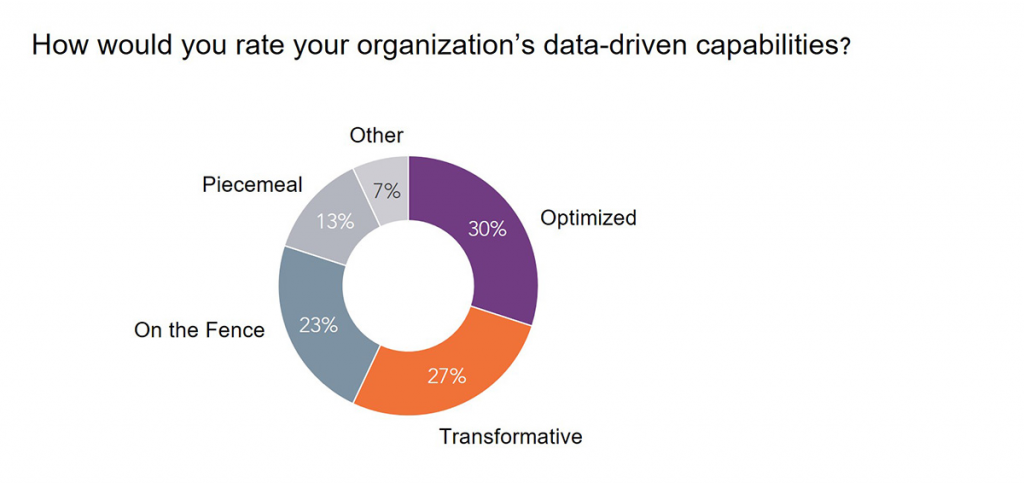
Sample: HFS Pulse, 2H2021; 285 executives across Global 2000 firms in Europe and the United Kingdom
Source: HFS Research, 2022
Many organizations’ business leaders realize that the data quality problems they have been willing to live with are now a serious barrier to success for their business. Moreover, adopting low code to allow teams to co-innovate is a quicker way to clean and tidy up corporate data. Only by tackling data early in the journey can they create the integration points needed to create relevant and accurate insights on products, inventories, sales data, and more during the development phase.
Companies must fix their data and create standards for rolling out low code to be truly successful. Once this happens, the ability to quickly iterate new applications or processes can be significantly improved.
– Rhys Jones, ex-Global Head, Low Code Platform – Enterprise Technology, HSBC
Our discussions with technology leaders indicated their low code adoption and maturity level were linked to how confident they were in their data; taking the time to fix the back-end integrations and the data quality led to adoption by the business. Improving the data fabric also allows for a better security posture and policy as low code access, use, and storage can be implemented and maintained more effectively.
Low code’s purpose is to deliver value to the business. It does not fix things that aren’t working. If it’s not driving value creation for employees or customers, it is a bad investment of time or money. Given how European organizations are changing their investments in technology to reflect new ways of working, low code is important to creating lasting business value.
As Exhibit 2 shows, leaders in large European firms are focusing on increasing collaboration across employees and the firm’s ecosystem. HFS data from our Pulse survey indicates the emerging ways of working, larger ecosystems, cloud investments, and emerging technologies like AI, RPA, and low code are reshaping organizations. Low code, AI, and RPA are levers for providing employees with modern tools to solve problems faster.
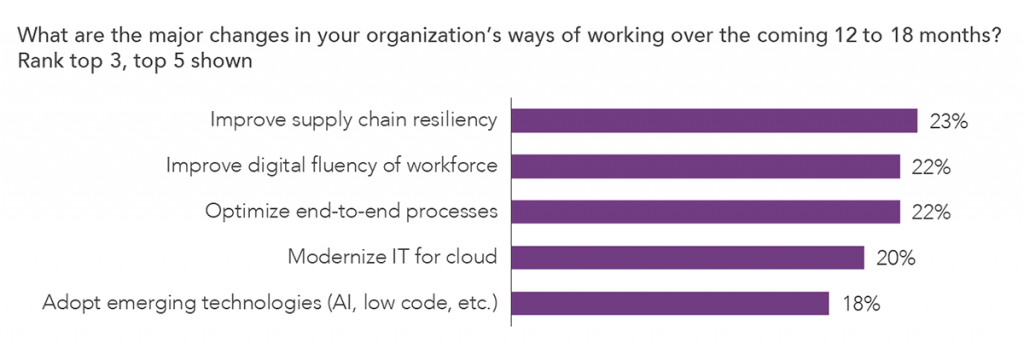
Sample: HFS Pulse, 2H2021; 285 executives across Global 2000 firms in Europe and the United Kingdom
Source: HFS Research, 2022
Low code means front-line teams can rapidly resolve local business problems rather than a central execution team adding them to a lengthy backlog. This same access can inspire and empower innovation, too, since non-technical people can evolve an idea to a rapid and scalable prototype using low code to solve a problem, rather than depending on technology to add new requirements to their development backlog.
Reducing the time to market is perhaps the greatest competitive advantage of low code. The backlog in IT and external service partners usually focuses on large and complex projects. In many cases, that backlog prevents the business from delivering simple but much-needed initiatives to respond to market demand promptly. Through low code, core business functions, with the support of operations teams, can significantly speed up the “time-to-market” for their new app and features.
The two adjectives which employees and technical staff should associate with low code are agility and velocity. Agility is about the company working together to flex to meet predicted and unpredicted opportunities or challenges. Velocity is about the speed with purpose.
—Ralph Diaz, Practice Lead, HFS
The focus of low code must be end-to-end. Value creation doesn’t come from an employee doing their own automation and saying, “It’s so simple you can do it on your computer.” That isn’t a journey. The real journey is about bringing the organization along to reap the rewards, experiences, and successes as a collective.
Adopting a OneOffice mindset is a shift to create collaborative, cross-functional, enterprise operations powered by an integrated stack of emerging tech that complements your core, natively automates your processes, enables your people, and powers your decisions. While technology teams can facilitate this with traditional software development and code, the increasing involvement of the business in scoping, co-developing, and co-deploying software is fueling the need for low code.
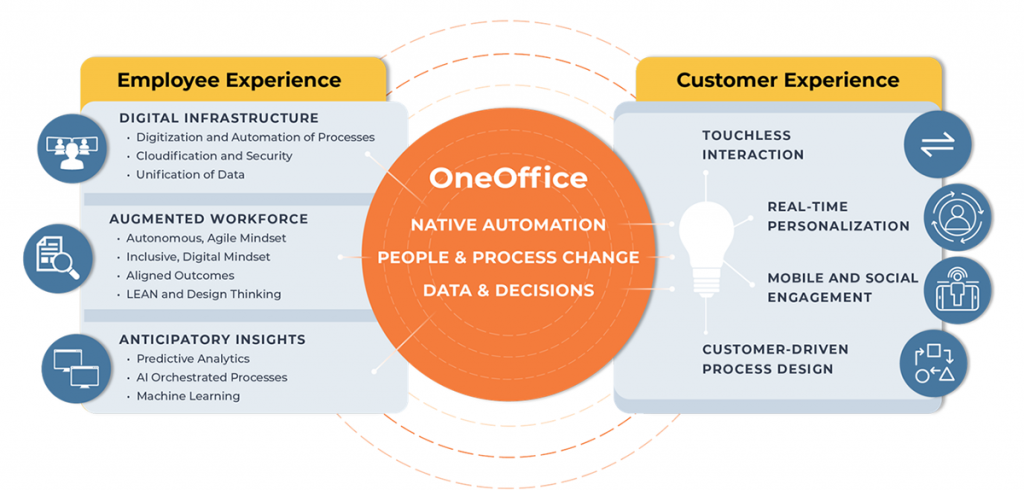
Source: HFS Research, 2022
Many business users’ low code journey likely began on Microsoft Excel. There has been a well-known need to automate how data was delivered as a single source of the truth but in a relevant context to each line-of-business leader. Unfortunately, these solutions were predominately desktop and lacked scale and consistency.
The software developer’s low code journey began as their DevOps teams embraced Agile. Today these are embedded in the digital engineering capability, which is responsible for how they approach working on both back-end and front-end systems and many modernization efforts.
Our journey with low code was to dive in, automate, fix the data, then apply more advanced AI/ML to reduce the customizations or nuances of the human element.
—Ben Rayner, Head of Analytics and Process Optimisation, Citi Enterprise Operations and Technology, Citi
As a result of its growing usage, low code is shaping the software development culture in the business. Understanding that it is a cultural shift, not a technology one, should be a tell-tale sign indicating you and your organization are ready for low code.
A lot has been made about low code and citizen developers. However, in our interviews with leaders across European businesses, there isn’t much interest in seeing business professionals becoming application developers. Rather, the interest lies in leveraging the growing digital fluency of the workforce. Furthermore, several high-profile low-code platforms require certified and dedicated professionals for effective utilization.
Less than 10% of the global workforce is from Generation Z (born between 1996-2010), yet by 2030, more than 30% will be employees and future leaders. Moreover, these individuals are growing up tech-savvy, think mobile first, and know more about manipulating data than most Gen Xers will even know.
A strong leader, or at least one who plans to not retire by 2030, should be looking for ways to harness the skills these young professionals bring to the workplace. As they’ll be digital-first in their mindset, it is worth calling them digital citizens, no matter what their job. And as such, their skills from operations to sales to technology will be useful. And you can bet the farm now that low code will be part of their DNA.
Therefore, the time to start preparing for the impact these future employees will have on your company and its culture is now. Consider these three important factors when making low code a solution for digital citizens:
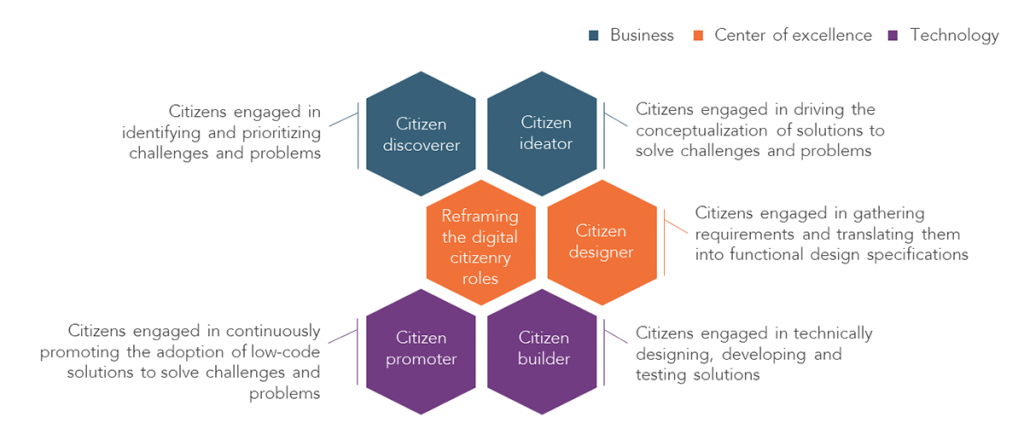
Source: HFS Research, 2022
The digital workforce is about the co-creation, co-development, and co-innovation between traditional business roles and software development and technology teams. Reframing the conversation away from “you need to be a developer” creates an opportunity to reframe how the business, technology teams, and partners can work together.
Low code does not mean “no code” or no training required. As we have discussed regarding data, workflows, and new talent, training users on how to properly use the data and which low code tools are available for different jobs is crucial. Successful low code solutions will need to be documented, supported, and in some cases, converted to more robust traditional code. Developing a training program to discover, assess, create, and publish low code is essential for long-term success and business benefits.
Investing in training is part of building the right culture. When people know you are investing in them, they are less likely to worry about automating their job away.
– Seng Yue Yau, Head of Digital Transformation and TBS IT at Takeda
Low code platforms have problems with their delivery model matching the existing processes with complex enterprises. These are defined as the “most common problems and the most popular applications or workflows.” Many firms have customized systems and technology-based processes, so overlaying generic low code won’t work. Technology teams will need to overcome issues associated with versioning, tracking installations, and the need for manual support when installing to ensure the low code solution has the access and rights to be helpful.
A resulting challenge was when it became time to integrate, whether the low code solution was developed in-house or by a partner; in many cases, there was a lack of knowledge on how to integrate. This was a hidden cost of low code.
– Maja Mikic, Executive Director, Digital Transformation, BRD (Groupe Societe Generale)
The last thing companies should be aware of is that low code misses the complexity of building sustainable software and workflows in an organization. Low code is about assembling from defined data sources, workflows, and applications. A firm needs to consider how its center of excellence will function to address many of the company’s systems, policies, and processes. We will discuss that more in Part 2 of our series.
Solving a firm’s challenges with low code isn’t an easy road. There are many permutations, variations, and complexities to addressing a business’s real challenges. In addition, leaders must manage the risk of too many people’ banging away’ for incremental improvements to their job, which can lead to inconsistencies in design, control standards, support needs, and more.
Start today with efforts to address how low code complements your software development programs. Cleaning up your data and creating functioning communities of practice will allow low code to play a pivotal role in making your business more responsive to the needs of its employees and customers.
Watch this HFS Videocast – Unfiltered Stories | Enterprise adoption of low code:
Register now for immediate access of HFS' research, data and forward looking trends.
Get StartedIf you don't have an account, Register here |
With the exception of our Horizons reports, most of our research is available for free on our website. Sign up for a free account and start realizing the power of insights now.
Our premium subscription gives enterprise clients access to our complete library of proprietary research, direct access to our industry analysts, and other benefits.
Contact us at [email protected] for more information on premium access.