
This HFS Research Point of View is for services CEOs, sales and commercial leaders, and enterprise sourcing executives structuring AI-era deals whose economics depend on workforce reduction.
The services industry has arrived at its most uncomfortable inflection point yet, with too many service providers competing for deals and greedy enterprises exploiting AI to squeeze them to the limit. In short, many enterprises are outsourcing their downsizing and lack of AI acumen to services firms rather than dealing with the internal transformation themselves. If this continues to escalate, the result will be a broken industry, deeply short of talent and with a cutthroat culture that few will want to work in.
And while we definitely get some vibes from the late ’90s and early 2000s, when massive “take the people” deals kick-started the whole global outsourcing industry, the difference this time is the elimination of roles to machines, as opposed to a redistribution of talent to lower-cost locations. What we used to call “you mess for less” is fast becoming “your debts for less.”
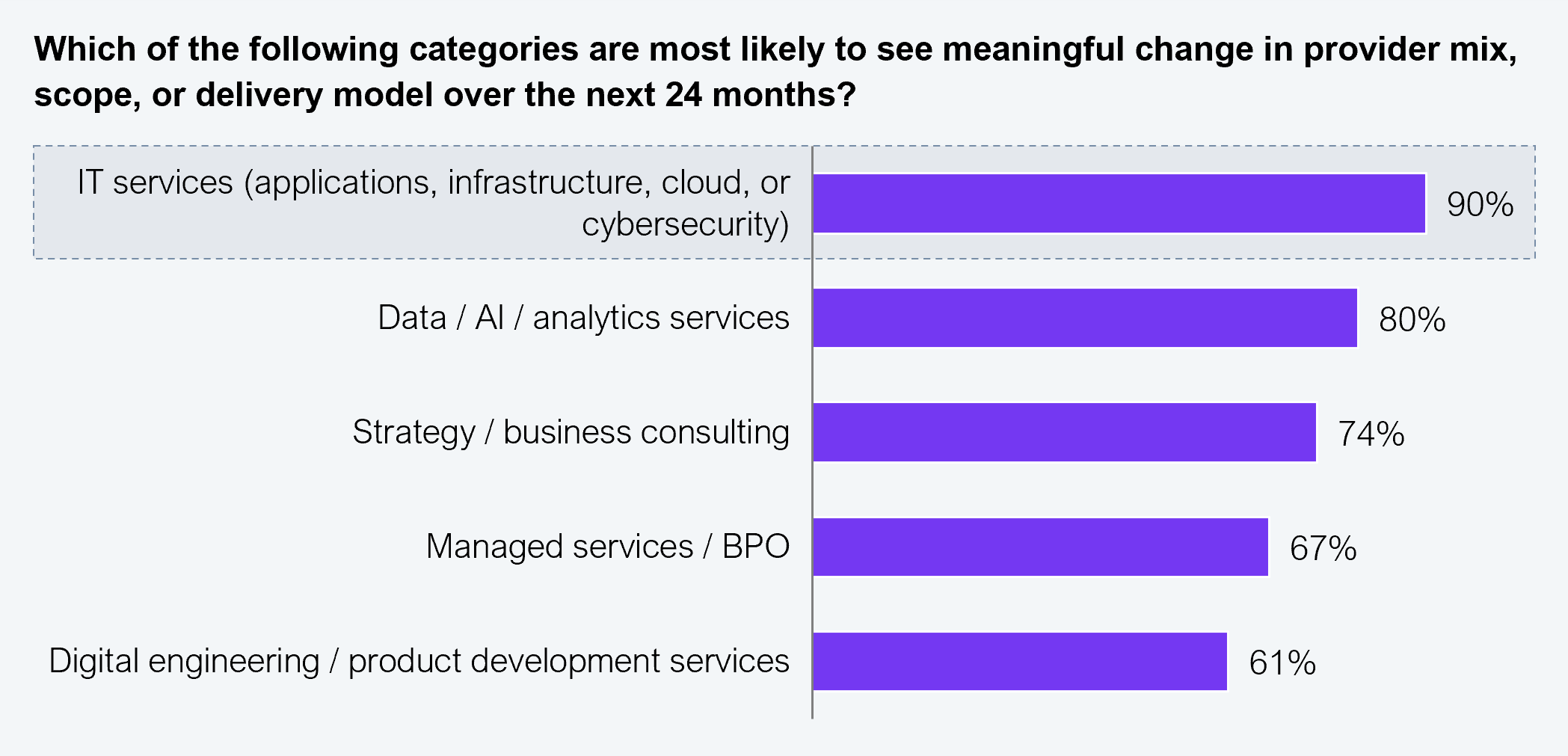
Ninety percent of enterprise leaders expect meaningful change in their IT services provider mix, scope, or delivery model over the next 24 months, according to our 2026 HFS Enterprise Pulse Study (see Exhibit 1). Meanwhile, we recently saw a competitive deal where an enterprise demanded its provider write it a check upfront for 40% of the transformation value on MSA signing. And one provider went for it.
Sample: 202 senior enterprise leaders from organizations with $1 billion+ in annual revenue
Source: HFS Research Enterprise Pulse Study, 2026
Put those two converging issues together, and you can see the threat to the health of the entire industry. When practically every contract is in play, desperate providers will accept economics that would have been laughed out of the room five years ago. When those economics require buying the business upfront, the only way to fund the deal is to fire your way to the savings.
And this 40% check is not an outlier. Picture a bank rebadging 2,000 finance and operations staff to a provider that guarantees a 40% run-cost reduction by year three, funds the transition itself, and absorbs all the severance costs. Or an insurer running a reverse auction where the contract goes to the provider willing to halve the inherited service desk within 18 months, with penalties tied to headcount targets rather than service outcomes. These are just examples of the aggressive enterprise behavior seriously impacting the services industry.
A provider that bought the business and inherited the client’s employees cannot carry those people indefinitely, hoping a magical AI productivity dividend appears. It has to automate aggressively and cut the workforce fast enough to fund the commitments it made to win the deal. Beneath the legitimate automation and AI story sits a much uglier unwritten objective: the enterprise gets the provider to do its firing.
The HFS Pulse data shows why providers are accepting these terms. Beyond the 90% churn intent in IT services, data and AI services sit at 80%, consulting at 74%, managed services and BPO at 67%, and even embedded engineering teams at 61%. Only 17% of enterprises expect to renew with limited change, while 77% plan to renegotiate pricing, 48% plan to shift work to another provider, and 34% expect to consolidate with fewer firms.
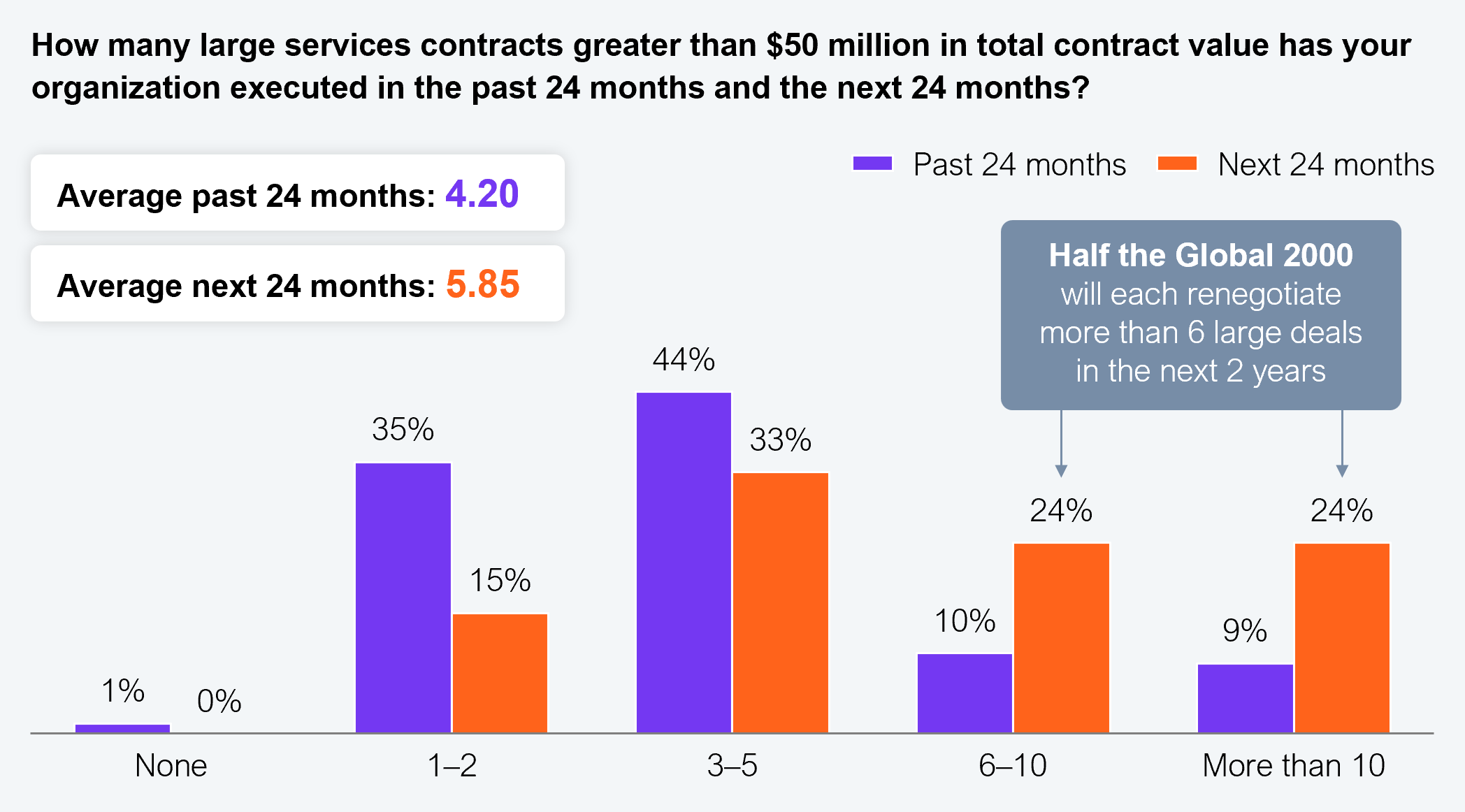
The volume is accelerating too, from an average of 4.2 contracts worth more than $50 million over the past 24 months to an expected 5.85 over the next 24 (see Exhibit 2). In fact, nearly 50% of major enterprises will each evaluate more than 5 large service contracts in the next 24 months.
Sample: 202 senior enterprise leaders from organizations with $1 billion+ in annual revenue
Source: HFS Research Enterprise Pulse Study, 2026
And the desperation cuts both ways, because 73% of enterprise leaders say their providers have not yet delivered AI-led services meaningfully. Buyers feel entitled to punish that capability gap, and providers feel compelled to promise whatever it takes to prove they belong in the AI era.
So imagine sitting inside a major provider whose legacy business is barely growing, where Wall Street wants an AI growth story and losing one $500 million client wipes out years of smaller wins. Someone eventually decides to buy the revenue, and that is when a competitive market becomes a dangerous one.
We have seen buy-the-business economics before. The mega-deal era of the 2000s left the industry unwinding write-downs and broken relationships for a decade. The difference today is that buyers want future AI productivity priced into the contract before the productivity exists.
Rebadged employees instantly become a liability on the provider’s P&L. The transformation team is no longer asking only how much work AI can truly improve. It is also asking how many people must disappear for the spreadsheet to work.
This gets particularly ugly in process-heavy areas such as finance operations and indirect sourcing, where agents can absorb much of the workflow but success still requires the client’s own people to change how they work. Our Pulse data shows 60% of the friction preventing AI from scaling sits inside the enterprise across integration, data, and talent. So providers inevitably start measuring adoption: which analysts route invoices through the new agentic workflow, and which managers quietly rebuild the manual checkpoints the agent was supposed to eliminate.
But there is a nasty line between telling a client where its process is resisting change and identifying which employees are resisting change. Once providers report individuals by name and knowing those names feed workforce decisions, the transformation partner has entered a very different business.
The client no longer has to be the bad guy policing adoption and deciding who no longer fits. It becomes a dirty little snitching game where the provider identifies the resistance, the client approves the restructuring, and everybody points to AI as the reason it had to happen.
Outsourcing has always involved displacement, rebadging, and offshoring, but AI lets leaders question every process, role, and contract simultaneously and provides convenient cover. Cut 5,000 jobs because you missed your numbers, and you have a morale problem. Cut 5,000 jobs because you are becoming an AI-first enterprise, and suddenly it sounds like innovation.
The hypocrisy shows up in our data. Enterprises cite innovation speed as their top sourcing driver at 49%, ahead of AI-led productivity at 45% and cost at 44%, yet they structure deals whose economics reward headcount removal above everything else. You cannot claim to buy innovation while paying for elimination.
The Big Four have spent decades running restructurings, so aggressively reshaping a client’s organization is familiar territory. For firms such as TCS and Infosys, it is far more uncomfortable, because their cultures were built as enormous employment engines with an implicit social contract around long-term careers. Competing this way does not simply challenge their pricing; it challenges what kind of companies they want to become.
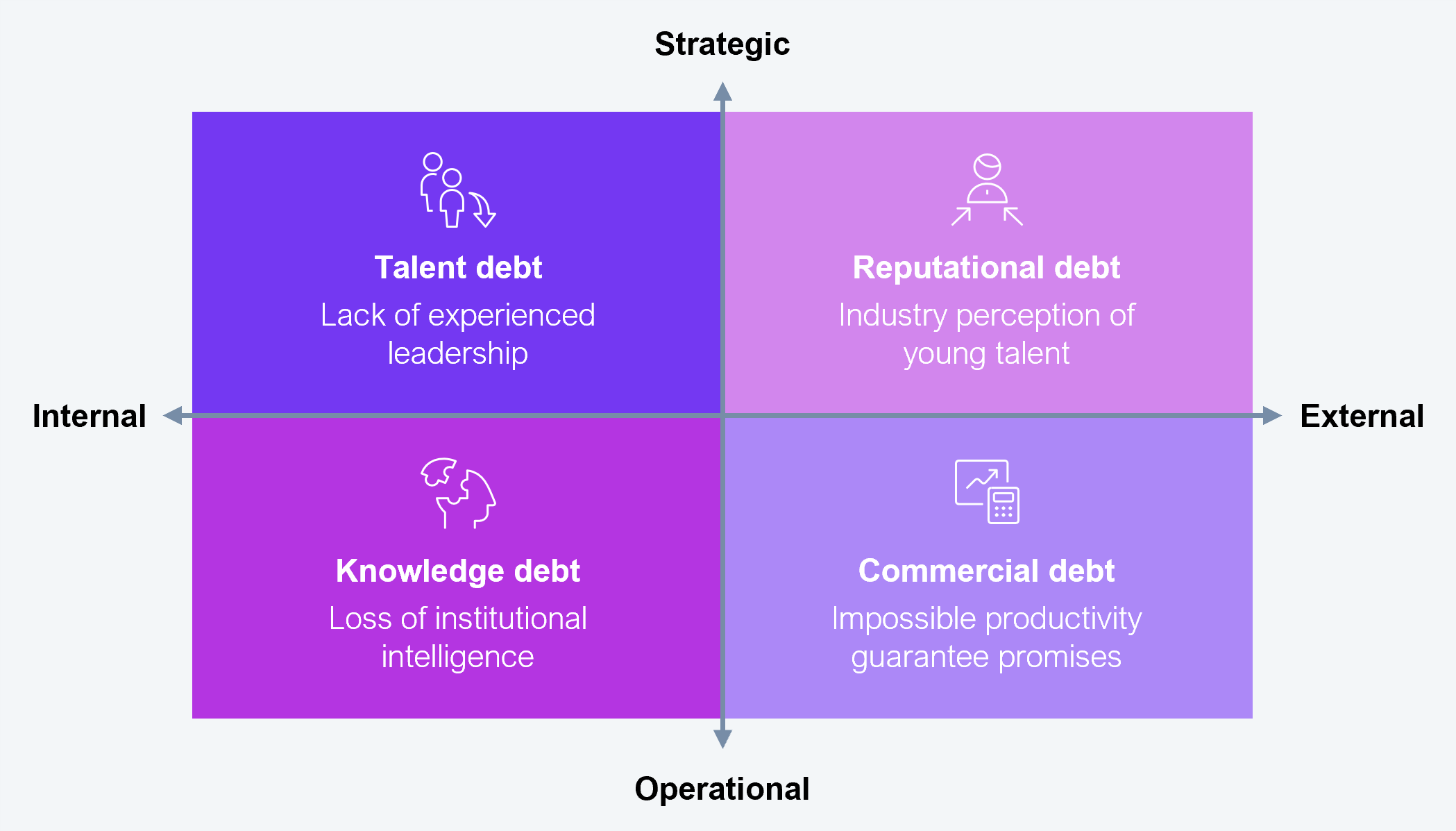
Talent debt arises when providers cut graduate intake, only to discover years later that they lack people experienced enough to lead complex transformations. Knowledge debt follows because veteran employees are eliminated before their institutional intelligence is captured, creating automated amnesia rather than an autonomous enterprise.
Commercial debt builds when a provider promises 25% productivity, a rival promises 35%, and somebody desperate for the logo promises 45%, until some guarantees prove impossible to deliver without destroying margins or quality. Reputational debt completes the set, as employees learn who built the technology that measures them, and young talent decides whether this industry deserves their careers. None of these debts appear in the business case on MSA signing. Instead, they arrive later.
Source: HFS Research, 2026
Here is the paradox that demolishes the firing narrative. Just 24% of enterprise leaders expect model-driven modernization to reduce labor demand, even though 42% believe it will reshape IT services entirely.
Model-driven modernization means rebuilding the IT estate around foundation models and agents rather than around people and their processes. Instead of armies of engineers manually migrating applications, documenting code, and testing releases, models increasingly perform the modernization work itself. Enterprises are taking this seriously, with 51% now viewing their primary foundation model as mission-critical and agentic AI topping their technology priorities. This is the biggest change to how services are delivered since offshoring, which is exactly why the labor finding matters so much.
Even with that scale of change, most enterprise leaders expect demand to shift toward higher-value work, not disappear. The mass workforce reductions being priced into these deals rest on an outcome most buyers do not even believe in. Eliminating obsolete work is progress, while selling the elimination of workers is Firing-as-a-Service.
The graduate pipeline is already being cut at the source, with the Big Four trimming UK intakes citing AI and recent US graduates facing around a 7% unemployment rate. We destroyed a pipeline once before when the BPO wave stripped out the entry-level accounting work where graduates cut their teeth. Ten years ago, these kids competed with offshoring, and now they compete with software.
Yet the fundamentals have not changed. Services has always been built on skills-at-scale tied to common technology platforms, and Services-as-SoftwareTM runs on the same principle with AI platforms and domain-centric skills. A provider that hires AI-native graduates and turns them into augmented doers has something to sell beyond headcount elimination.
So make the antidote practical and redeploy rebadged employees into adoption coaching, data stewardship, and exception handling rather than making termination the default output of automation. Commit a fixed percentage of every guaranteed saving to reskilling so procurement can compare it across bidders. Talent is a services firm’s identity, and firms that sacrifice it to fund these deals will wake up as faceless corporations united under a logo.
Providers should be extremely cautious about deals whose economics require workforce reductions that have not been technologically proven. They also should insist that employment decisions remain with the enterprise whose people are being transformed. CEOs, meanwhile, must stop celebrating every massive AI deal without asking who actually pays for these economics. If the answer is the provider upfront and thousands of employees later, we are consuming the very talent base on which this industry depends.
The promise of AI is to eliminate the work humans should no longer perform and to create a new generation of professionals who combine judgment, domain expertise, and machine intelligence. The danger is that a desperate industry buys revenue with its own cash, rebadges its clients’ employees, and fires enough of them to make the economics work, while the enterprise stands at arm’s length and calls it AI transformation.
That is not Services-as-Software. That is Firing-as-a-Service, and if it becomes the defining business model of the AI era, we will have turned the most powerful technology revolution of our careers into an extraordinarily sophisticated way for enterprises to get somebody else to do their dirty work.
Register now for immediate access of HFS' research, data and forward looking trends.
Get Started

If you don't have an account, Register here |
With the exception of our Horizons reports, most of our research is available for free on our website. Sign up for a free account and start realizing the power of insights now.
Our premium subscription gives enterprise clients access to our complete library of proprietary research, direct access to our industry analysts, and other benefits.
Contact us at [email protected] for more information on premium access.

