This Market Impact Report is for telecommunications executives, network operators, and enterprise technology leaders evaluating how to build a 6G roadmap that monetizes AI and creates new revenue streams.
Try imagining the AI era without ubiquitous high-speed wireless access.
Wireless technology advancements have connected the world’s population, computing devices, and endpoints to facilitate communications, commerce, and connectivity. Yet, leaders in telecommunications firms have continually struggled to produce revenue growth in line with their crucial role in the carriage, delivery, and quality of services associated with wireless networking. They continue to be seen as the pipes—not the fuel—of the information age. This is about to change. With AI at the core of the network design, the network will become intelligent. That is the promise of 6G.
5G, the current high-speed standard, has reached nearly three billion subscribers while operating at peak data rates of 100 to 400 Mb/s. The flow of data across computers, operational technologies (OT), and internet of everything (IoE) devices currently provides reliable data, voice, and video communications.
But that was before the AI era arrived.
This is a watershed moment for telco leaders. With the arrival of generative artificial intelligence (GenAI), the possibilities for telcos’ solutions can finally transcend connectivity. With 6G, they can provide intelligent networks offering advanced resilience, boosts in traffic throughput (peak speed of 50 to 200Gb/s), and tailored signal quality control, promising new customer experiences while creating fresh revenue streams for operators.
A telco’s success in the AI era will depend on how it adopts, deploys, and monetizes AI across its operations. Opportunities appear across the network stack, as AI can be in every layer and function. As 6G begins to go live around 2030, it will provide an optimal architecture to take AI to the next level and future-proof for emerging technologies like quantum, location-as-a-service, virtual reality, and hyper-personalized business and customer solutions.
With its advanced architecture, 6G improves bandwidth usage, automates network optimization, provides node-level service delivery, and enhances customer experiences. The challenge is that telco leaders often focus on comparing 6G and 5G from a technical perspective. Instead, they should think about how 6G’s new architecture is primed to unlock commercial outcomes.
Exhibit 1 shows that telcos migrating to 6G will enjoy many advancements. While the technical comparisons are often the impetus for investment, HFS believes the real opportunities arise from unlocking value-creating outcomes. Instead of focusing on attach rates and delivering over-the-top (OTT) services, telcos will use 6G to provide extremely low latency, superior data throughputs, and improved multimodal coverage, delivering significant user experience advances. Still, the real gains come from unlocking new business-to-business capabilities from industry-centric solutions to low-energy tracking and reporting for complex supply and logistics problems.
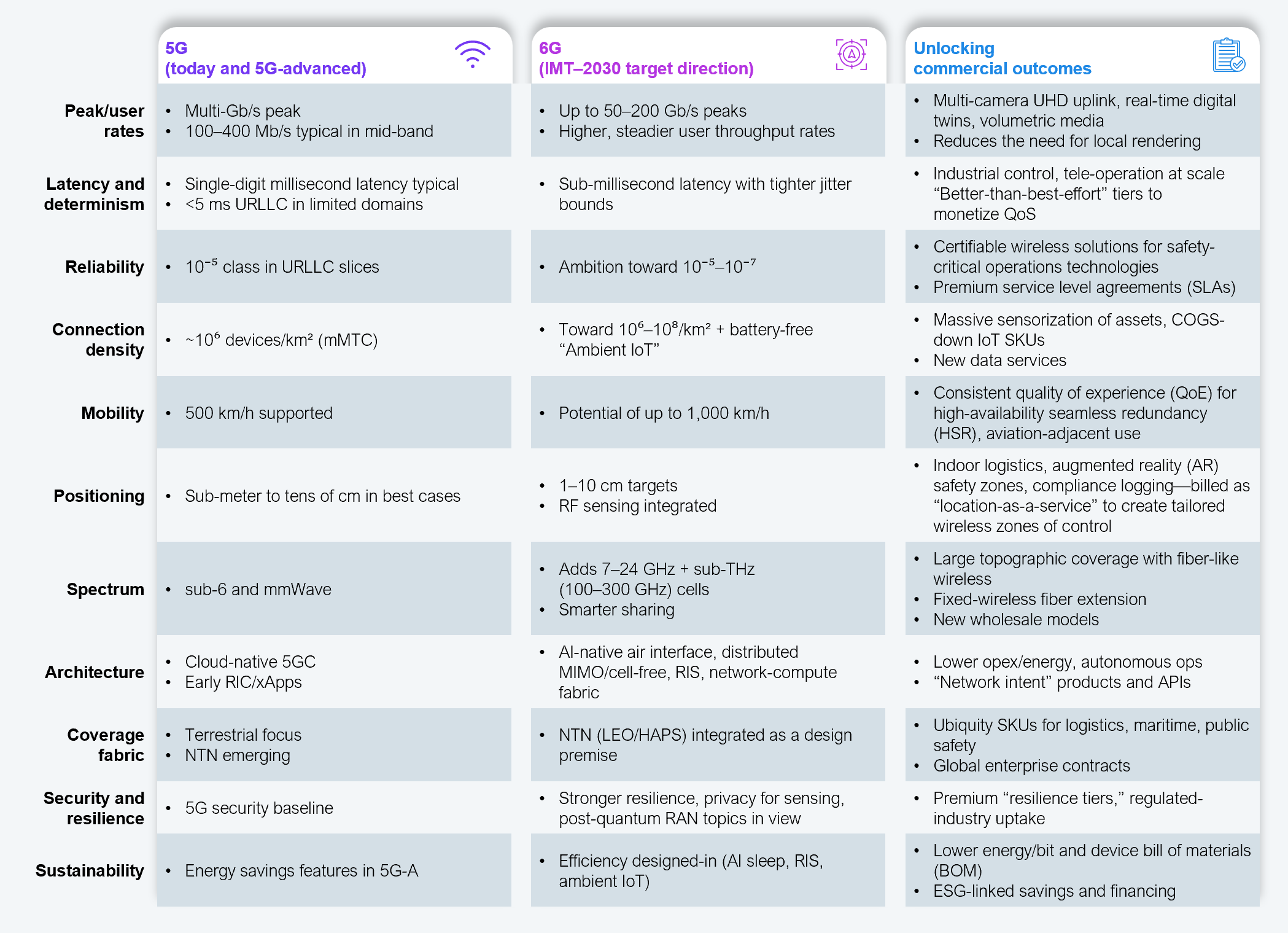
Source: HFS Research, 5G and 6G industry standards, 2025
HFS believes these “unlocked outcomes” will attract investment in new technologies, services, and revenue streams, which promise to create new ARPU (annual revenue per user) across customers, devices, and services and enable operators to provide hyper-tailored services for their customers.
For example, sporting venues that layer 5G, LTE, Wi-Fi, and Open RAN (ORAN) to manage traffic and provide many services could consolidate into a single wireless fabric. Cost savings alone will encourage investment, but the ability to tailor traffic based on intent will create new revenue opportunities unimaginable with current solutions.
These all lean in on the advancements of AI-native telecommunication solutions. We expect AI to quickly move from proof of concept at an individual or team level to scaling solutions as telcos turn to their service partners for tailored solutions from the core BSS/OSS (business support systems and operations support systems) to field services to customer success. AI will automate, optimize, and analyze what is going on across the network operators’ operations, ecosystem, and customer usage profiles, turning complexity across signals into actionable programs tailored to the telcos and their clients’ intentions.
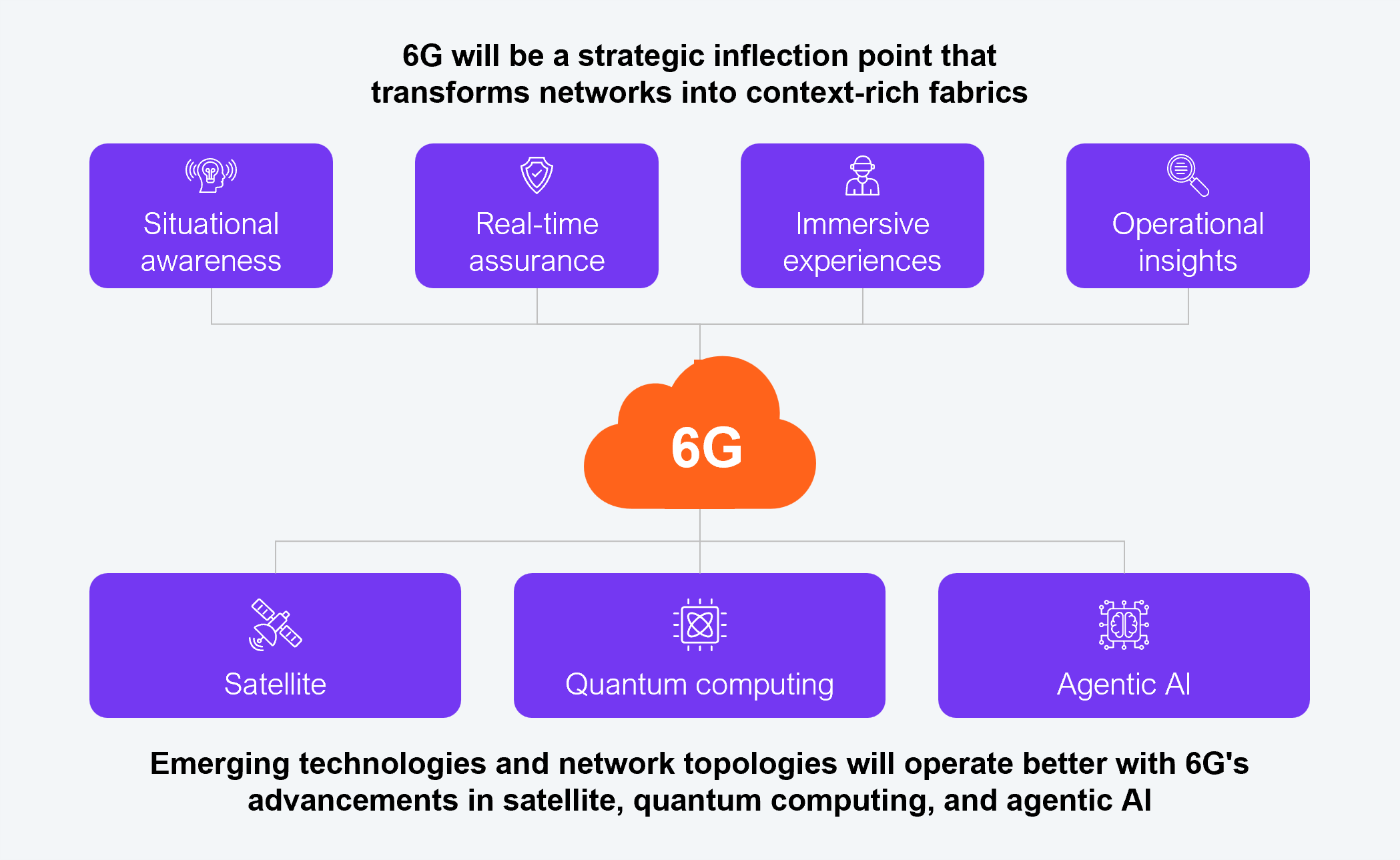
5G at its core is about connectivity and capacity, but 6G allows telcos and their customers to get more on their investment because of the deep AI integration. As a result, 6G will be a strategic inflection point that transforms networks into context-rich fabrics. These intelligent networks will allow telcos to begin selling situational awareness, real-time assurance, immersive experiences, and operational insights to their customers.
For enterprise users, these technology advancements are a boon for usage models, from data centers to edge IoT (internet of things) programs. 6G is designed to provide a singular wireless solution for ultra-dense, low-energy requirements. Unlike 5G, 6G’s architecture allows customers to connect nearly anything to the network without a local battery. For customer operation leaders, this means tracking assets, monitoring machinery, and using telemetry to track and audit, which provides new levels of operational assurance while opening new revenue streams for the network operator.
As AI transforms operating models across industries, processes, and technology solutions, the overlay of 6G capabilities allows the network to be a “living” part of this journey as it can adapt its services to the intent level of the customer, application, or endpoint device. Further, the network can learn and improve based on the data, usage, and customer-defined parameters. New usages will emerge as AI-native 6G allows data transmission beam-forming, intelligent scheduling, and intent-based orchestration to become practical, not theoretical.
While the unrealized promises of 5G may tempt network operators to hold back, the AI-native power of 6G is a chance to reset. It is no longer about selling “faster pipes”; instead, because the network is becoming intelligent, it can marry speed and reliability with sensing, positioning, and energy optimization. The resulting benefit for the network operator is that they can become a more valued partner in solving industry, technology, and customer needs.
AI is a key part of 6G’s value proposition to the global telecom market; however, AI isn’t the only emerging technology reshaping global communications. Applications will rapidly evolve as software and services increasingly overlap, what HFS terms “Services-as-Software™”, driving the need for networks that can facilitate the development, deployment, and management of a new generation of software that is on the horizon for 2030 and beyond.
Additionally, we anticipate that quantum computing will begin commercial deployment by 2030. HFS expects that “quantum-as-a-service” from providers like Google, Microsoft, and IBM will require significantly more data capacity to link customers with their advanced computational offerings. With 6G offering speeds up to 200 Gb/s, the commercial opportunities for providing, managing, and assuring these services could be lucrative.
Beyond advanced AI and quantum, other technologies are beckoning for the technical capabilities of 6G. Advances in extended reality (metaverse, augmented reality, spatial computing), autonomous transportation systems (cars, infrastructure, drones), and global digital twins (ultra-dense IoT, OT, IT models) are other technologies on the near horizon, begging for 6G’s unique offerings.
Source: HFS Research 2025
The 6G roadmap isn’t without its bumps and sharp corners. Telcos will need to work with partners to support strategies for a multi-release runway for the technology. 5G isn’t going anywhere soon. The International Telecommunications Union (ITU) has set its 6G blueprint in the IMT-2030 framework. This blueprint provides a common path for 3GPP, regulators, equipment suppliers, and telcos to align on spectrum, technical parameters, and performance goals. While telcos are well-versed in this based on previous iterations (5G’s IMT-2020 followed the same formula), it would behoove them to work with partners that have shared experiences, vendor relationships, and technology capabilities to augment the discovery, testing, and deployment planning.
If you haven’t already, begin crafting the vision and strategy for transitioning from 5G to 6G. We recommend that telcos start working with a combination of their equipment providers, IT services firms, and advisory partners to interpret how they can implement the IMT-2030 framework. Telcos that haven’t started mapping their spectrum needs, market opportunities, and tailored industry strategy are falling behind their competitors. These efforts will be crucial to helping your enterprise clients understand how they will transition to 6G’s benefits.
To develop a transition plan, we suggest working with your partners to co-develop use cases and industry councils to identify key verticals that will be early adopters of 6G-enabled services. Industries like healthcare, critical infrastructure, transportation, and logistics have many challenges that 6G’s speed, latency, resiliency, and AI solutions will readily address.
Many 6G offerings will need substantive testing to meet operational requirements. Telcos and their partners will need to explore, fine-tune, and attune new solutions like low-to-ambient IoT solutions, joint communications and sensing (JCAS), and spectrum (7-24 GHz ranges) to their allocation of the 6G spectrum.
Telcos and their partners will need to invest in next-generation open radio access networking (ORAN) equipment. Partners can leverage their co-relationships with equipment manufacturers and labs to build closed-loop automation, network testing, and management scenarios. Further, telcos must engage with hyperscalers to validate the new APIs, integrations, and AI handoffs for network-to-compute integrations.
Early success will zero in on how well telcos partner with their services firm. Network operators need to augment their capabilities with systems integrators to help manage spectrum refarming, device certification, and non-terrestrial network (NTN) integration. And given the challenges for talent with AI, 6G, and other key emerging technologies, IT services firms will be needed to drive AI-led operations, energy optimization, and workforce upskilling to run these new networks.
Given that many IT services and advisory partners are still establishing their 6G solutions, one thing we believe telcos can do is expand their relationships around 5G-advanced coverage, since this will anchor 6G multi-radio access technology devices.
Telcos will need to invest in partnerships to attain 6G outcomes that meet business objectives. Many IT services firms have developed deep domain and industry solutions for their customers. Telcos must strengthen co-innovation efforts to shape market-ready solutions when their 6G solutions are nearing the go-live stage. For healthcare, the assurance of data, deep IoT integration, and augmented reality will all offer transformative values. In manufacturing, supply chain, and logistics, leveraging large-scale digital twins for sensor management will create new economies of scale. For banking and financial services, the ability to apply quantum across financial models and security will be game-changing.
As we’ve made clear, there are multiple new revenue streams on the 6G horizon for network operators. The challenge will be adapting traditional subscription and fee-based services to experience tiers based on value delivery, service-level-agreement-based (SLA-based) services, and industry solutions. This is another opportunity for telecom providers to work with services firms going through similar transitions from fixed-fee or T-shirt models to outcome and results-based pricing models.
We believe 6G will allow firms to grow ARPU. However, they will need to tailor services and value-driven pricing models to achieve maximum gains while remaining competitive. As telcos move away from being communications utilities and toward providing tailored services, the pricing must align with how the customer measures value.
Going all-in with 6G, even as 5G adoption is just starting to peak, requires boldness. Being bold is crucial for network operators to position themselves to deliver future services and participate in realizing revenue streams that are not available with current 5G or other wireless solutions.
For operators, 6G can enable new revenue streams through immersive media, assured SLA latencies, and “experience tiers” their customers can benefit from. For enterprise users, 6G will collapse the layer cake complexity of fixed wireless, satellite, Wi-Fi, and 5G into a unified, manageable service. This is the first time operators can reintroduce premium pricing for user experiences without relying on handset OEMs or third-party “over-the-top” solutions as the catalyst.
Additionally, network operators will benefit from gains in energy efficiency, a convergence of terrestrial and non-terrestrial technologies, and advanced location positioning services, allowing them to shape their networks based on intent. The gap between hyperscalers and telcos in delivering value-added services will continue to erode as 6G lifts network providers from “feeds and speeds” into a realm of value-added, AI-native services provisioner and orchestrator.
Lastly, if you aren’t ready to go all in, understand that your competitors will be.
Register now for immediate access of HFS' research, data and forward looking trends.
Get StartedIf you don't have an account, Register here |
With the exception of our Horizons reports, most of our research is available for free on our website. Sign up for a free account and start realizing the power of insights now.
Our premium subscription gives enterprise clients access to our complete library of proprietary research, direct access to our industry analysts, and other benefits.
Contact us at [email protected] for more information on premium access.