
Infosys has marked sustainability services for rapid growth: from a growing baseline within Engineering Services, to being a native competency for all Infosys employees
In 2019, we published a call for Infosys to turn its corporate social responsibility (CSR) prowess into sustainability services for clients. Since then, Infosys has more publicly made sustainability a key driver across industries it services—especially within its Engineering Services division. Many of Infosys’ direct competitors are developing distinct sustainability practices and services—with some aiming to embed sustainability in everything they do internally and with clients: making sustainability “native”. Infosys has the chance to drive its similar “Sustainability First” narrative throughout the market and show that sustainability services are a native part of its offering—as well as a core value for Infosys as an enterprise—across environmental, social, and governance (ESG) factors.
With clients including a leading oil major, search engine, software company, and several universities, Infosys Engineering Services is currently seeing dozens of proposals a month with sustainability in the service-level agreement (SLA); in a year, Infosys is expecting every Engineering Services proposal to go out with sustainability in the SLA. Infosys is expecting significant revenue in sustainability services to be coming in annually within 3 years through a mix of advisory and delivery—before anticipated “exponential” growth in the 2 years after that, as the rest of the Infosys business embeds sustainability:
“Everyone in Infosys will deliver sustainability services in 5 years: that’s over 250,000 individuals.”
Corey Glickman, Global Head Sustainability and Design Consulting Services at Infosys
A core solution enabling this shift will be REF-OR-M Eco Watch that offers a pre-configured platform tailored to a variety of sustainability tracking and management use cases—including process flows and best practices from proven value-adding engagements. The next section details more on Infosys’ approach to sustainability transformations.
Infosys has made itself carbon neutral as an enterprise through a mix of carbon reduction and science-based offsetting—which especially helps in conversations with clients looking for “360-degree” partnerships with their providers. Infosys itself partners with the Ellen MacArthur Foundation and its network that pioneers circular economy principles. Infosys can prove to clients it understands the metrics of sustainability and global reporting criteria; it has also been recognized through awards and involvement in broader CSR work.
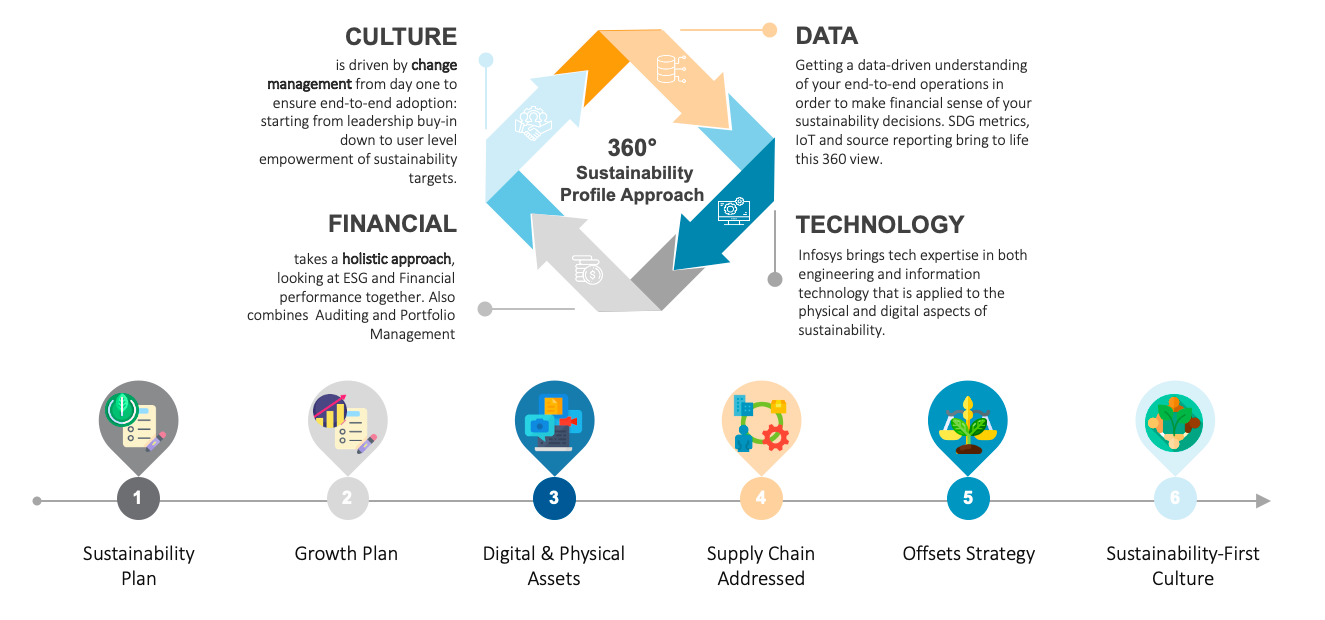
Infosys presents a cyclical approach to the sustainability journey—covering data, technology, finance, and cultural transformations
The journey presented in Exhibit 1 is a crucial step in mirroring the HFS view for making sustainability a native part of enterprise and service provider portfolios—rather than a standalone strategy.
Exhibit 1: Infosys Engineering Services’ approach to sustainability is a step towards making it native in all its client engagements
Source: Infosys, 2021
Infosys’ value map for sustainability covers the key tenets we’re seeing throughout the broader sustainability services ecosystem:
Infosys is promoting a “Sustainability First” culture within its organization and with its clients
Infosys sustainability services are beginning to span a broad range of enterprise demands. For example, Infosys is providing advisory services around traceable and sustainable finance for all enterprises in all industries—alongside its sustainability work for banking and financial services (BFS) firms—as well as services spanning data, technology, and culture change management through advisory services, platforms and solutions, and service integration.
BFS is one industry that epitomizes the need to make sustainability native. BFS has been getting over its digital challenge for the past decade or more—but avenues are now opening up to advise clients on measuring and monitoring climate risks in lending, broader financial services, and their own portfolios. Advice includes investment in low- and zero-carbon technologies, which combined with a view for the data aspects of assessing the sustainability of entire companies, supply chains, portfolios, and industries, serves to proliferate sustainability towards making it a native “have-to-have” competency. BFS firms are also seeking advice on how to “talk tech”, and on the science, strategy, and more technical aspects of climate change.
Another challenge of measuring and monitoring climate impact appears in the story of a global lubricant giant, that produces lubricants for all manner of industrial and everyday uses; operations and immediate supply chains are fairly obvious direct sources of emissions, but this lubricant firm and Infosys are beginning to account for wider impacts down the value chain. For example, the firm in question makes spray coating for cereal boxes: so where does the tracking and reporting responsibility lie, and how is it split between a lubricant firm and a cereal company, packaging company, farmer, or any other stakeholder?
As well as turning its technology and services to sustainability services, Infosys is also improving the sustainability of those offerings—which in turn improves the sustainability of the enterprise customer. Through its cloud platform, Cobalt, Infosys can alternate the source of computing power based on “load balancing” to reduce the emissions footprints of cloud storage and operations. This mirrors the efforts of cloud hyperscalers and enterprise platform providers, along with other advisory firms and system integrators (SIs), as the data, measuring, monitoring, and reporting of sustainability become a more essential part of all enterprise functions.
The Bottom Line: Infosys must double down and own the Sustainability First narrative as it becomes a core part of its broader portfolio.
A wide variety of firms are mirroring this. Infosys can leverage the opportunity to partner and compete on a new level as enterprises from all industries move towards making sustainability native—taking on board Infosys’ Sustainability First approach. Enterprises are past the point where they have a choice in making this transition: their service providers must be ready to take them on that journey through advisory, delivery, data, and technology solutions.
Register now for immediate access of HFS' research, data and forward looking trends.
Get StartedIf you don't have an account, Register here |
With the exception of our Horizons reports, most of our research is available for free on our website. Sign up for a free account and start realizing the power of insights now.
Our premium subscription gives enterprise clients access to our complete library of proprietary research, direct access to our industry analysts, and other benefits.
Contact us at [email protected] for more information on premium access.

