How Indecomm is reinventing mortgage services with an Integrated Automation Platform
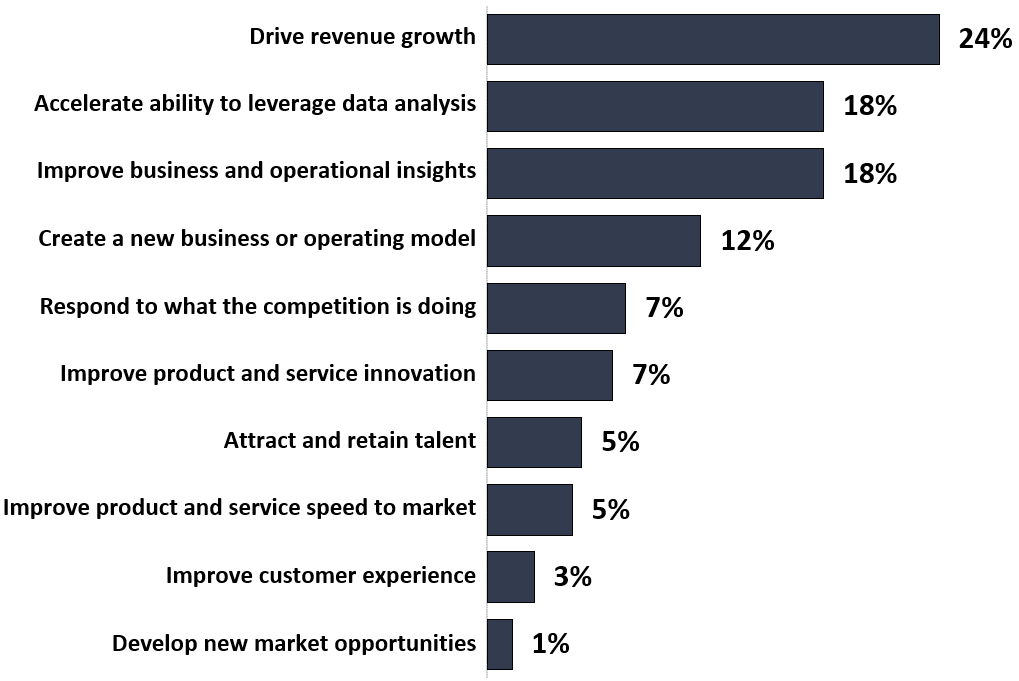
A recent HFS Research study of 590 major global enterprises revealed the leading strategic objective for intelligent automation (IA) initiatives is revenue growth (Exhibit 1). Enterprises have a clear vision for leveraging IA to help increase existing revenue streams and drive new ones.
Exhibit 1: Enterprises are looking at IA to drive top-line growth
What are the key strategic objectives for your company’s intelligent automation strategy?
Source: HFS Research in conjunction with KPMG International, State of Intelligent Automation, 2019
Sample: 590 Business Leaders including 100 C-level executives
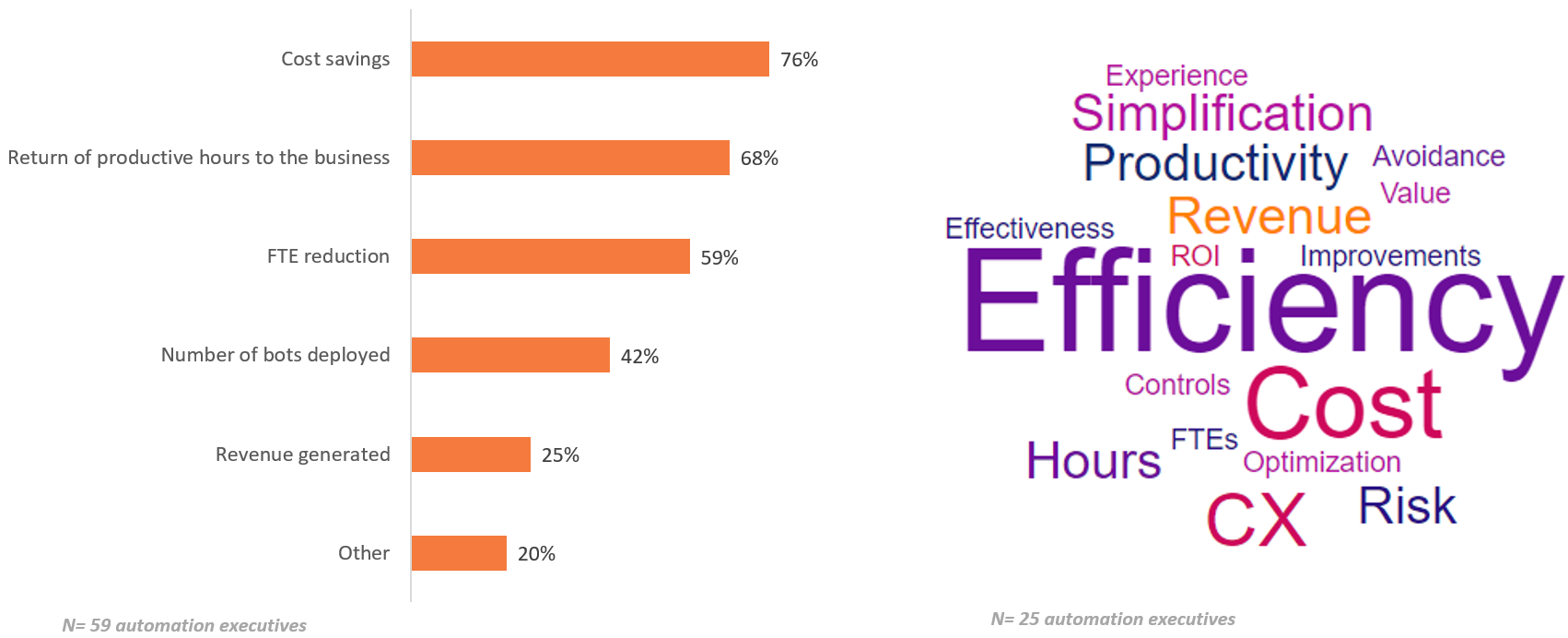
Despite enterprises’ aspirations to grow their revenues, the majority of benefits they realize and measure revolve around cost savings, productivity, and efficiency gains (Exhibit 2). Enterprises are having trouble achieving their top-line objectives with IA because they are using emerging digital solutions, namely interactive technologies, analytics tools, automation, and machine learning, to run their business processes the same way they have been for years, just slightly faster and cheaper. Where are the examples of enterprises applying IA to drive transformation and new business models?
Exhibit 2: The realized benefits of IA are decidedly linear
How are you measuring the benefits of intelligent automation?
Source: HFS Research, 2019
The emerging examples of IA-led digital transformation are coming from enterprises that are willing to do things differently. The mortgage industry, with its complex processes and mountains of unstructured data, is ripe for change. This voice of the customer (VOC) report spotlights Indecomm Global Services, a provider of SaaS-based technology and services to the mortgage industry, and its integrated automation platform (IAP) partner AntWorks. Indecomm is leveraging integrated automation to transform how mortgages are originated and serviced, which is great for both its customers and its top-line performance.
We recently declared that RPA is dead when it comes to driving business transformation. Most of robotic process automation (RPA) in its current form is incorrectly defined, and this market will eventually fizzle out if it doesn’t have a radical overhaul. When we introduced the term “RPA” in 2012, the focus was on unassisted automation, self-triggered bots (where bots pass tasks to humans), and increased process efficiency. Only a small portion of “RPA” today is actually process automation. Most RPA engagements are attended desktop automation deployments—a loop of human and bot interplay to complete tasks (not processes). These engagements are not the pure form of RPA that we envisioned back in 2012. They are a motley crew of scripts and macros applying band-aids to messy desktop applications and processes to maintain the same old way of doing things.
Most companies have not made fundamental changes to intrinsic business processes because most still operate with their major functions in silos—procurement, customer service, marketing, finance, HR, and supply chain—with IT operating as a non-strategic vehicle to maintain the status quo and keep the lights on. Many industries have already maximized their delivery methods for executing processes as efficiently and cheaply as possible.
Net-net, most enterprises have kept pace with each other without actually changing the underlying logic of their processes. You are already in the phase where wrapping the needs of customers around front-to-back office business processes is critical. And you can’t do that simply by adding more software and bot licenses to stitch together wonky systems and processes—you have to redesign how processes work so you can outthink your competitors. The only true way forward is to evaluate the tools and technologies you need to rewire your business processes and then integrate them to enable the journey.
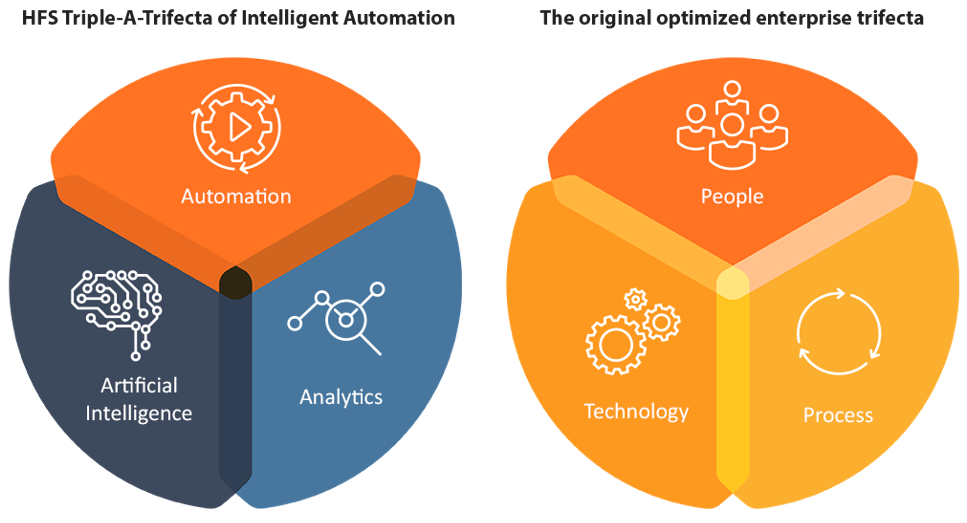
Hence, long live the integrated automation platform as the emerging approach helping enterprises drive enduring change. By “integrated,” we mean integrated technology across the HFS Triple-A-Trifecta (automation, analytics, and AI); also, and all importantly, we mean integration across people, process, and technology, supported by focused objectives and change management. Integrated automation is how you transform your business and achieve an end-to-end Digital OneOffice (Exhibit 3).
Exhibit 3: The rise of integrated automation
Source: HFS Research, 2019
Indecomm is a 25-year-old provider of business services and technology for the US mortgage industry. It helps its clients—typically large and mid-size lenders, servicers, and title companies—originate, process, and service mortgages throughout the mortgage lifecycle by offering BPaaS (business process as a service) and SaaS (software as a service) solutions. More than a decade after the global financial crisis, the US mortgage industry is much more regulated to better protect consumers (as well as global financial stability). But, process complexity and associated costs have grown exponentially, with the Mortgage Banking Association estimating that loan production costs have increased by approximately 60% since 2012.
Indecomm was determined to innovate its way through the increased complexity of post-financial crisis mortgage processes. It realized early on that simply offering a labor arbitrage-based model to its clients was a race to the bottom—for the health of both its business and the end-borrower experience. It instead invested in process excellence, resources, and intellectual property to help provide compliant mortgage support services cost-effectively and to support as much of the mortgage value chain as possible. Over the past four years, under the leadership of Rajan Nair, CEO, Financial Services, Indecomm has intentionally pivoted its mortgage business from labor-arbitrage-based outsourcing to monetize its underlying platforms via SaaS-based models. Today, its products are increasingly automation-enabled to help optimize speed to solution, cost-effectiveness, and auditability, but finding the right capabilities to enable this magic mix was a complicated journey.
Indecomm’s initial foray into software products was with its IncomeGenius platform targeted at an essential early-stage step in mortgage qualification: income verification. This platform gathers and analyzes income documentation and produces an auditable income verification analysis. Indecomm’s in-house engineering team initially drove automation into the software with a rules engine and optical character recognition (OCR) tools to process documentation, helping make it faster and more cost-effective than underwriter-only-based approaches. After initial success with IncomeGenius, Indecomm wanted to see if it could further refine its underlying technology and create new tools with broader functionality to tackle the full purview of loan documentation validation, essentially creating an automated loan review as a service capability.
Indecomm was looking for a dynamic and adaptable platform, and it initially thought RPA was going to be the silver bullet for its challenges. Indecomm extensively evaluated a range of RPA tools and eventually realized that RPA alone was not up to the task. It was the combination of document volumes in often unstructured formats plus the added complexity of state-specific guidelines and formats that made it challenging to apply linear, scripted RPA in any scaled fashion. It could be done, but it would require regular technology interventions that slowed the time to solution. Indecomm needed a broader set of integrated capabilities and loads more flexibility. It needed something that would provide integrated automation that combined elements of automation, artificial intelligence, and smart analytics to enable end-to-end workflows beyond what single toolsets could accomplish.
In 2017, Nair and his team were introduced to AntWorks, a growing Singaporean artificial intelligence and intelligent automation firm focused on helping enterprises unlock the value of unstructured data using cognitive and automation technologies like data curation and digital workforce management. From a functionality standpoint, Nair described his ideal solution as “an automation factory enabled by a platform that can ingest necessary documents regardless of source, correctly and quickly identify them by type, state, etc., intelligently extract the necessary information, and then assemble curated data and route it accordingly.” Nair and his internal team of engineers and process experts conducted extensive testing with AntWorks, initially starting with a loan estimate use case—testing to see if AntWorks’ Integrated Automation Platform (IAP), ANTstein, could ingest numerous documents and successfully recognize and extract key data from various loan estimate documents. AntWorks’ Cognitive Machine Reading (CMR) functionality, sort of a computer vision meets machine learning-based smart pattern recognition, sufficiently convinced Nair and his team that they might have found a toolset and potential partner that could help Indecomm realize its vision.
“[We needed] an automation factory enabled by a platform that can ingest necessary documents regardless of source, correctly and quickly identify them by type, state, etc., intelligently extract the necessary information, and then assemble curated data and route it accordingly.”
—Rajan Nair, CEO, Financial Services, Indecomm Global Services
Additional testing of ANTstein ensued to the extent that the relationship pushed toward co-innovation. Culturally, the Indecomm and AntWorks teams worked well together, partially enabled by the AntWorks executive team’s depth of process expertise it had gained from deep experience with business process outsourcing.
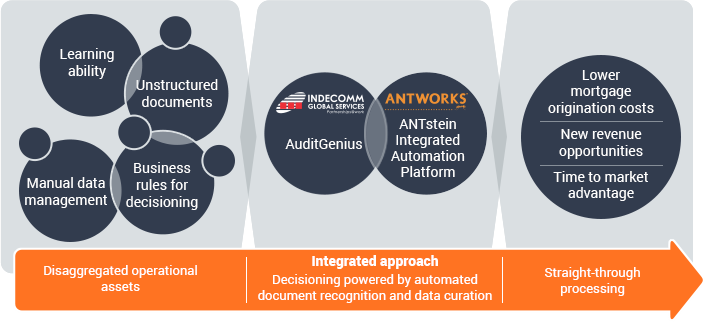
Working together, Indecomm rebranded and enhanced the capabilities of its AuditGenius offering using ANTstein as its core (Exhibit 4). AuditGenius is a SaaS-based platform that conducts loan audits and mortgage risk management using cognitive automation to ensure all required documents, often 500+ pages worth of content, have been submitted and are, in fact, the documents required to secure loans. The audit process of loan documents is a notoriously error-plagued, slow, and manual process that increases origination cycle time. AuditGenius enables lenders to focus on exceptions rather than auditing all documentation, thus improving speed and accuracy.
Exhibit 4: Indecomm’s AuditGenius workflow
Source: Indecomm, 2019
As Govind Sandhu, AntWorks’ Co-Founder and COO, noted, “Working with Rajan and the Indecomm team is the ultimate example of having skin in the game. AntWorks is not just a technology partner, but truly are part of Indecomm’s transformation from a BPO to platform play and beyond.”
“Working with Rajan and the Indecomm team is the ultimate example of having skin in the game. AntWorks is not just a technology partner, but truly are part of Indecomm’s transformation from a BPO to platform play and beyond.”
—Govind Sandhu, Co-Founder and COO, AntWorks
Indecomm’s use of AntWorks’ IAP ANTstein is helping it transform its business from labor-arbitrage-focused outsourcing services to a SaaS-based product business. This is creating new opportunities for Indecomm as well as driving change in a complex and highly regulated market rife with manual processes and escalating costs. The key benefits Indecomm has realized thus far include:
Looking ahead, Indecomm is upgrading its existing IncomeGenius platform with elements of AntWorks’ IAP ANTstein. From there, it is developing new modules to leverage and sit on top of AntWorks’ core to continue to automate various manual processes within the mortgage industry.
Integrated automation combines elements of automation, artificial intelligence, and smart analytics to enable end-to-end workflows beyond what single toolsets can accomplish. However, the real point of integrated automation is actually to move beyond the tools. Yes, the Triple-A-Trifecta offers more functionality, but it still does not work unless you change your business, your people, and your processes. As Nair stated, “Our change had to be a business initiative, not IT or engineering. We had to get everyone bought in; otherwise, we would not have succeeded. So our transformation was in equal parts about an integrated toolset and integrated digital change management across our business.”
“Our change had to be a business initiative, not IT or engineering. We had to get everyone bought in; otherwise, we would not have succeeded. So our transformation was in equal parts about an integrated toolset and integrated digital change management across our business.”
—Rajan Nair, CEO, Financial Services, Indecomm Global Services
This is what makes the Indecomm story interesting. It didn’t just bring in some new tech; it focused on how it could bring innovation to its business model, change processes, and ultimately bring efficiency to manual mortgage processes.
Register now for immediate access of HFS' research, data and forward looking trends.
Get StartedIf you don't have an account, Register here |
With the exception of our Horizons reports, most of our research is available for free on our website. Sign up for a free account and start realizing the power of insights now.
Our premium subscription gives enterprise clients access to our complete library of proprietary research, direct access to our industry analysts, and other benefits.
Contact us at [email protected] for more information on premium access.