
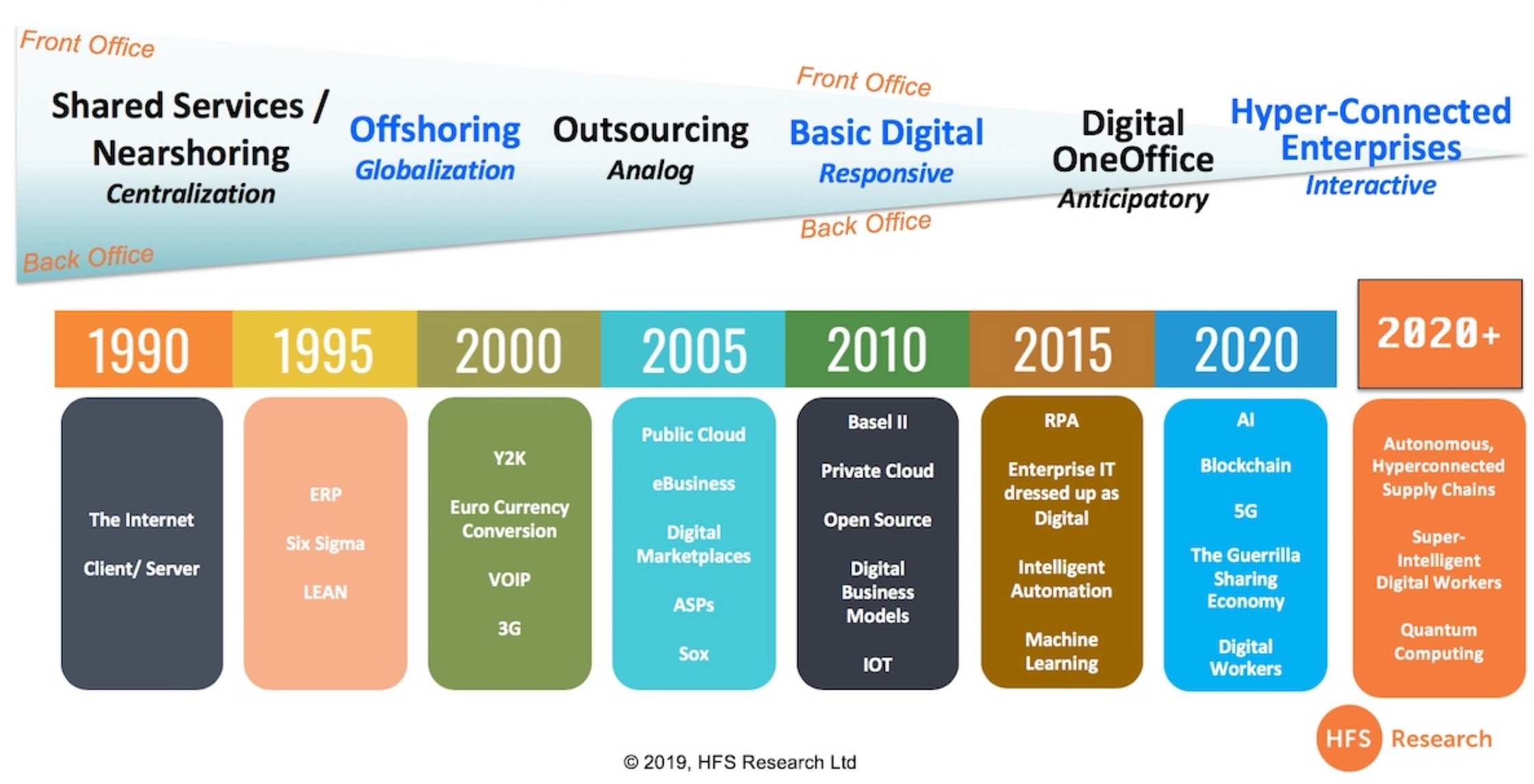
Manufacturers are facing the ballooning hype of “Industry 4.0”— commonly presented by suppliers and consultants as a top-level mash-up of any semi-applicable technology. As we hurtle into this hyperconnected economy (Exhibit 1), manufacturing must define its own path: one different to non-industrial enterprises but also one more streamlined than the thousands of Industry 4.0 model variants confusing the industry.
Exhibit 1: The Hyper-Connected Economy
To streamline the hype, HFS Research sees two distinct challenges:
Although the overall objective of both the hyperconnected enterprise and the hyperconnected plant is ecosystem integration, the respective journeys to reach either state of nirvana are very different:
HFS coined the Digital OneOffice in 2017. It acts as an integrated plan for organizations’ people, processes, infrastructure, and knowledge. Moving into 2019, we predict that leading companies will move beyond the OneOffice to the Hyperconnected Enterprise—a connected ecosystem enabled by emerging technologies such as AI, blockchain, and the IoT.
In 2018, we published the Digital OneManufacturing framework (Exhibit 1), which enables manufacturers to begin to break down the Industry 4.0 journey. One goal of the OneManufacturing vision is the ability to mass customize at scale—manufacturing for “one” customer economically and efficiently.
Exhibit 2: The Digital OneManufacturing Framework
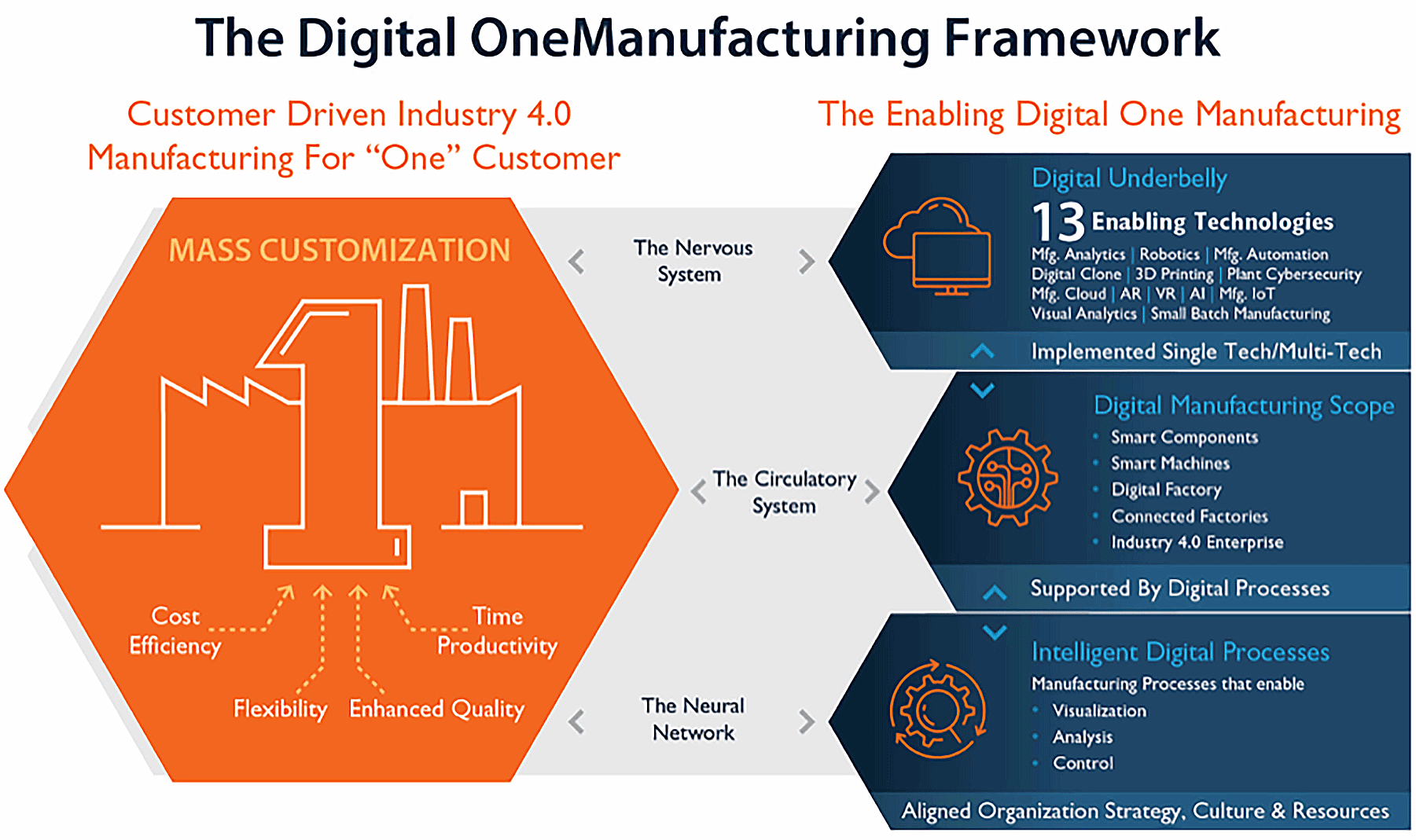
Source: HFS Research, 2018
The Digital OneOffice connects the front, middle, and back offices of an enterprise: a touchless digital customer experience and the creation of an intelligent, cooperating office to enable it.
Beyond OneOffice, organizational silos will converge, ecosystems will develop, and Hyperconnected Enterprises will emerge as leaders in their field.
Exhibit 3: Transitioning to a hyperconnected enterprise from the Digital OneOffice
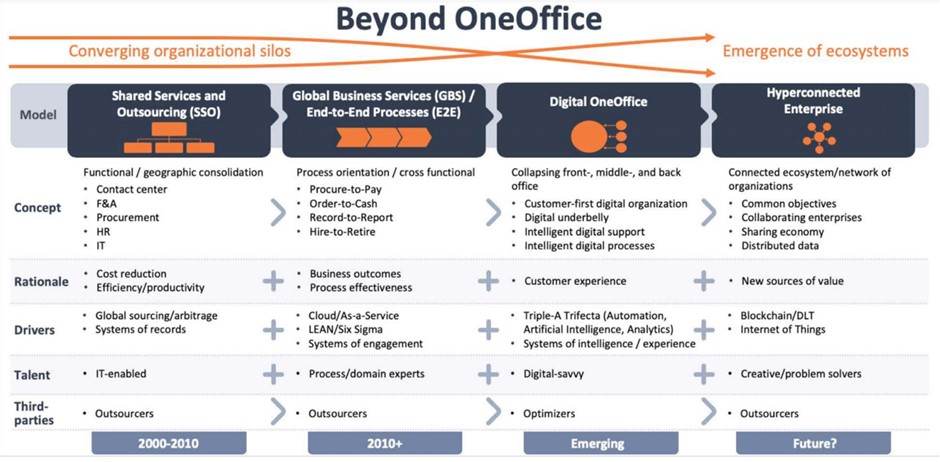
Source: HFS Research, 2019
Digital has disrupted some of the core mechanics that enable finance, entertainment, and retail sectors to deliver customer value. The impact on manufacturing companies has been less clear, with many still relying on old, tried-and-tested ways of production. Manufacturers chiefly feel the impact within their business processes and stakeholder relationships at an enterprise level. These processes have had to keep pace with customer demands and supplier demands. As ecosystems’ supply chains become more digital, the pressure on each link in the chain becomes greater.
Having legacy production, coupled with more cutting-edge business operations, will give short-term gains to a manufacturer, but until it modernizes and syncs production with the other parts of the organization, it cannot claim to be Industry 4.0. While other organizations can evolve operations in a more piecemeal fashion, if the physical production is not in line with the evolutionary process, genuine transformation will not happen. Without this Big Bang approach to hyperconnection, OneManufacturing, Hyperconnected Plants, and the encompassing beast that is Industry 4.0 will be a pipe dream.
Exhibit 4: Breaking down OneManufacturing and the Hyperconnected Plant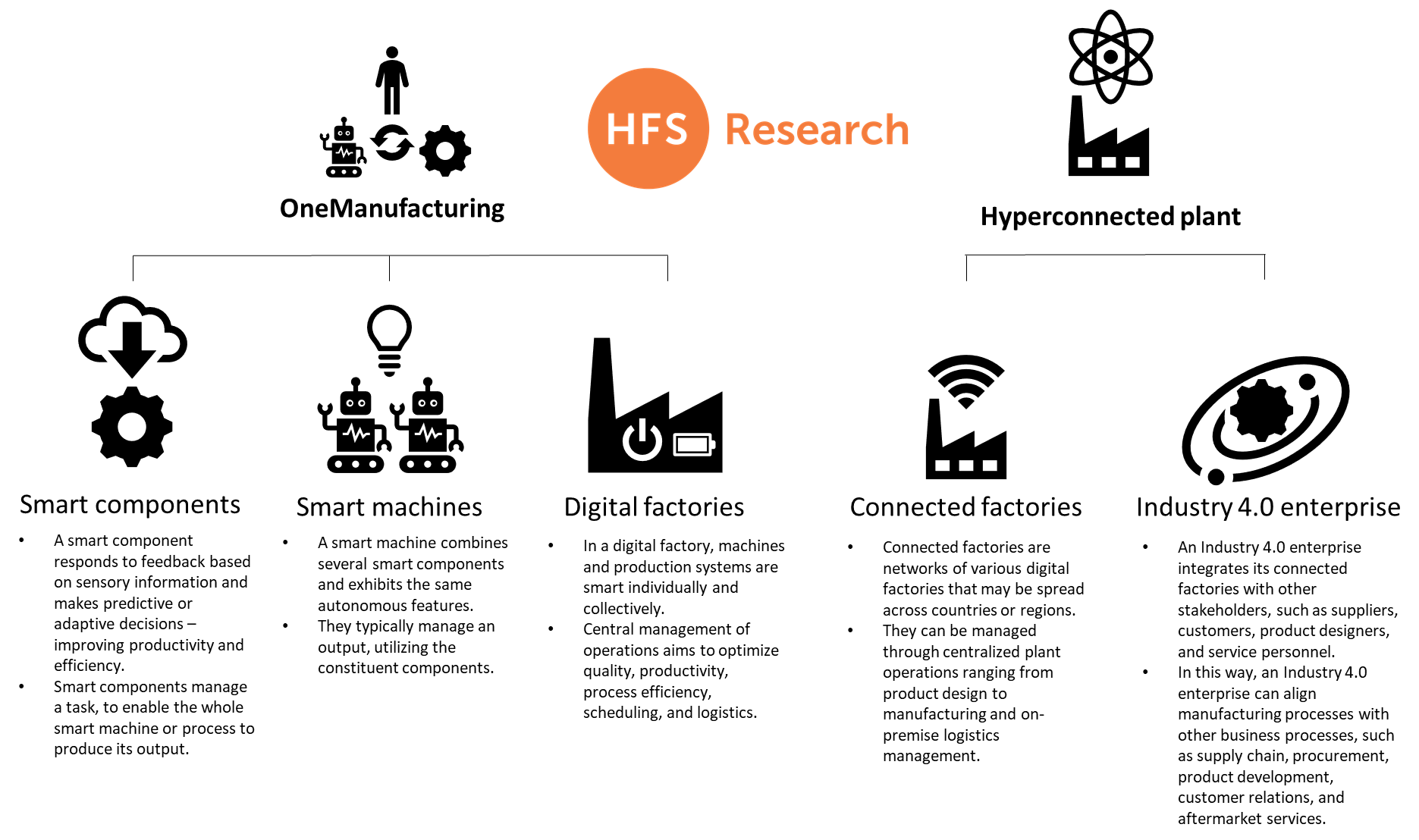
Source: HFS Research, 2019
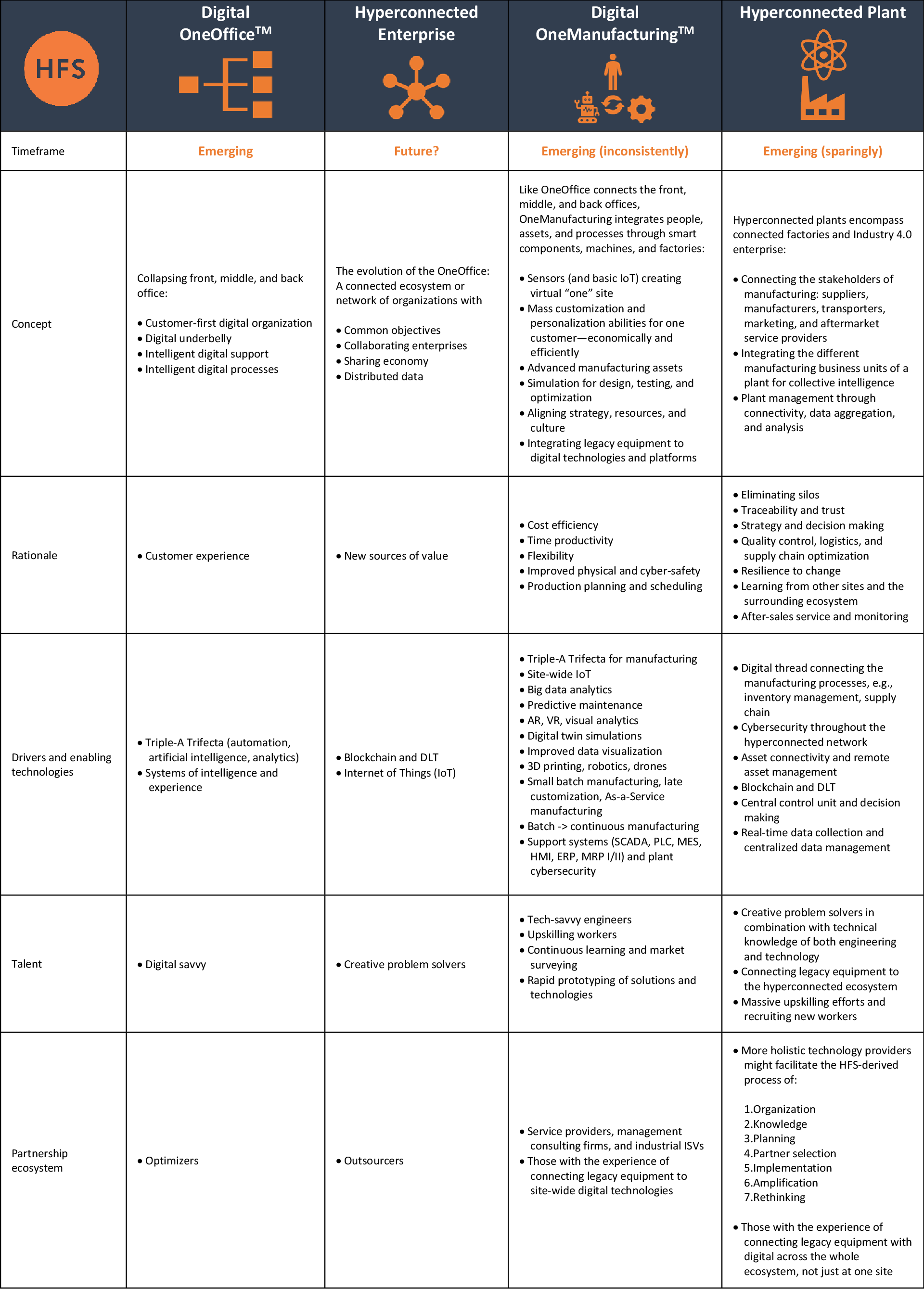
Exhibit 5: Comparing the journey to a Hyperconnected Plant from Digital OneManufacturing, versus a Hyperconnected Enterprise from the Digital OneOffice
Source: HFS Research, 2019
Manufacturing organizations function in a unique world of their own. The priorities of financial operations, asset management, supply chain, procurement, maintenance repair operations, and IT within manufacturing organizations are very different from those in other types of enterprise. The paths of the transformational journeys that non-manufacturing and manufacturing organizations will take to the hyperconnected enterprise are fundamentally different.
For non-manufacturing companies, the evolution of operations will modernize the business core and take the whole organization on the journey. For manufacturing companies, enterprise-level change cannot drag production evolution with it; a revolutionary mindset must facilitate a “Big Bang” rollout, while ensuring that the risk of the required capital injection is managed and mitigated. The heart of the physical process must change simultaneously for the enterprise to maximize the value from a transformation.
Register now for immediate access of HFS' research, data and forward looking trends.
Get StartedIf you don't have an account, Register here |
With the exception of our Horizons reports, most of our research is available for free on our website. Sign up for a free account and start realizing the power of insights now.
Our premium subscription gives enterprise clients access to our complete library of proprietary research, direct access to our industry analysts, and other benefits.
Contact us at [email protected] for more information on premium access.

