
Competing priorities, culture, and talent are the biggest inhibitors to achieving customer-centricity among the Global 2000 (see Exhibit 1). Your partner strategy must include selecting a provider that is focused on talent and culture if customer experience is an initiative at your company. The leading customer engagement service providers are no longer just taking calls and answering emails; they are also helping to design the CX strategy at top global brands, using analytics to gain insight into their clients’ customer expectations and operations, and helping customers to implement intelligent automation that complements how customer service agents do their jobs. This change in client expectations means providers need to be on top of their game when it comes to attracting, developing, and retaining the best talent in the market and cultivating a customer-focused culture to be able to deliver on these services.
Exhibit 1: Competing priorities, culture, and talent gaps are holding companies back from customer-centricity
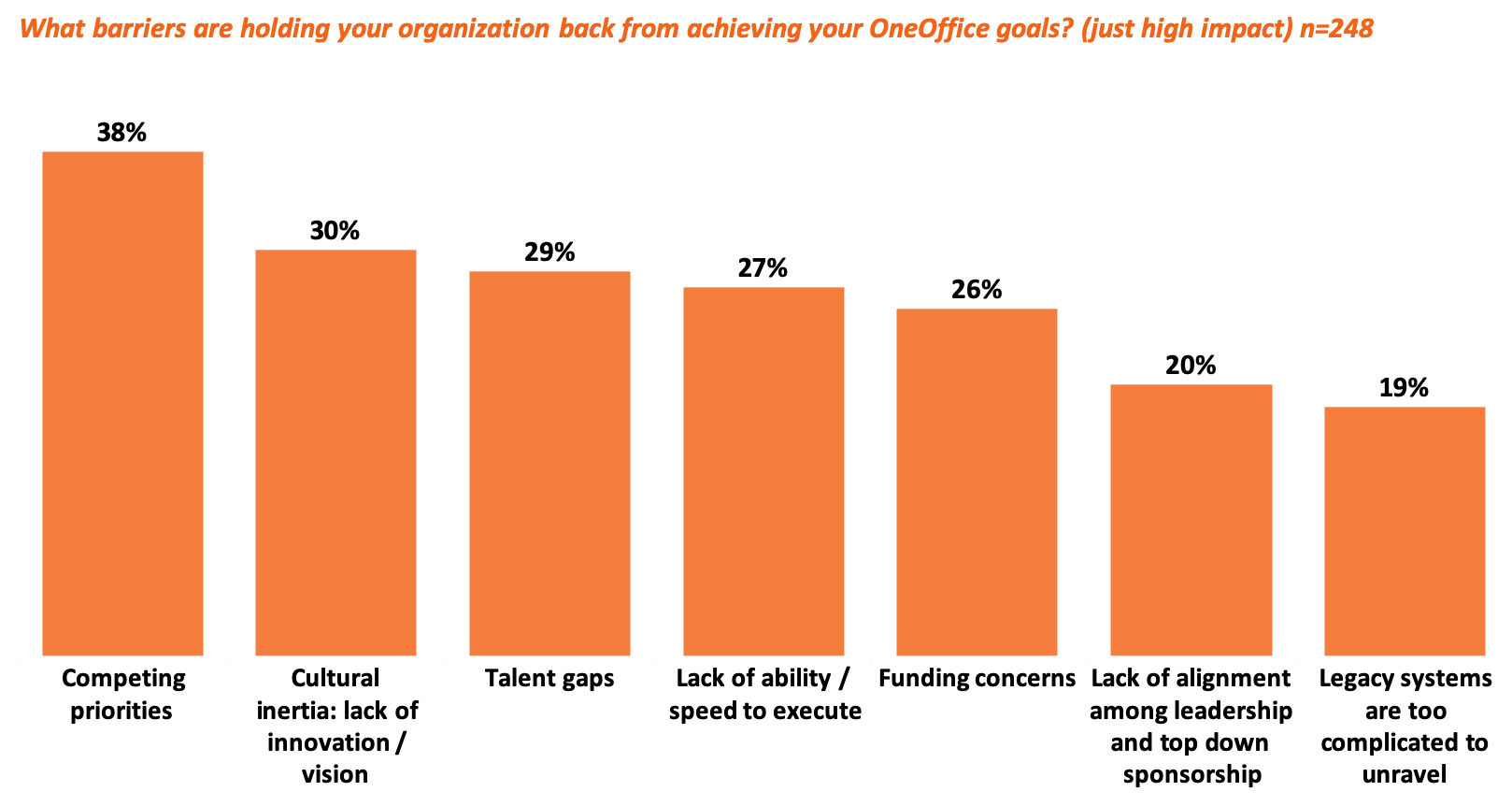
Source: HFS Research, 2019, n= 248 Global 2000 Enterprise Leaders
Service providers should be investing in the best and brightest: The Teleperformance University example
Teleperformance, the world’s largest contact center service provider and the leader in HFS’ 2019 customer engagement operations Top 10, twice annually invites its rising stars to a unique international training program called Teleperformance University (TPU). Each “semester,” an executive committee selects 20 to 30 staff members in various leadership roles across functions including operations, marketing, and research to participate. Over eight months, the MBA-style program sends TPU students around the globe to several Teleperformance delivery locations to attend classes on a variety of topics ranging from AI to P&L management, with online courses supplementing the curriculum between global meetups.
Teleperformance invited HFS to join a recent TPU graduation ceremony and heard from each of the students individually about the knowledge and ideas they are bringing back to their respective locations from all world regions and many countries including Egypt, China, Jamaica, Philippines, Canada and Mexico. It was clear from their stories that the program is as much about training and upskilling as it is a way of spreading the company culture and values to its 300,000 employees across 80 countries. HFS was also invited to sit on a panel to provide perspectives from our research on key topics like AI and automation. The discussion highlighted how well attuned these leaders are to the issues impacting their market, and it demonstrated an earnest desire to embrace technology and figure out the best ways to put it to work for clients.
Multilingual hubs are a stand out example of talent strategy
Teleperformance’s multilingual hub in Athens, Greece, provided a fitting backdrop for the graduation events. The ENA campus in Athens is a striking six-building facility overlooking the Acropolis and downtown Athens. This delivery center has an employee-focused design, and it fosters a social, positive culture with attractive cafes, outdoor dining spaces, and amenities like an open-air gym, chess tables, and a cinema; there are plenty of social spaces for people to gather.
Here, staff provides customer support in 32 languages to some of the world’s best-known brands via phone, live chat, email, and social media. The interactions we witnessed were sophisticated programs leveraging analytics and digital technology to support customers across Europe.
Teleperformance was the first service provider to effectively execute on the multilingual hub model 10 years ago. Today, it has 8,500 employees in Athens and continued to take business away from competitors that struggle to attract and retain talent in disparate locations across geographies. The model is not easy to execute; Teleperformance recruits multilingual talent from all over Europe and provides attractive relocation assistance to Athens as well as other hubs such as Barcelona and Istanbul.
Investments in talent and culture are impacting partner relationships—what to consider
The Bottom Line: Nurturing talent and culture must extend to partnerships with shared customer-centric values
We need to stop talking about the “future of work” – it is here now. Between crowdsourcing and the gig economy, robotic colleagues and intelligent cognitive assistants, the way we work – and support customers – has changed dramatically. It’s time now to make put the focus and investments not just on process and technology, but on people, in particular to support our customer experience initiatives.
Register now for immediate access of HFS' research, data and forward looking trends.
Get StartedIf you don't have an account, Register here |
With the exception of our Horizons reports, most of our research is available for free on our website. Sign up for a free account and start realizing the power of insights now.
Our premium subscription gives enterprise clients access to our complete library of proprietary research, direct access to our industry analysts, and other benefits.
Contact us at [email protected] for more information on premium access.


