
Business leaders can leverage an “AI-in-a-Box” approach quickly to build disruptive, AI use-cases for first-mover competitive advantage, disrupting competitors at their own game. The key is to bring all relevant components required to build AI solutions for your business together “in a box” so that you can quickly build, train, and deploy the use cases, rather than reinvent the wheel.
AI-in-a-Box is a simple verticalized business AI use-case framework with partially pre-built modules including:
The recent HFS study on machine learning (ML) adoption showed that different industry verticals (see Exhibits 1 and 2) are applying these core AI technologies and algorithms at different levels of the 3Vs of volume, velocity, and variety.
Exhibit 1: What Machine Learning means to enterprises (by Industry)
Question: How much do you agree or disagree with these statements? (N=10 to 26)
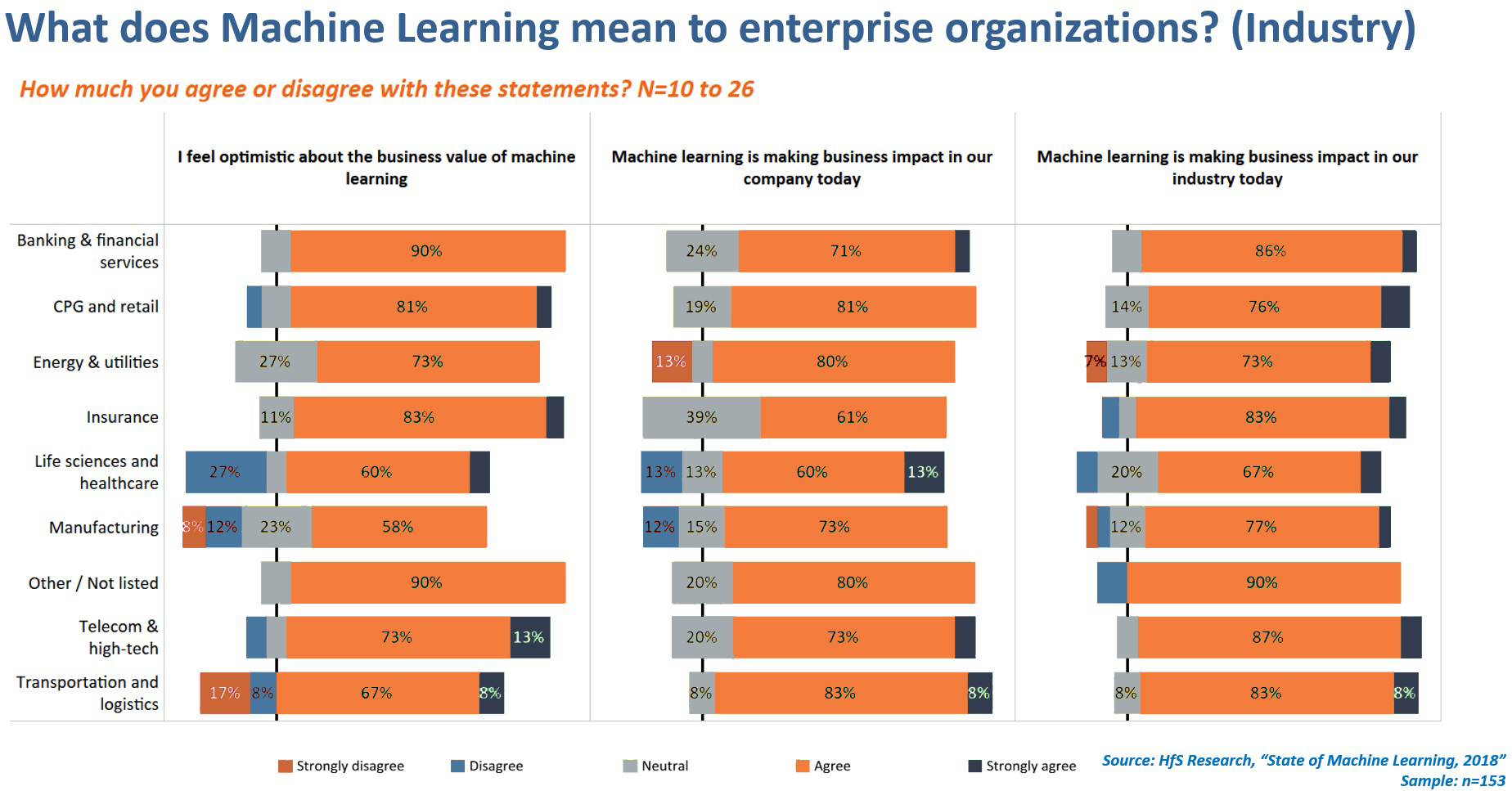
Source: HFS Research, 2018; Sample: 153 senior level executives from organizations with $1 billion or more in revenues
Exhibit 2. Where Machine Learning is expected to provide impact
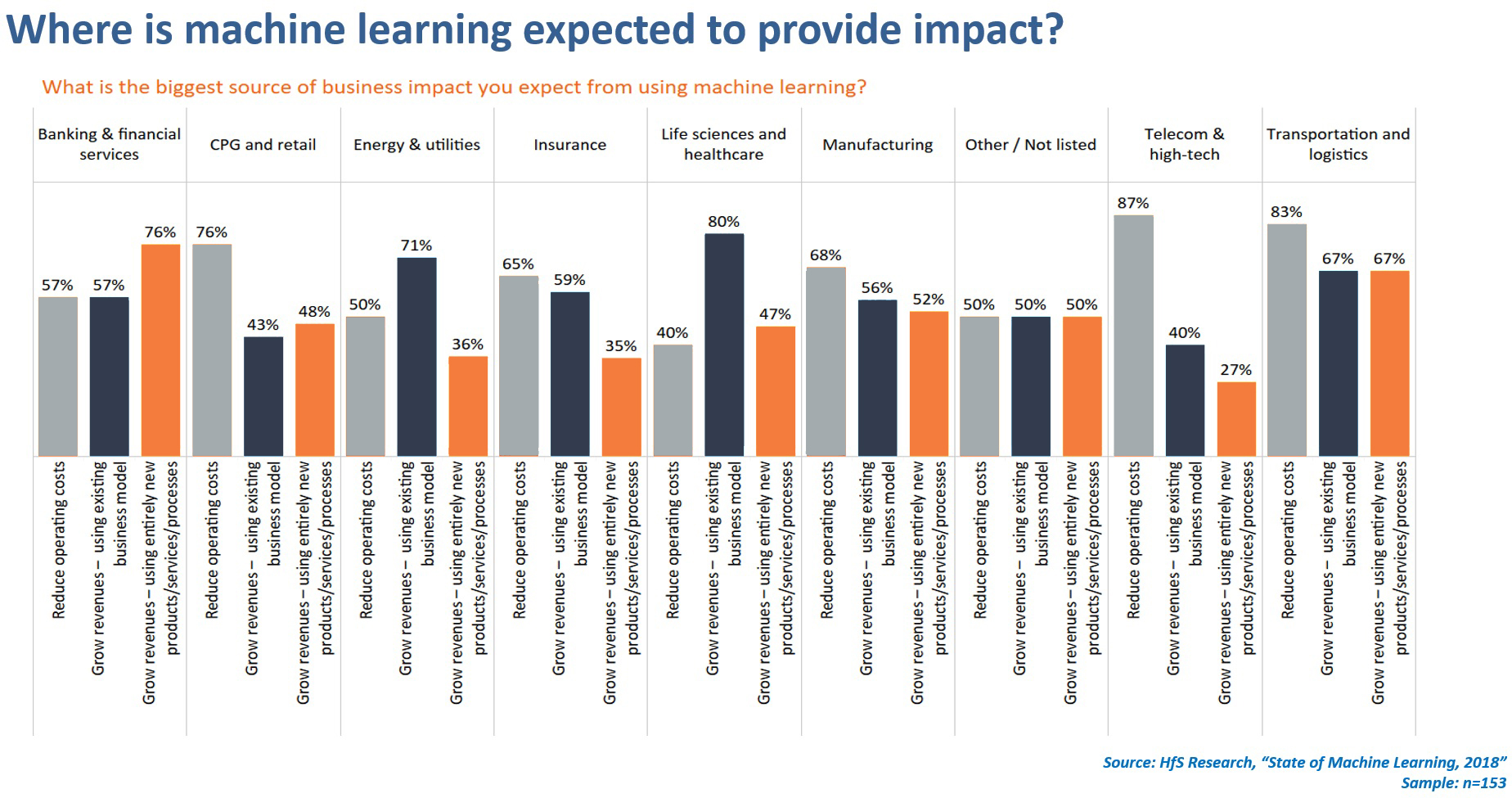
Source: HFS Research, 2018; Sample: 153 senior level executives from organizations with $1 billion or more in revenues
While all industries are using various AI solutions to reduce operational costs, BFSI, CPG and retail, high tech, healthcare, and transportation are leading the way (see Exhibit 2). BFSI and healthcare are unique verticals because 75% to 80% of respondents from these verticals have prioritized revenue growth over cost reduction.
Here are three simple steps to start this transformational practice:
1. Mine your future digital initiatives for requirements to determine which AI applications will empower and enable them.
Digital businesses cannot work without leveraging the speed, scale-up and scale-out capabilities, and infinite variations provided by AI and intelligent automation. Two use cases illustrate this concept:
2. Design and build verticalized AI-in-a-Box solutions that are quickly trainable, quickly deployable, and pre-enriched with critical knowledge components and required infrastructure.
Just as ERP started as common business process solutions that eventually matured into vertical-specific stacks, AI solutions are also closely linked with specific verticals. Just as reusability fosters adoption of object-oriented systems, partially pre-built domain context, quick training, and quick deployment of new-age AI use cases scales up AI adoption. In AI-in-a-Box verticalized solutions, there should be five key components, as Exhibit 3 explains.
Exhibit 3: AI-in-a-Box solution architecture components example
|
Components |
Description and example |
|
Domain-relevant contextualized interfaces |
Domain lexicon-based NLP query engines; end-to-end intelligent automation agents such as KYC (know your customer) for banking, which could include creating KYC documents for each customer and presenting them in query-able unstructured text |
|
Pre-built model-base |
Pre-built model-base with sample knowledge models in appropriate processed forms, such as K-graphs and semantic nets |
|
Domain ontologies and lexicons |
Ontologies and domain lexicons, for example, ontologies in OWL that are built with a common set of relevant word clusters and entities, semantic nets, and rules |
|
Vertical-specific preprocessed data sets |
Vertical-specific preprocessed, curated, clean, relatively noise- and bias-free training, testing, and validation data |
|
Infrastructure and data lakes |
Pre-selected and pre-curated technology stacks—algorithms, APIs, and infrastructure for training and inferencing |
3. Brainstorm with business leaders and different customer groups to frame strategically disruptive AI use cases that can generate a sustainable competitive advantage for your organization.
The transformational value of AI will manifest only if a business uses it as a critical source of strategic competitive advantage beyond just operational cost reduction; for example, a business can use it to transform existing business and operating models, design and create new products and services faster, generate new demand and revenue, enter new markets, and attract new customers. Exhibit 4 provides some examples.
Exhibit 4. Disruptive and strategic AI use cases
|
Verticals or value chain |
Disruptive or new AI use case |
Indicative solution components |
|
BFSI |
Customer-created personalized banking assistants |
AI-based intelligent agents for service assessment and pricing, interaction design, individualized information, and insights delivery |
|
E-bay model of services, C2C banking, insurance platforms |
AI solutions enabling customers to share insights, best practices, insurance services, and investment ideas; earn rewards; and provide recommendations in a blockchain |
|
|
Telecom and healthcare combined, hyper-connected digital ecosystems |
5G-based adjacent services use cases such as autonomous support |
IoT-AI integrated solutions, sensors, and robo-assistant actuators for people with mobility issues—using their edge device as a digital twin |
|
AR-VR teleportation-based use cases such as robo-surgery delivered anytime, anywhere |
Sensors, computer vision elements, real-time 5G networks, autonomous and semi-remote-controlled actuators and instruments |
AI-in-a-Box models can deliver new and strategically disruptive integrated use cases quickly, which can change the rules of the game in any business domain. Verticalized AI solutions with pre-built components in a box can make AI truly transformational. Organizations that are thinking ahead about competition will leave the traditional players far behind in the red ocean of cost competitions; they will reinvent themselves into new digital avatars emerging out of the blue oceans of AI-empowered opportunities. Human imagination will be the only limiting factor on what AI can do—to disrupt or be disrupted—no matter which vertical your business belongs to.
Register now for immediate access of HFS' research, data and forward looking trends.
Get StartedIf you don't have an account, Register here |
With the exception of our Horizons reports, most of our research is available for free on our website. Sign up for a free account and start realizing the power of insights now.
Our premium subscription gives enterprise clients access to our complete library of proprietary research, direct access to our industry analysts, and other benefits.
Contact us at [email protected] for more information on premium access.

