Enterprises are facing an unprecedented threat (and opportunity) from disruptive digital business models, ever-increasing customer expectations and an unprecedented data explosion. To this end, a recent HFS study of 350 digital leaders shows a third of them have seen their top two competitors change over the last couple of years – and a similar number is expected in the next couple.
Cost reduction alone no longer ensures success; driving top-line growth is equally important. The Triple-A Trifecta of automation, artificial intelligence (AI), and smart analytics has compelled the C-suites to address their business objectives. Goals from the trifecta technologies are ambitious, and expectations are unrealistic. Most enterprises want to achieve industrialization of their initiatives across the trifecta within two years!
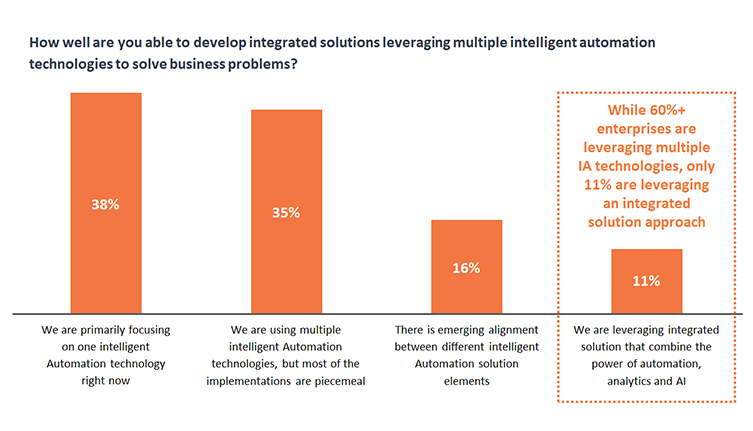
However, in reality, the industrialization questions are largely unanswered. Scaling up intelligent automation (IA) initiatives is the single biggest challenge. Solutions remain siloed and piecemeal. While 60% or more of enterprises are leveraging multiple IA technologies, only 11% are leveraging an integrated solution approach (see Exhibit 1). Data quality, organizational culture, and talent questions are holding us back from reaching the promised land.
HFS believes that integrated solutions at the intersection of automation, AI, and analytics balanced with an adequate focus on people and processes are necessary for making progress on this journey to enterprise-wide digitization.
Exhibit 1. The solution approach to automation initiatives continues to be piecemeal
Source: HFS Research, 2018
Sample = 590 Business Leaders including 100 C-level executives
On this quest to unravel the mysteries behind successful enterprises scaling up their automaton initiatives, we analyzed emerging technology solutions and juxtaposed their solution approach against the key challenges behind automation industrialization. One such promising solution is arago’s HIRO.
Industrializing intelligent automation with HIRO shows great promise, due to its scalable platform and its ease of adapting to change across IT & business processes
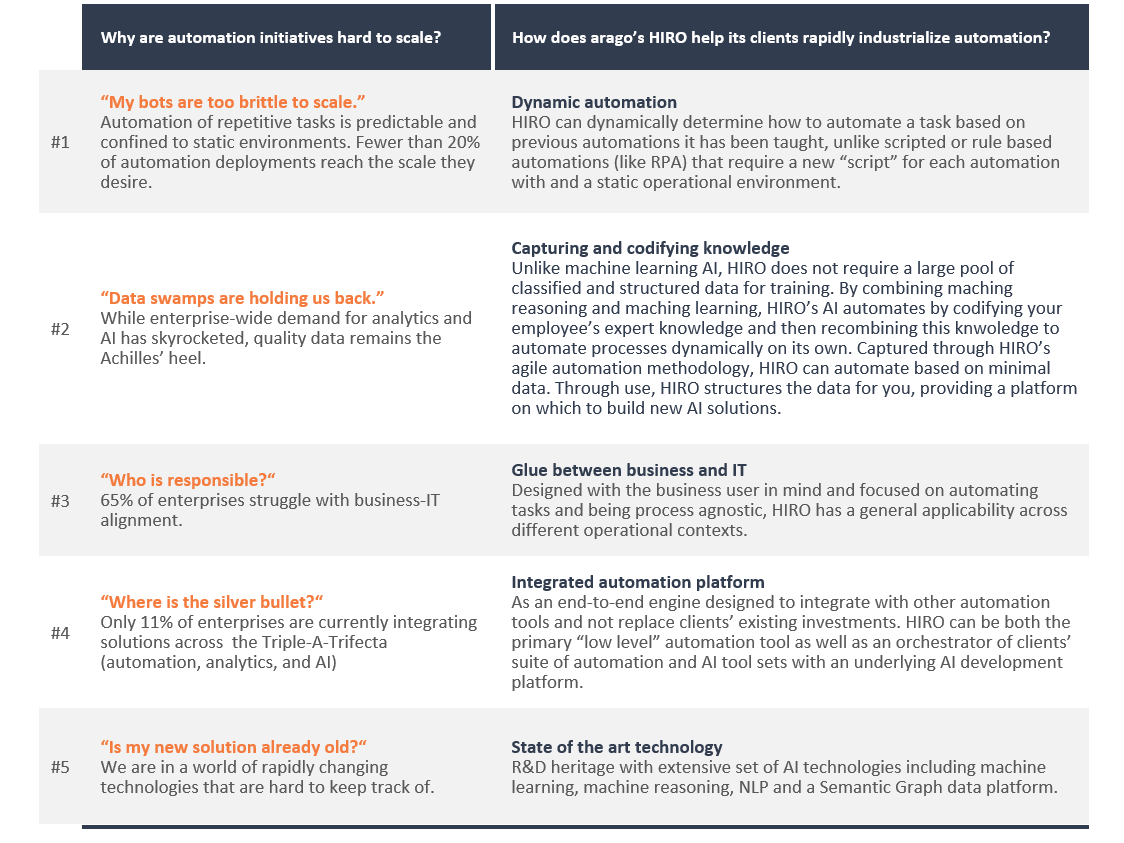
Arago is a Germany-headquartered pioneer in the field of artificial intelligence and one of the few companies worldwide to offer a commercially proven horizontal artificial intelligence platform, HIRO. We spent considerable time over the past few months with arago’s leadership and its clients, probing them on their approach to countering challenges industrializing automation. HFS’ noted five stand-out dimensions of arago’s approach for helping clients rapidly scale up their automation initiatives (see Exhibit 2).
Exhibit 2. HFS perspectives on HIRO’s ability to rapidly scale up automation initiatives
Source: HFS discussions with HIRO clients and arago’s leadership, 2019
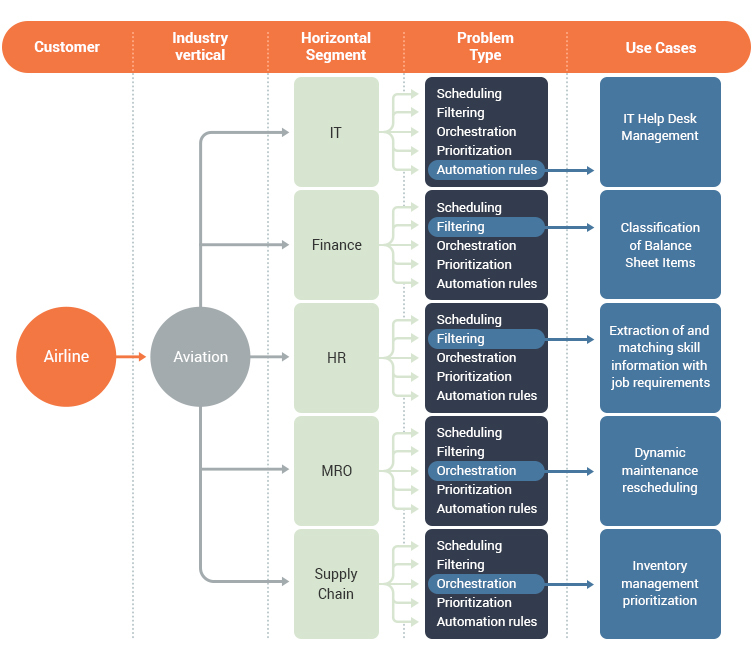
Exhibit 3: HIRO’s business process automation approach
Source: arago
2. Capturing and codifying knowledge. We live in a world that some researchers say generates a “tsunami of data.” Enterprises have always struggled to manage internal data and are now hard-pressed to respond to the digital data explosion happening inside and outside company walls. While enterprise-wide demand for analytics and AI has skyrocketed, ensuring quality data remains the Achilles’ heel. HIRO tries to address this problem by capturing and codifying the knowledge of specialists and experts who troubleshoot operational processes and changing environments. After HIRO learns an initial pool of knowledge, it reuses its knowledge base to solve tasks dynamically, achieving significantly higher automation rates. HIRO’s approach creates a clean data landscape while it is working, but a clean data landscape is not a prerequisite. Also, HIRO’s data ingestion has no limits, and its knowledge-driven approach enables it to scale up quickly and effectively. It focuses on the quality of knowledge items, not just the quantity.
3. The glue between business and IT. For most organizations, IT’s chief data officer and chief information officer are in the main decision-making roles for automation related initiatives. However, it is often the business operations leaders and departments that have the most critical needs for automation. Coordination and collaboration between IT and business stakeholders is crucial for any success. Only 35% of enterprises, according to our latest research, consider their IT-business alignment to be excellent. We categorized study participants as leaders (companies leading in financial performance on the top quartile) and laggards (everyone else i.e. companies lagging behind in terms of financial performance). Over half the leaders (54%) report having excellent IT-business alignment, compared to a mere 12% of laggards. This is where HIRO is also uniquely positioned—it is IT and business agnostic. It has general applicability and trainability of different models in diverse operational contexts. Focused on solving problems, HIRO is process and industry agnostic, and it can be used across an organization to orchestrate its automation tools and accelerate digital transformation.
4. Integrated automation platform. Business problems are solved not by one standalone technology, but by a combination of technologies. However, only 11% of enterprises are currently integrating solutions across the Triple-A Trifecta (automation, analytics, and AI). While clients realize the need for integrating their automation initiatives, the product landscape continues to be fragmented and piecemeal. HIRO manages this complexity of digital operations with one end-to-end engine. It is designed to ringfence—not supplant—clients’ investments by acting as an orchestrator of automation and AI tool sets, by providing connections to leading enterprise software applications, and by providing a development platform for clients.
5. State of the art technology. We are in a world of rapidly changing technologies that are hard to keep track of. Arago’s heritage is R&D, led by AI pioneer Chris Boos and focused on driving fundamental research into self-learning systems. Arago brings together an extensive set of AI technologies, including ML, machine reasoning, and NLP. To auto-adapt to changes, HIRO only needs information about the change. This way, it is not only ringfencing clients’ investments, but it also provides the flexibility that is crucial to managing digital operations.
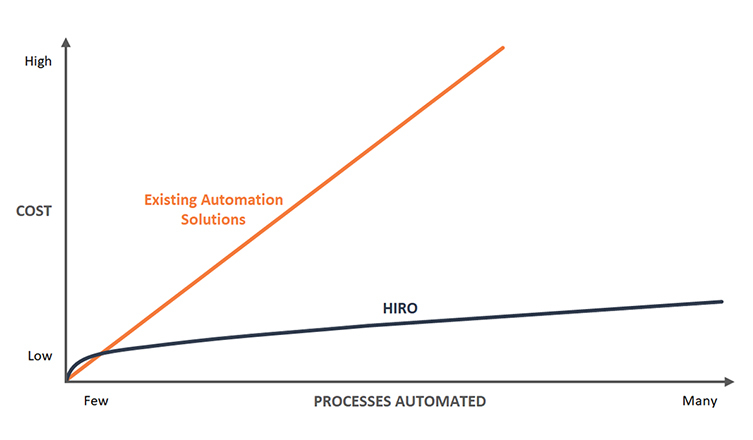
HIRO automation may sometimes require more initial setup effort than traditional automation. However, its flexible and dynamic approach toward automation delivers much greater efficiency at scale (see Exhibit 4).
Exhibit 4: Comparing HIRO’s value realization versus traditional automation
Source: arago
We interviewed several clients who were early adopters and that have successfully scaled up their automation initiatives. Across underlying models, the following best practices emerged as the most practical “do’s and don’ts.”
“Automation is not just about cost savings. Our story for automation is that we empower our human workforces with an increasingly capable digital workforce.”
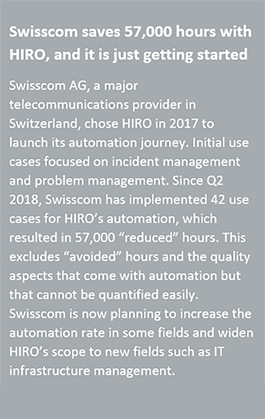
—Roger Jaussi, head of automation and operational excellence, Swisscom, who used arago to save nearly 57,000 hours of work besides other qualitative, hard-to-measure benefits
The Bottom Line: To industrialize intelligent automation, you must move beyond piecemeal technology adoption, towards an Integrated platform approach
You must extend the scope of the Triple-A Trifecta way beyond piecemeal tasks and toward integrated, end-to-end process automation. The use of an intelligent, integrated automation approach is at the core of this strategy. While still rare, products like arago’s HIRO are emerging that can help on your journey to industrialize automation.
Register now for immediate access of HFS' research, data and forward looking trends.
Get StartedIf you don't have an account, Register here |
With the exception of our Horizons reports, most of our research is available for free on our website. Sign up for a free account and start realizing the power of insights now.
Our premium subscription gives enterprise clients access to our complete library of proprietary research, direct access to our industry analysts, and other benefits.
Contact us at [email protected] for more information on premium access.