–
Score every workflow to calculate

This enterprise asset is for care delivery CIOs, CMIOs, and COOs moving front-office operations from digitization to agentic AI.
This Functional Diagnostic Tool and Operational Playbook is designed for CIOs at care delivery organizations, including health systems, hospitals, and ambulatory surgery centers seeking to modernize front-office operations through agentic AI to address administrative burden, clinician burnout, revenue leakage, and patient access gaps.
It tells them where they stand by scoring each front-office workflow on a 1–5 maturity scale, weighing them by cost and patient-leakage impact, and rolling the results into a single 0–100 index. The output identifies the workflows that create the greatest operational and financial pressure and shows where action should begin.
The playbook also tells CIOs what to do about it. It lays out a staged, three-step path, digitization, automation, and agentic AI, with specific actions, owners, and exit gates for each step, helping their organizations improve front-office maturity in stages rather than attempting a large-scale shift in one program.
This playbook’s approach should reduce front-office labor for routine work by 30% to 50%, cut routine call volume by 40% to 60%, and return four to six clinician hours per week within 12–18 months, while maintaining HIPAA and state privacy compliance.
HFS Playbooks are practical guides to solving key enterprise challenges that consume significant costs, time, and resources. They give enterprise leaders an evidence-based baseline of where they stand today and turn that into a realistic, staged roadmap with specific “to-dos” so they can reduce operational pressure and focus resources on higher-value priorities.
Healthcare delivery organizations in the US continue to face operational pressure due to structural forces across reimbursement, workforce availability, and patient expectations. Reimbursement is tightening as payers expand denials and utilization review, front-office roles are among the hardest to fill and retain, and patients now expect the on-demand digital service they get from retail and banking.
These forces have pushed every care delivery enterprise to align with the Quadruple Aim: improving health outcomes, reducing the cost of care, enhancing patient experience, and ensuring health equity. Front-office performance directly affects all four dimensions. When patients drop out before receiving care, outcomes suffer. Denials increase costs. Poor access damages the patient experience. And language barriers deepen inequity. A front-office program focused only on headcount reduction may lower cost but could worsen access, experience, clinician workload, or equity.
Administrative work accounts for 20%–40% of hospital operating costs. Front-office work (includes scheduling, registration, intake, eligibility, and patient communication) is the most labor-intensive and patient-facing slice of that spend. CAQH 2025 statistics show that although automation already saves US healthcare an estimated $258 billion a year in administrative costs, roughly $21 billion is still tied to such manual or partially manual activities.
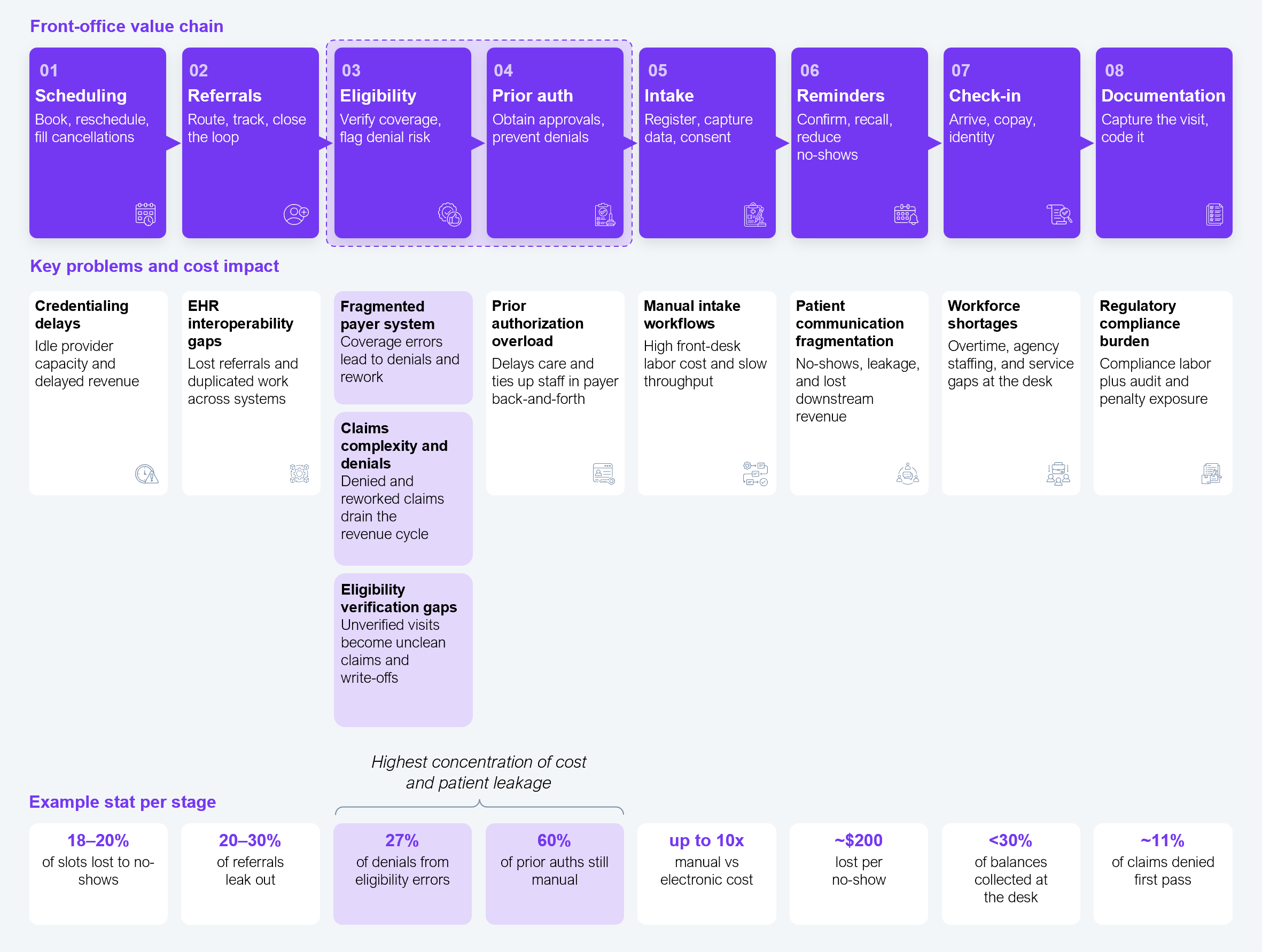
The front-desk model remains expensive because every handoff creates additional work, while denials, no-shows, and patient leakage reduce revenue. For a 1,000-bed system handling roughly one million encounters a year, front-office labor runs an estimated $25 million–$40 million annually. A staged agentic build can reduce this by 30%–50%. Exhibit 1 maps where that cost is concentrated in the front-office value chain, highlighting the hotspots this playbook targets first.
Source: HFS Research, AHA, CAQH
The real issue is not the lack of technology. Most healthcare organizations have already invested in electronic health records (EHRs), patient portals, and digital intake tools. The problem is that these tools were layered on top of manual processes without changing how work gets done. In many cases, healthcare organizations have digitized the chaos but did not eliminate it.
As a result, most providers today operate at Level 1 (digitization) or Level 2 (automation), which are the early stages of digital transformation. Fully electronic adoption of core front-office transactions remains at 40% for prior authorization and 24% for claim attachments, reflecting a continued reliance on manual or rules-based processes. While technology speeds up manual work, it doesn’t remove it. Front-office staff still perform scheduling, intake, eligibility checks, and patient communication, even when systems exist to support these functions. This results in an ongoing administrative burden, high staffing costs, and fragmented operations.
In Level 3, autonomous agents handle routine interactions end to end, while staff focus on oversight and exceptions. The operating model shifts toward proactive, continuous patient engagement, changing who performs the work and how exceptions are handled rather than simply automating individual tasks. This leads to reduced wait times, rework, and patient drop-off, creating benefits across all four aims. However, achieving a mature Level 3 operating model requires structural change, redesigning workflows rather than simply replacing staff activity through technology, making it rare in most healthcare enterprises.
This report addresses these problems in two parts. The first presents a diagnostic that scores the severity workflow by workflow across the front-office value chain. The second provides a playbook that lays out a staged execution path to close the gaps that the diagnostic surfaces.
Before any investment is made, the diagnostic assesses where each front-office workflow stands today and have the greatest impact on cost, access, patient experience, and clinician workload. It scores every workflow on a 1–5 maturity scale, each weighted by cost and patient-leakage impact, and rolls the result into a single 0–100 index. The objective is to create a quick, evidence-based baseline for investment and vendor decisions. CIOs can use the score to choose where to begin, build an investment case with the CFO and COO, and track maturity quarterly.
Not every workflow carries equal weight. Strong performance in lower-impact workflows such as reminders cannot offset weaknesses in eligibility, prior authorization, or documentation, which is why each one carries its own cost-and-leakage weighting. Cost and patient leakage form the basis of the index as they can be measured cleanly. However, the operational gaps the diagnostic identifies affect all four aims simultaneously. The highest-priority workflows are those that affect cost, access, experience, and clinician workload.
Most CIOs know their front office is underperforming. What they can’t say is by how much or where. Exhibit 2 provides that view: eight workflows that are each scored on a 1–5 maturity scale based on the cost and denial risk they carry and then rolled into one number out of 100. Teams that assess themselves honestly most land below 40, indicating Level 1 or Level 2 maturity across the front office. The maturity gap may be substantial, but it can be addressed workflow by workflow.
The weighted diagnostic: Each workflow should be scored on 1 to 5 and then weighted by cost and leakage
| Front-office workflow | Weight | Why it carries this weight | Your score | Index points |
|---|---|---|---|---|
| Weighted index | 100% | Sum of (your score × weight), then multiply by 20 |
20 to 100 |
Source: HFS Research, 2026
The composite score determines which step to begin with in the playbook
The difference between the highest and lowest-scoring workflows shows where improvement is most urgent. A score only helps if it tells you what to do next.
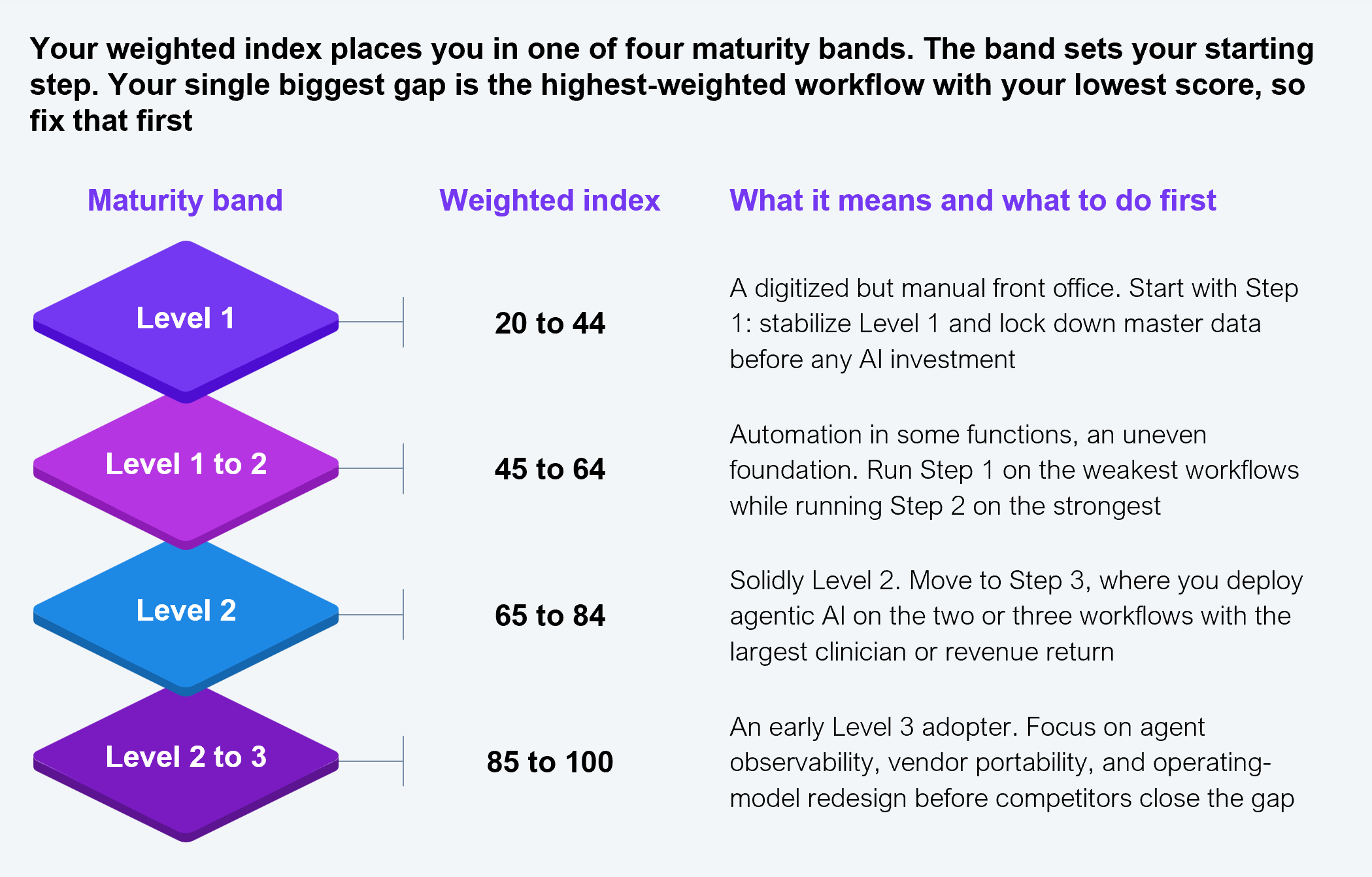
Exhibit 3 maps the composite score to a recommended starting point. Organizations scoring 20–44 should begin with step 1. Those scoring 45–64 should run Step 1 on the weakest workflow and move to Step 2 on the strongest. Organizations scoring 65 and above can move to Step 3 in the two or three workflows (agentic deployment) with the greatest returns. For example, an organization scoring 38 should strengthen its foundations, while one that scored 72 can begin deploying agents in selected workflows. The score gives leadership a common basis for deciding where to begin.
Source: HFS Research, 2026
Read borderline and mixed scores with caution and resolve them at the function level
Scores near a band boundary require additional review because the composite score can hide large differences between workflows. A 42 or a 67, for example, sits close enough to a boundary to be ambiguous. An organization with a few functions at level 3 and others still at level 1 can fall into the Step 2 band while urgently needing Step 1 for its lowest-maturity workflows.
Organizations should apply three rules when interpreting borderline or mixed scores:
Two diagnostic patterns to watch for
Pattern 1 – the L2 illusion: The composite score is 26–30, but two or three functions are still at Level 1. The risk is that leadership may believe the front office is automated, while a handful of broken foundations still drive most of the cost.
Fix: Apply Step 1 only to the Level 1 functions before moving the organization to Step 3.
Pattern 2 – Pilot lift, production drag: The composite score is inflated by high-performing pilots that have not been scaled. The risk is that leadership may assume that pilot performance reflects organization-wide maturity when it does not, and Step 3 investment is directed toward workflows whose foundations cannot support it.
Fix: Score only the capabilities that are deployed across the organization and then rerun the diagnostic as each pilot moves into full production.
What to do with your score
Benefits: Better access, higher efficiency, and more clinician time
Agentic AI removes routine work from the front office rather than simply helping staff complete it faster. This playbook turns that shift into three objectives, stated upfront so every step can be judged against them: better access, lower cost, and more clinician time. Delivered together, these changes can improve front-office cost, capacity, access, and revenue performance. The benefits below are organized around these three objectives.
Benefit 1
Better patient access and experience
Benefit 2
Lower cost and stronger revenue
Benefit 3
More clinician time and stronger retention
The solution: Move from digitization to agentic AI in three stages
As discussed in the previous sections, most healthcare organizations own Level 1 and Level 2 tools but continue to operate with Level 1 capabilities. Here’s a rundown on how the transformation progresses typically through the three maturity levels:
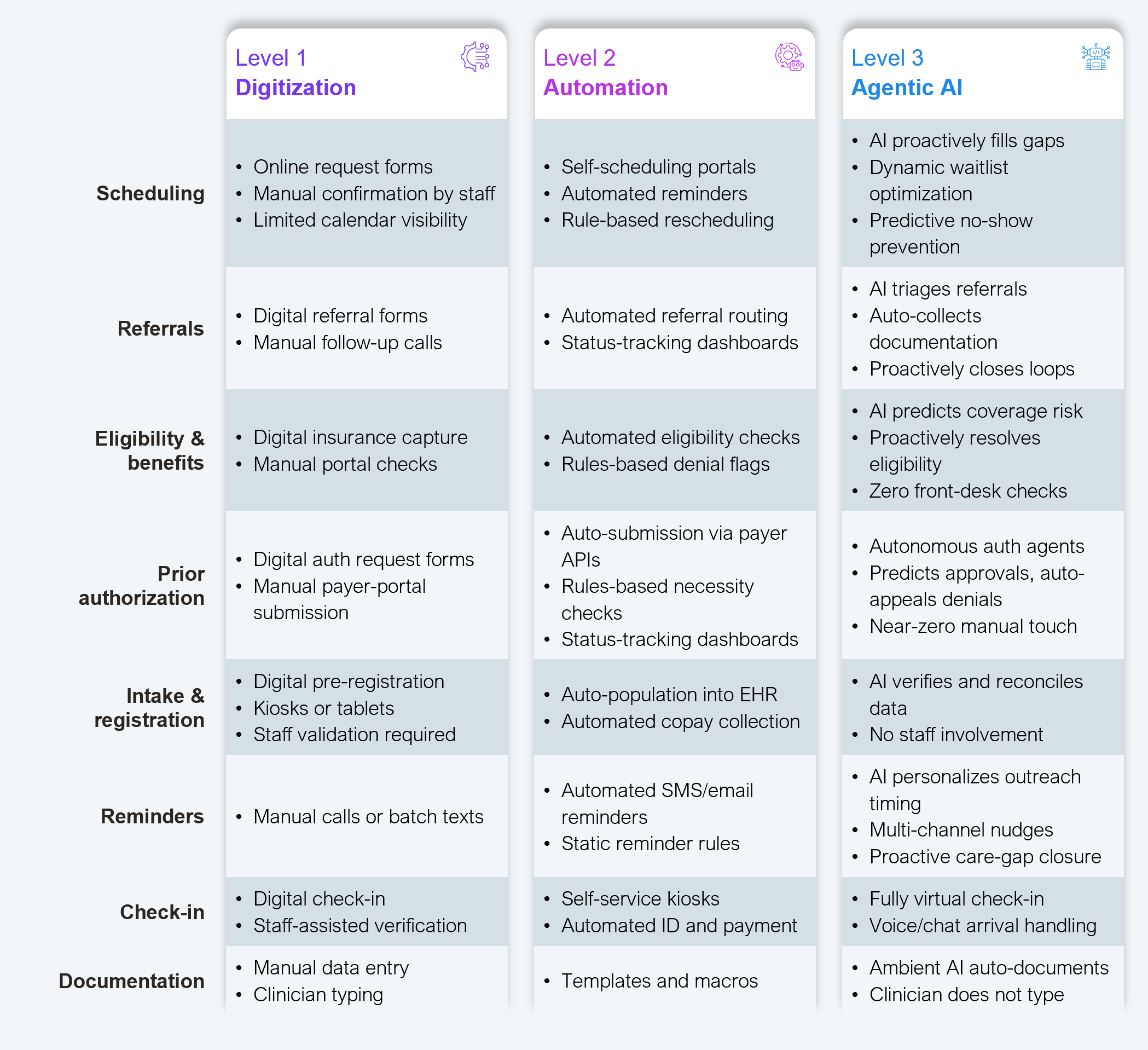
The transformation needed is not mainly about buying technology but about redesigning operations and executing in stages. Exhibit 4 compares those capabilities at each maturity level.
Source: HFS Research, 2026
The three steps
This playbook outlines a staged approach to making agentic AI work across front-office functions within 12–18 months, helping organizations reduce administrative costs, improve patient access, and protect clinician time.
The first step is to identify the two or three functions with the largest gap between available tools and actual operating maturity. Close those gaps first rather than attempting to move every function to Level 3 at once. These functions should be prioritized during the first six months because they present a large maturity gap and have measurable operational impact. The transformation runs in three steps, one per maturity Level.
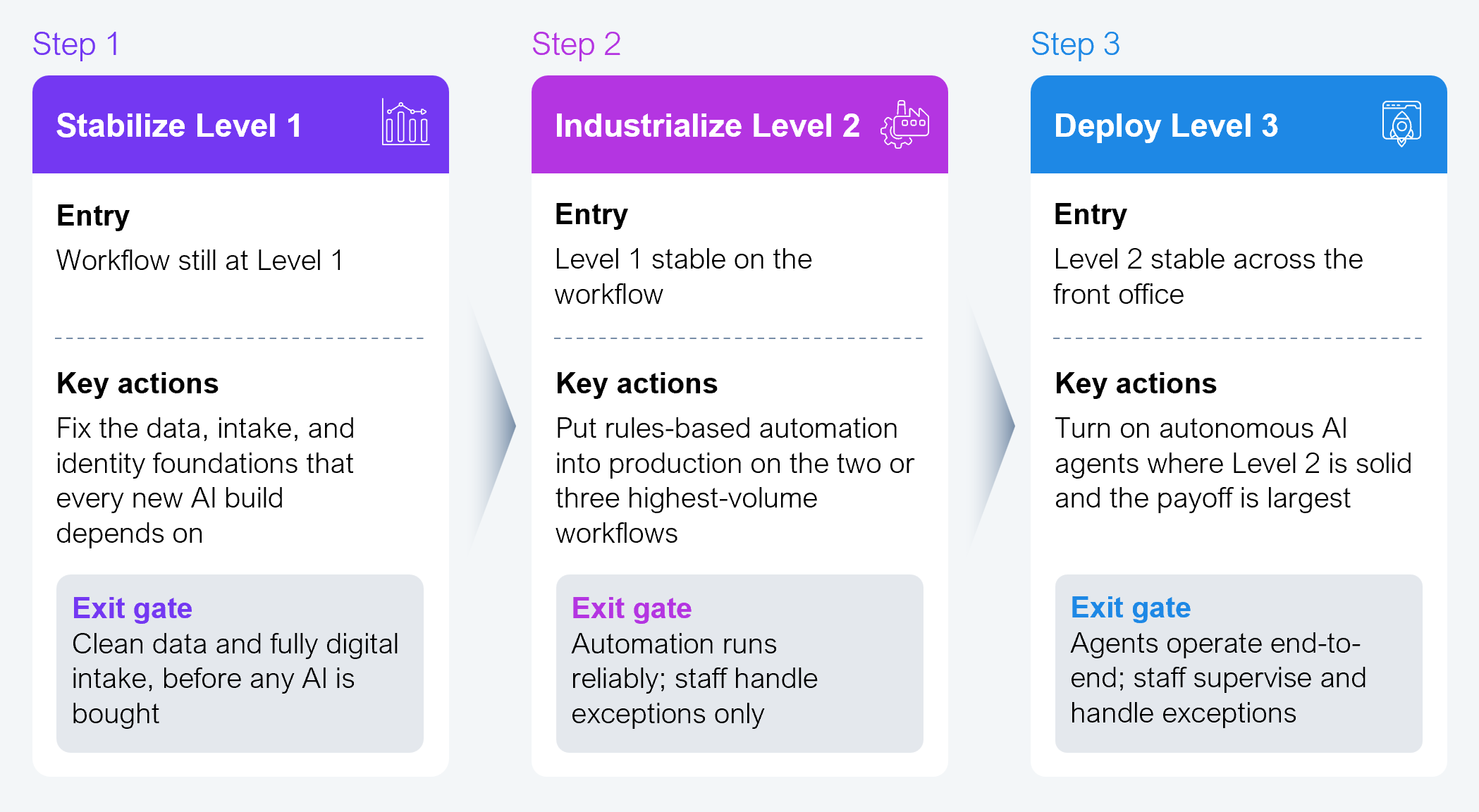
The gates are sequential per workflow, but the steps run in parallel across workflows. Step 1 is the foundation. Step 2 scales rules-based automation across selected workflows. Step 3 enables autonomous AI agents only when Steps 1 and 2 are already solid. The maturity band from Exhibit 3 sets which step you enter first. Each step has clear entry criteria, concrete actions, and a measurable exit gate, as outlined here:
Skipping data and workflow preparation is often the reason why agentic AI deployments underperform. Weak data and unstable workflows increase error rates and can erode patient and clinician trust. Establishing the data and automation foundations before deploying autonomous agents is therefore essential. Exhibit 5 shows the three steps in a single sequence.
Source: HFS Research, 2026
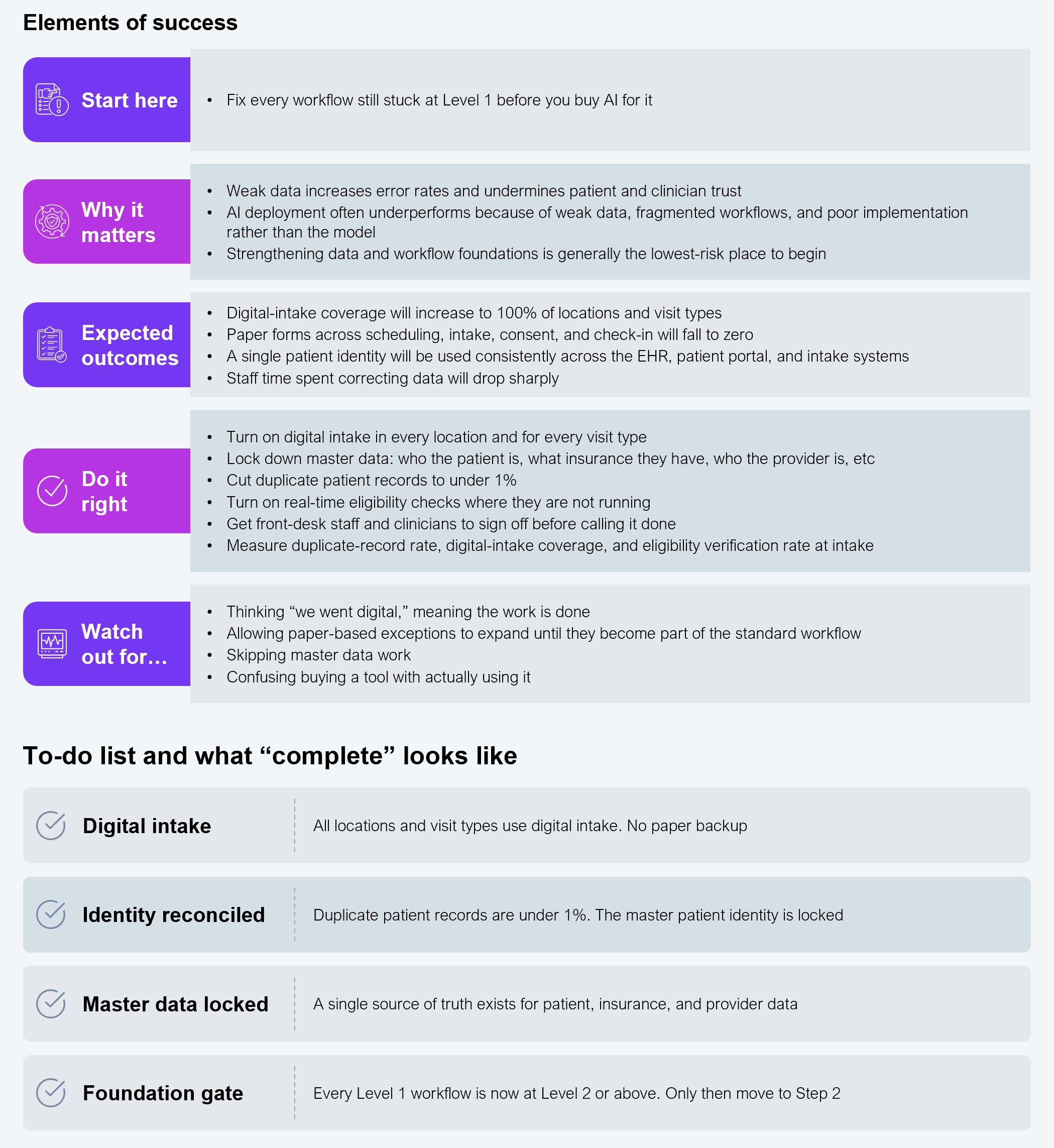
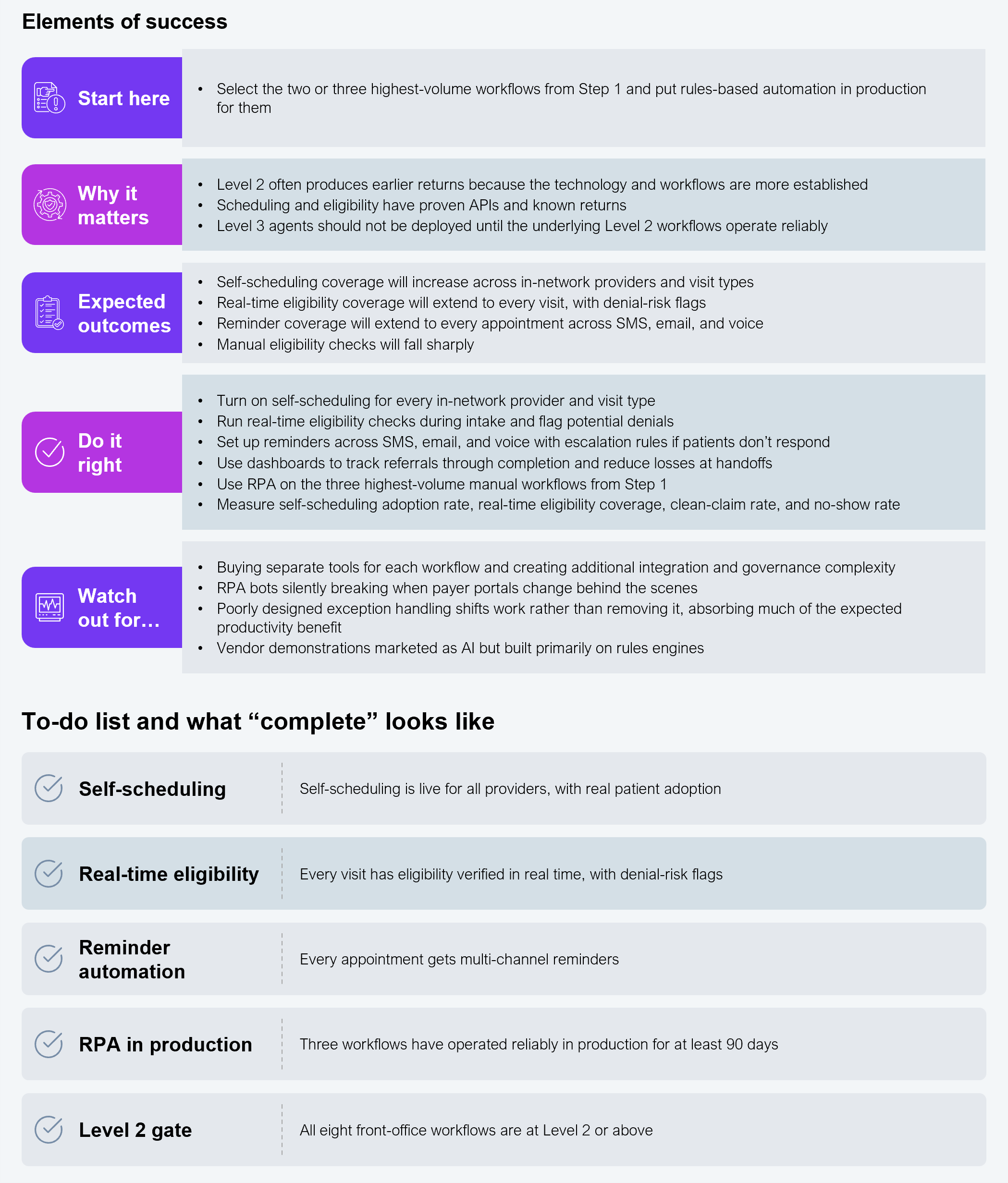
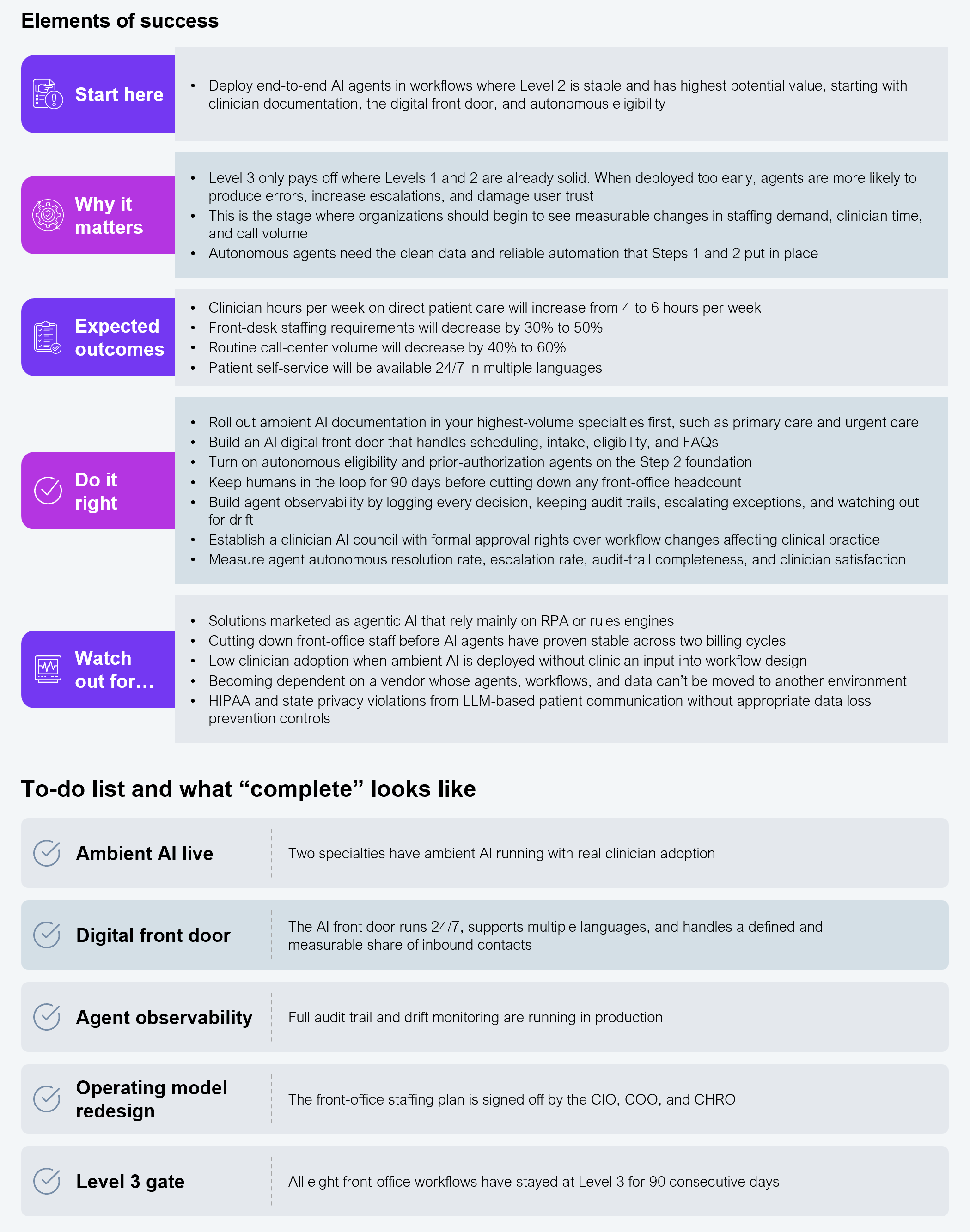
Care delivery CIOs and CMIOs should avoid two common execution problems: trying to leap from Level 1 or Level 2 to Level 3 in one program and waiting for the “perfect” agentic platform before starting. The first can overwhelm operations and weaken stakeholder support. The second delays efficiency gains while competitors continue to improve their operations.
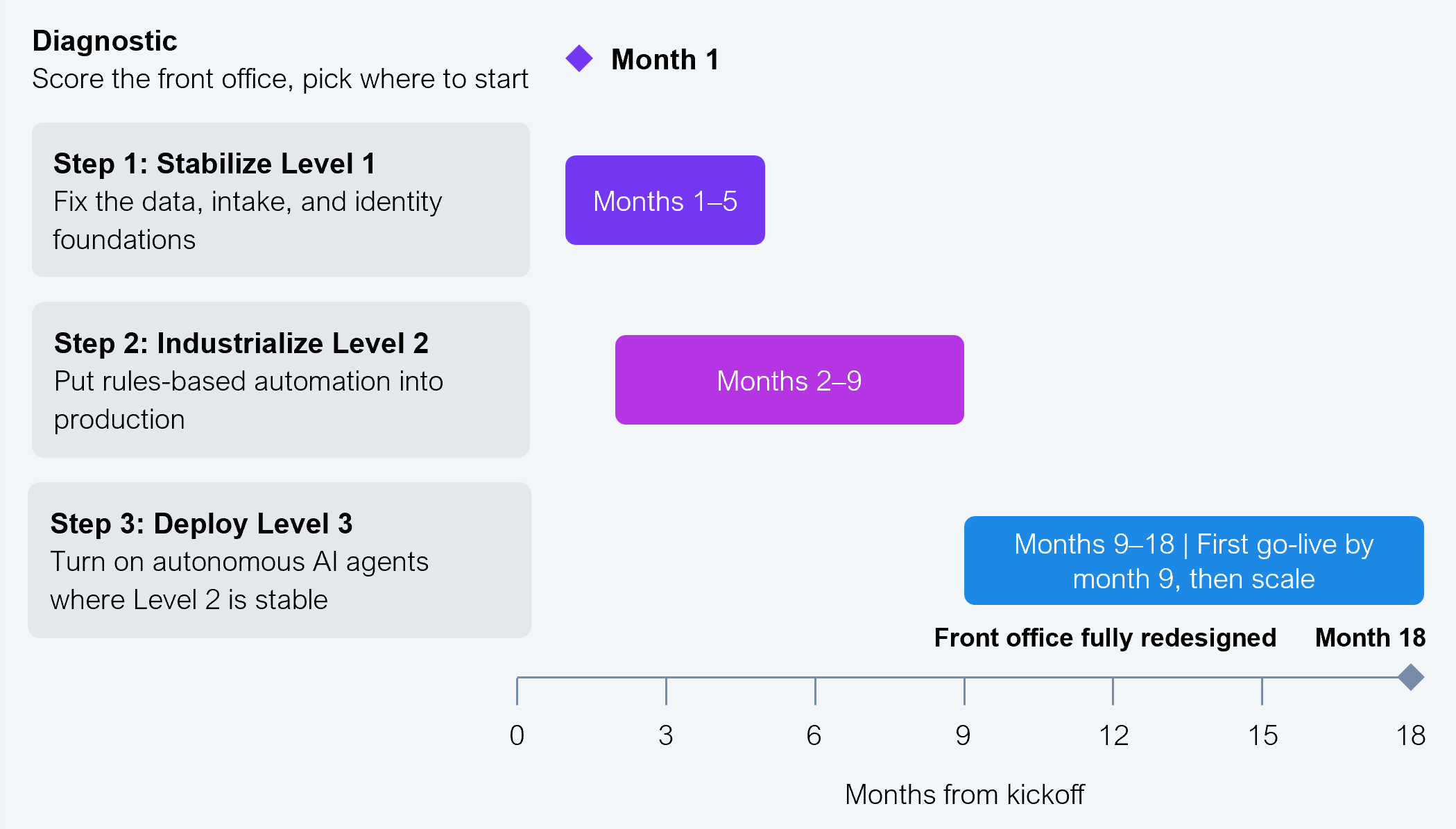
Run the three steps in parallel across functions, sequenced by each workflow’s maturity. The diagnostic comes first, in month 1. Step 1 stabilizes Level 1 foundations for the weakest workflows in months 1–5, while Step 2 industrializes Level 2 automation for the strongest workflows in months 2–9. The first Level 3 agentic deployment goes live by month 9 and scales across the remaining workflows from there. The full front-office redesign is targeted for completion by month 18.
Source: HFS Research, 2026
Five of these six surface before a single agent goes live. Sequence the controls the same way you sequence the steps
![[AS1.1]Six execution risks that can stall Level 3 transformation (unlabeled in the source; appears under the heading "The risks") Six-row risk register table. Columns are number, risk, what goes wrong, how to prevent it, and where the risk surfaces. Risk 1, fake agentic AI: solutions marketed as agentic still run on RPA, rules engines, or chatbot interfaces and look like Level 3 without changing how work gets done; prevent it by demanding a working demo on your own data and making the vendor show where an agent decides without human intervention; surfaces at vendor selection. Risk 2, the wrong vendor: proprietary memory, workflows, and orchestration create dependence that is expensive to unwind; prevent it by requiring data and workflow portability, exit clauses, and open standards before signature; surfaces at contract. Risk 3, governance failures: an agent acts on patient communications or clinical notes with no decision log, so no one can reconstruct what it did or why when a complaint or audit lands, and HIPAA, state privacy law, and emerging AI regulation all apply; prevent it by bringing security and compliance into design rather than final sign-off and contracting for BAA coverage, agent decision logs, model change notification, and data residency; surfaces at design. Risk 4, bad data: wrong patient IDs, stale insurance, and duplicate records turn into workflow errors that clinicians and patients see, and fixing them after a visible failure costs more than fixing them first; prevent it by reconciling master data across patient identity, insurance, and provider and cutting duplicates before any agent enters the workflow; surfaces at Step 1. Risk 5, clinicians say no: top-down deployment without clinician involvement produces low adoption and inconsistent use; prevent it by co-designing with a clinician working group from day one and piloting with volunteers before any mandate; surfaces at Step 2. Risk 6, a headcount promise with no transition plan: cutting roles before agents are proven, or without redeployment and retraining, weakens employee trust and creates labor, service-quality, and reputational risk; prevent it by redeploying to higher-value work first, keeping humans in the loop for at least 90 days and two billing cycles, and involving HR and labor representatives during design; surfaces at design and lands at Step 3. Source: HFS Research, 2026.](https://www.hfsresearch.com/wp-content/uploads/Table-1.png)
The following includes relevant HFS perspectives on care delivery operations and agentic AI adoption; watch for our series on selecting the right partner for front-office transformation.
Register now for immediate access of HFS' research, data and forward looking trends.
Get StartedIf you don't have an account, Register here |
With the exception of our Horizons reports, most of our research is available for free on our website. Sign up for a free account and start realizing the power of insights now.
Our premium subscription gives enterprise clients access to our complete library of proprietary research, direct access to our industry analysts, and other benefits.
Contact us at [email protected] for more information on premium access.