
This HFS Point of View, “Is this the end of BPO as we know it? How SaS is creating a $422 billion market,” is for CFOs, COOs, and sourcing leaders preparing to negotiate their next BPO renewal.
A year ago, we mapped the $1.5 trillion Services-as-Software™ (SaS) opportunity. ~$60 billion is leaving the BPO market, but something bigger is arriving.
Business process outsourcing (BPO) is being repriced and, at the same time, redrawn. The unit you buy is shifting from staffed capacity to completed work because BPO is one services market where AI can capture what providers actually sell, namely the process logic, the exception paths, and the decision rules that have always lived in people.
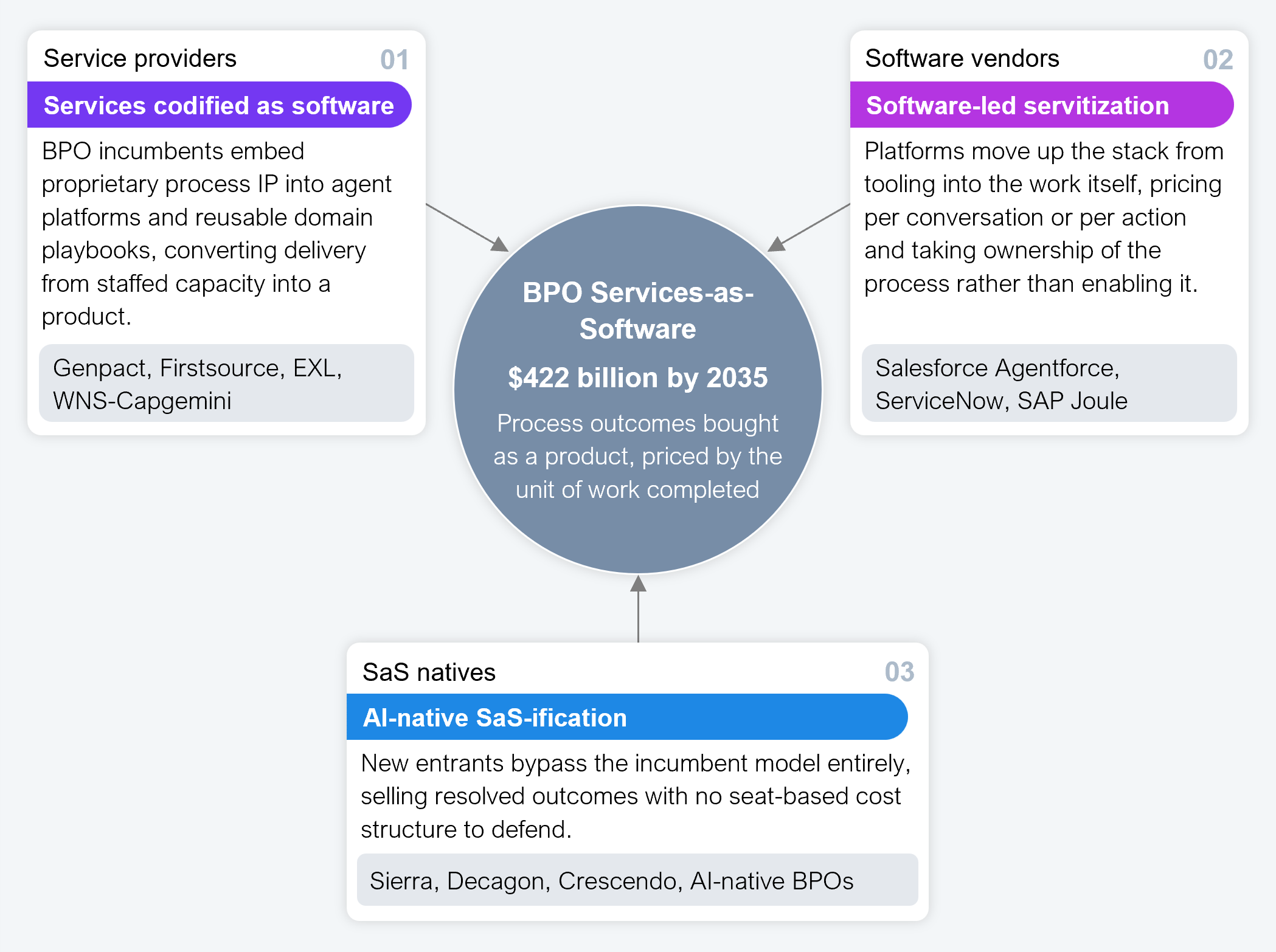
Once that knowledge sits in software rather than in people, it can be packaged, priced, and sold like any other product. That is what turns Services-as-Software™ (SaS) from a technology trend into a commercial model. HFS expects that shift to create a segment worth $422 billion within BPO by 2035.
For a CFO or COO, this changes the economics of the work you already buy and opens up process work that historically has never been priced. Both shifts will reflect in your next sourcing contract, which is why the next renewal cycle is where enterprises will either capture that value or concede it.
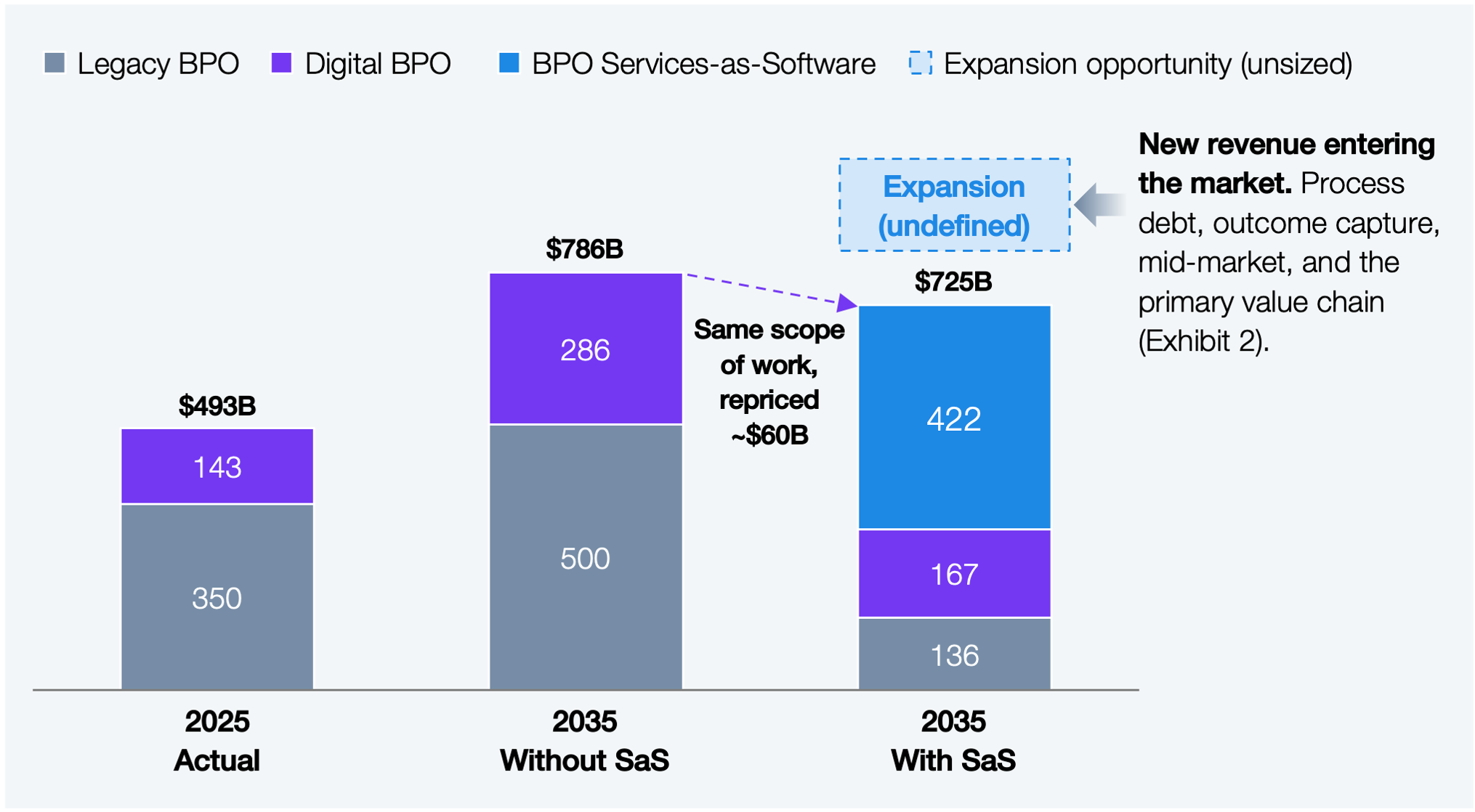
The impact of SaS on BPO runs in two directions simultaneously. As shown in Exhibit 1, approximately 75% of legacy work and 25% of digital work will be disrupted by it. As a result, the addressable market will contract to $725 billion by 2035, from $786 billion under a conventional trajectory. This roughly $60 billion net deflation reflects the changing economics of existing work: enterprises will pay less for the same business outcomes, leaving providers that remain dependent on FTE-based commercial models to compete for a structurally shrinking market.
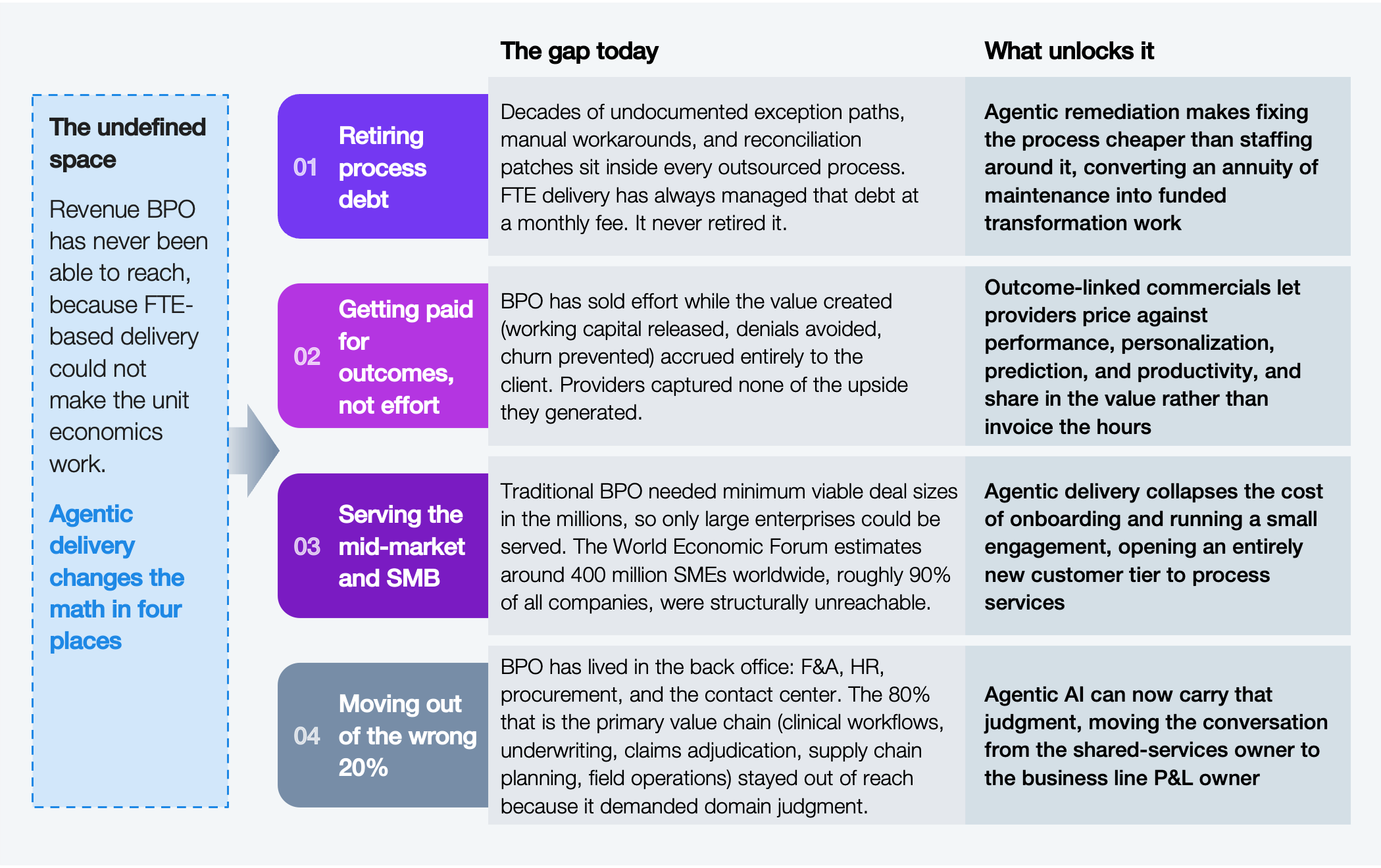
That arithmetic, however, captures only one side of the story. It excludes all the categories of work that traditional BPO economics could never profitably address. These include eliminating accumulated process debt, commercializing outcome-based services instead of labor inputs, serving the mid-market that minimum deal sizes have historically excluded, and extending managed services beyond the back office into the enterprise’s primary value chain. These revenue streams represent net-new market value. They sit on top of the $725 billion market rather than within it (see Exhibit 1).
HFS has deliberately left this expansion unquantified. That is a research position, not a gap. We will size this opportunity once three conditions are met: sufficient deal evidence across the primary value chain rather than isolated pilots, published pricing benchmarks beyond customer experience, and a defensible definition of the addressable mid-market. None of these milestones are far away. We would rather be late with the number than early with the wrong one.
The BPO industry has been facing four realities for as long as it existed. Agentic delivery changes all of them at once (see Exhibit 2).
Source: HFS Research, 2026
Buyer intent has already moved. Three in four enterprise leaders now expect a pivot from staff augmentation models to SaS. In 2026, HFS research found that traditional outsourcing models, defined by location dependency and manual effort, are expected to decline from 55% to 37% of delivery within the next two years. Also, our BPO-specific research found that more than 40% of enterprises plan to shift customer experience delivery to AI-led models within three years, with supply chain and F&A at 30% each. The functions that built the BPO industry are the same functions buyers intend to move first.
Provider economics are starting to follow. A small cohort is delivering sustained improvement in revenue per FTE and operating margin per FTE, and BPO-heritage names such as Firstsource and EXL sit among them on the HFS Non-Linearity Index. That cohort remains thin, and most gains are still concentrated by account or service line, so this is a strong directional signal.
Capital has moved faster than contracts. In October 2025, Capgemini closed its $3.3 billion acquisition of WNS, framed explicitly as the foundation for agentic AI-powered intelligent operations. Capgemini bought process knowledge that it could encode into AI agents, with delivery centers as the residue rather than the asset. In the same month, TELUS took TELUS Digital private at roughly a fifth of its 2021 IPO valuation. Each transaction signals that the value of BPO lies in the process logic, exception paths, and decision rules, and that all three can now be captured in software.
The three SaS swimlanes we mapped in June 2025 have held up. What changed is the altitude, and the distance traveled in fourteen months tells us where the market is going (see Exhibit 3).
Source: HFS Research, 2026
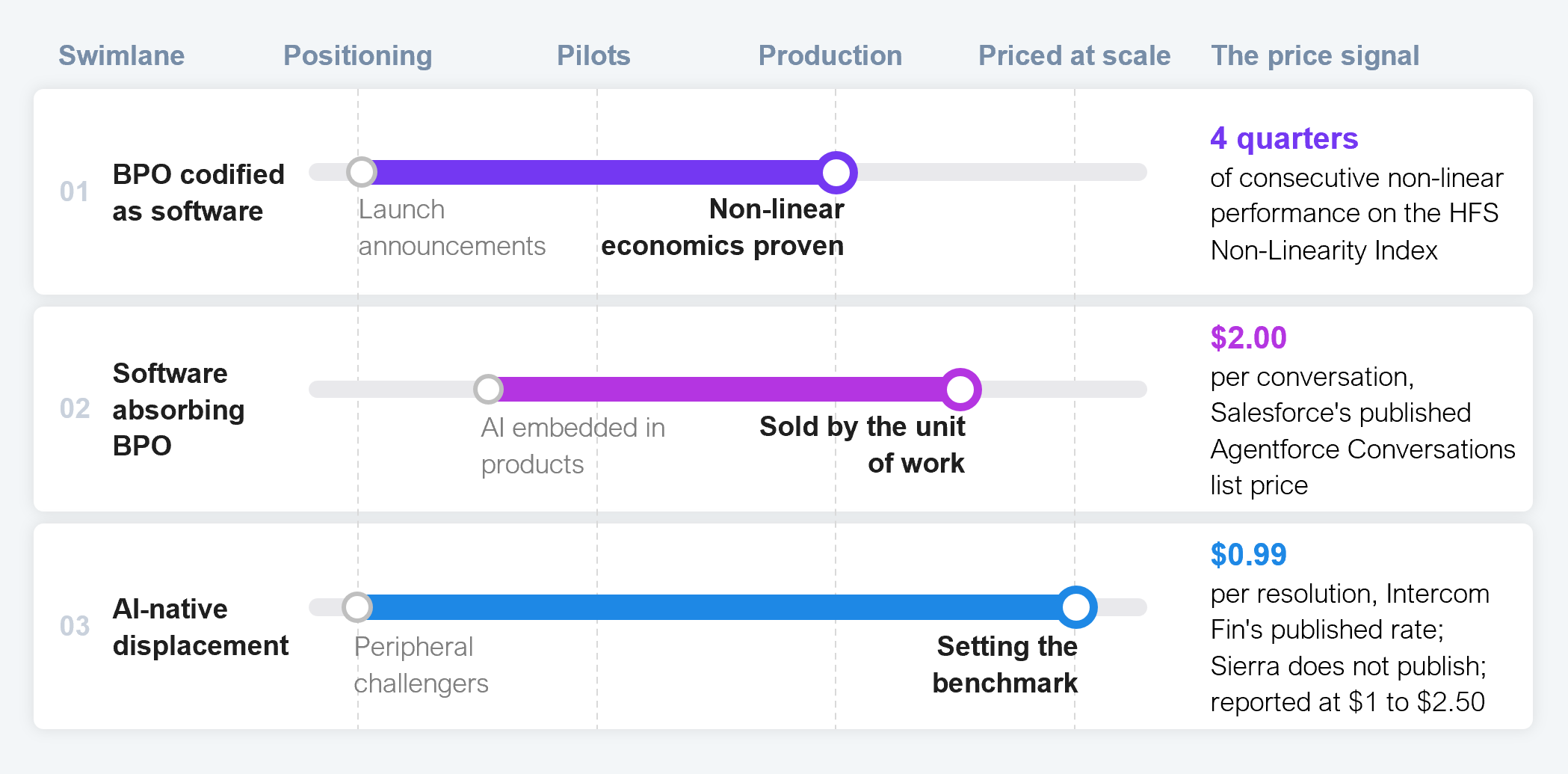
Swimlane 1: BPO codified as software. A year ago, this lane was defined by launch announcements. Genpact had introduced Service-as-Agentic-Solutions, and Firstsource was promoting its UnBPO framework. We pressed both for proof: Genpact has been delivering autonomous customer resolution vertical by vertical, and Firstsource has rebuilt delivery around an operating system for AI-native operations rather than a set of point tools. Entries for the 2026 HFS SaS Awards show the same shift within live client engagements. A BPO heritage provider reports that more than half its revenue is now outcomes-linked. Another converted a multi-year product support engagement moving from per-FTE billing to AI-first delivery priced by transaction, reflecting the commercial conversion that SaS promised for a decade.
Swimlane 2: Software-led servitization (i.e., software absorbing BPO). A year ago, the open question was whether SaaS platforms would replace service functions or merely reduce ticket volumes. The answer lies in how software is now priced. Salesforce publishes a list price of $2 per conversation for Agentforce customer-facing agents, alongside a consumption alternative that prices a typical three-action support case at roughly $0.30. When a software platform prices its product in units of completed work, it is competing for BPO budgets, and enterprise buyers can now evaluate it as a delivery alternative rather than just a tooling decision. The pattern extends across the stack, with agentic ServiceNow deployments absorbing HR operations work that previously flowed to shared services and BPO teams. Software is no longer just an enabler; it is increasingly becoming the process owner.
Swimlane 3: AI-native SaS-ification. This lane has traveled the furthest and is where BPO incumbents face the sharpest challenge. Sierra, founded in 2023 and positioned explicitly as a productized BPO replacement, reached a $15 billion valuation by May 2026 with 40% of the Fortune 50 as customers, using a commercial model built entirely on resolved outcomes rather than seats. Crescendo operates as an AI-native BPO that runs the AI and the humans together. The buyer’s decision has been reframed into a make-versus-buy call.
Eighteen months ago, none of these firms appeared on BPO competitive radars, and the challenge is not confined to Silicon Valley. An AI-native contact center operator, submitted to the 2026 HFS SaS Awards, now runs more than 500,000 interactions a day across ten-plus enterprise clients, prices only on resolved outcomes rather than seats or minutes, and underwrites guaranteed savings from day one. In a consumer electronics engagement, it delivered 45% lower cost to serve against a 30% guarantee, which sustained for more than six months. Taken all together, the evidence shows how far each swimlane has moved since we first mapped them in June 2025 (see Exhibit 4).
Source: HFS Research, 2026
The 2026 HFS SaS Awards drew 260 submissions from 126 organizations, providing the market with measured, in-production evidence. The pattern across the strongest BPO submissions is consistent: baselines are measured before deployment, outcomes are tracked across months rather than weeks, and pricing is tied to results rather than effort.
Those changes are already translating into operating gains. An agentic accounts payable deployment for an automotive components manufacturer, live since January 2026 and processing roughly 50,000 invoices a month, helped lift touchless processing from 27% to 71% within six months and cut the exception hold rate from 38% to 20%. Comparable results appear in prior authorization, casualty reinsurance underwriting, and global finance operations (see Exhibit 5).
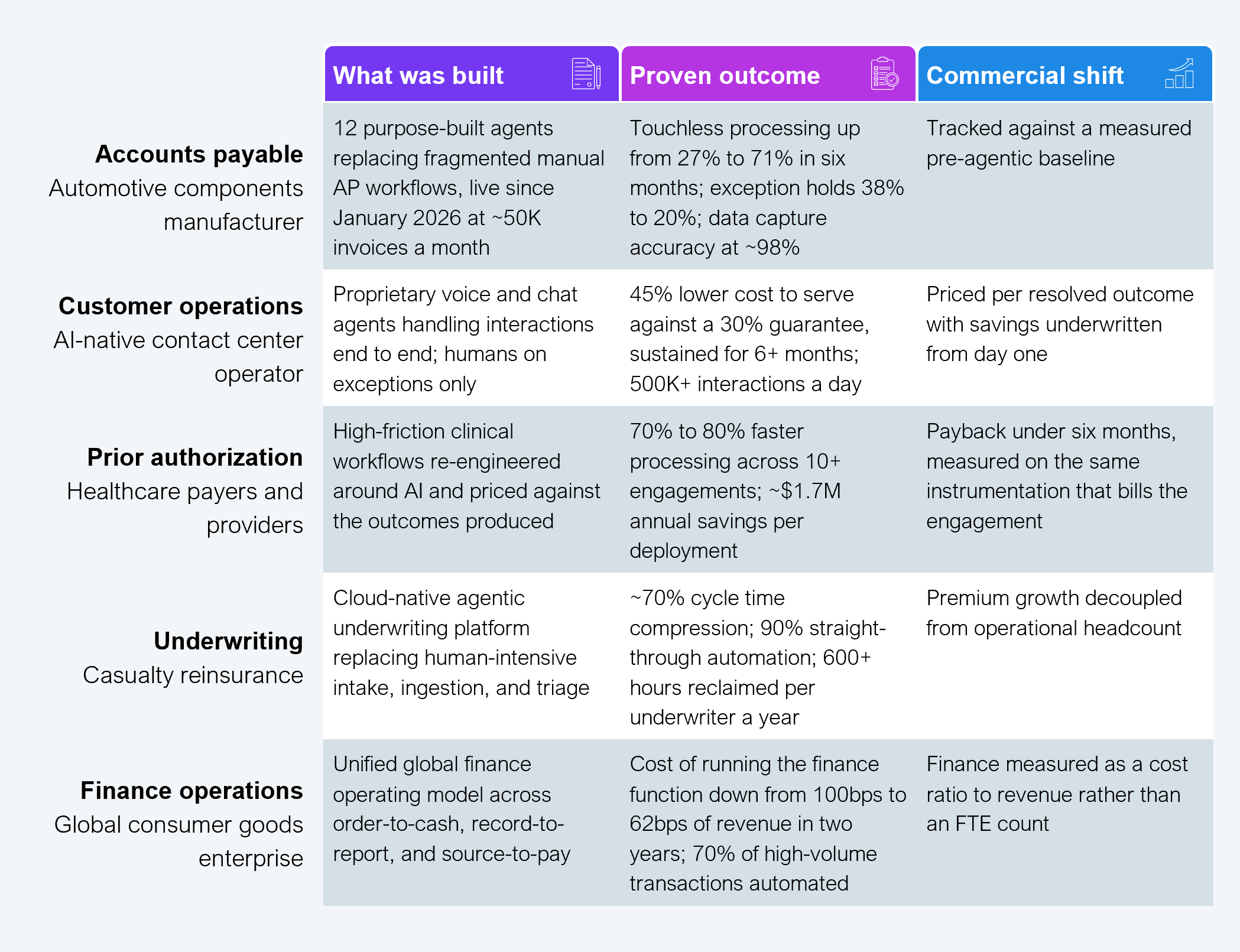
Source: HFS Research analysis of HFS SaS Awards 2026 submissions
Changing pricing dynamics is a telltale sign
Every structural shift in services announces itself through pricing. The commercial frontier has moved from FTE rates and fixed fees to outcome-based subscriptions: pay for claims processed, invoices reconciled, and customers served. Published outcome rates span roughly $0.99 to $2 per resolved interaction. Consumption models price a different unit, which is why Salesforce’s roughly $0.30 three-action case is not a contradiction: it prices the actions, not the resolution. Either way, every BPO renewal negotiation in CX, and soon in F&A and supply chain operations, now opens against a published price for a unit of completed work.
Outcome pricing can also move enterprises up the AI Trust Curve. When a provider underwrites the outcome, model confidence and data credibility are absorbed into its commercial risk, moving the enterprise conversation directly to behavioral trust and decision reliance. That is why outcome-priced SaS offerings scale faster than tool-based AI deployments that leave the trust burden with the buyer. One caution remains: resolution definitions are becoming the new SLA battleground, so buyers should insist on jointly governed, auditable definitions of a completed outcome before signing.
The leverage sits with the buyer for the first time in a generation, and it will not sit there indefinitely. The next renewal cycle is where it should be spent.
A $422 billion SaS market will emerge inside BPO by 2035, while the legacy segment shrinks by more than 60%. Providers that cannot demonstrate delinked economics within the next two years will be consolidated, disintermediated, or repriced. Enterprise leaders now hold more leverage in their BPO relationships than they have had in decades. Spend it on the scope you could never buy before, not on another round of rate card negotiation.
Register now for immediate access of HFS' research, data and forward looking trends.
Get Started

If you don't have an account, Register here |
With the exception of our Horizons reports, most of our research is available for free on our website. Sign up for a free account and start realizing the power of insights now.
Our premium subscription gives enterprise clients access to our complete library of proprietary research, direct access to our industry analysts, and other benefits.
Contact us at [email protected] for more information on premium access.

