
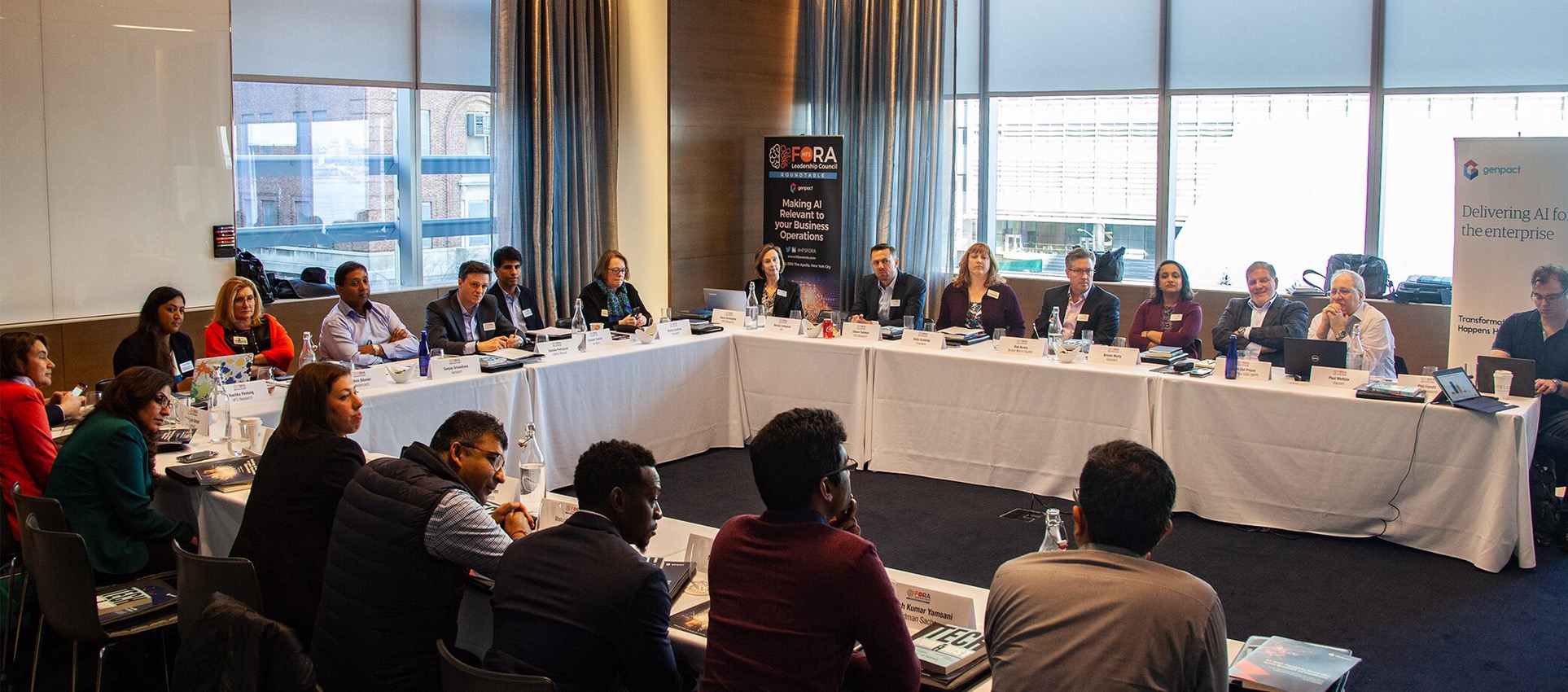
At a recent FORA Roundtable in NYC, produced in association with Genpact and featuring their Chief Digital Officer, Sanjay Srivastava, HFS Research led a discussion with 20 enterprise leaders diving into the what, why and how of AI for business operations. The participants each came with a unique perspective on the challenges and opportunities of AI for their business, and there was a breadth of maturity between those in the “getting started” and the “getting good” phases of AI experimentation and adoption. It is clear that we at the beginning of a long cycle of learning and understanding how AI will impact business operations – but as the impact of AI will be inevitable, enterprises must start having these conversations, or risk falling far behind.
The ”why” and “what” of AI have largely been defined… now it’s getting to the hard task of “how”
There is no longer any question about why to bother experimenting with AI. It seems most people feel that the risk of not investigating and experimenting outweighs the risk of trying and failing, and have accepted AI as an inevitable part of business moving forward. A greater understanding of what AI really is also seems to have also developed. The most important clarity that most organizations have gained over the last several months is that AI is not some monolithic thing or a singular technology. Instead, we’ve come to understand AI as a toolkit, or “a bucket of stuff” that enterprises can use to make their operations more intelligent; building blocks that include various elements of foundational AI moving across a spectrum toward more packaged solutions.
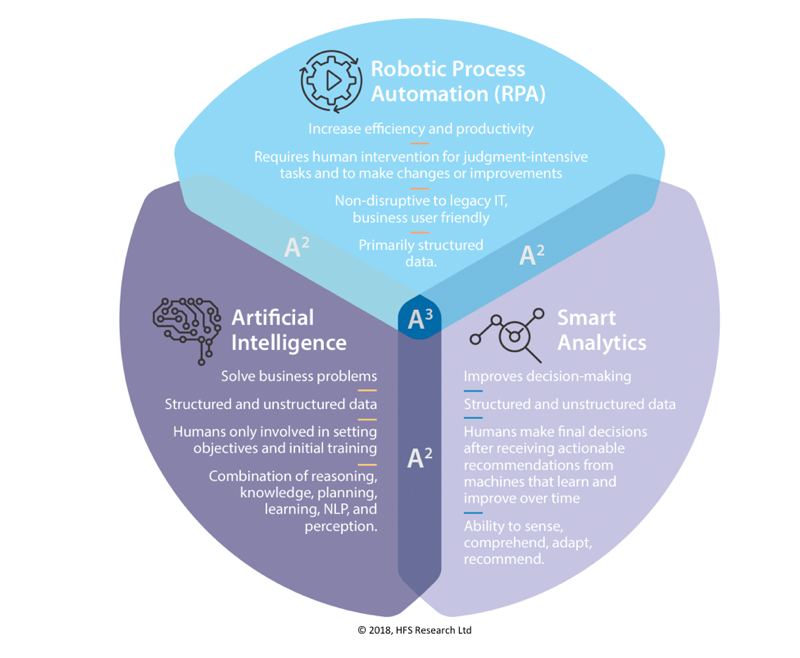
There’s also an emergence of integrated automation (exhibit 1), which demonstrates the power of AI as combined with the other important change agents of RPA and smart analytics. Many companies lamented that they’ve started to make progress with RPA but not yet dabbled with AI, despite the opportunity to combine forces using the elements of these tools to make operations not just more efficient and effective, but more intelligent and intuitive. But, the distinction between RPA as a script-focused point solution and AI as a business solutions focused tool seems to have gained credence.
Exhibit 1: The Future of AI lies in integrated automation
How will enterprises adopt and industrialize AI? By facing critical challenges head on
The diversity and inclusion element is very important to any AI discussion; AI is not just only for the tech savvy cool kids. Many roles will be impacted and we all need to learn (or unlearn old habits) to come to terms with a new reality. The machine intelligence paradox dictates that the more businesses become reliant on AI, the more important true human skills become, and some human-in-the-loop component must be baked into AI design.
The Bottom Line: Making AI relevant to business operations requires a fundamental refresh and rethinking of critical processes and enterprise goals.
No company has found a silver bullet answer for how to approach AI, and the journey looks different for every organization. We are already seeing use-cases of effective AI in business operations as a result of these integrated solutions, but many questions still loom along the inevitable AI journey. The impacts of AI are happening — whether we like it or not – and will be significant. Now is the time to prepare by having thoughtful discussions to rethink the potential opportunities that AI and its fellow change agents represent.
Register now for immediate access of HFS' research, data and forward looking trends.
Get Started


If you don't have an account, Register here |
With the exception of our Horizons reports, most of our research is available for free on our website. Sign up for a free account and start realizing the power of insights now.
Our premium subscription gives enterprise clients access to our complete library of proprietary research, direct access to our industry analysts, and other benefits.
Contact us at [email protected] for more information on premium access.

