
The internet of things (IoT) has already ingrained itself in businesses, homes, and people’s lives—from the humble smartwatch to advanced industrial sensors. However, one of the IoT’s biggest hurdles remains in existing 4G infrastructure. 4G may sufficiently power your Alexa home assistant, but powering an entire smart city becomes problematic when autonomous vehicles or augmented reality need ultra-low latency to succeed for consumers en masse. If enterprises want to see their IoT projects scale competitively, they must recognize the benefits and necessity of 5G and build their baseline capability—before mass-rollout kickstarts.
5G promises to facilitate approximately 1,000 times more connected devices per square kilometer, but realism is essential. This boom is not around the corner, and it will certainly not happen overnight. So, enterprises and all the IoT ecosystem players must prepare wisely to avoid getting stuck jostling for position or playing catch up when 5G infrastructure and IoT technology mature and combine into a long-awaited smart mega-market.
IoT is a priority industry for almost all, despite project pitfalls and the limitations of existing infrastructure.
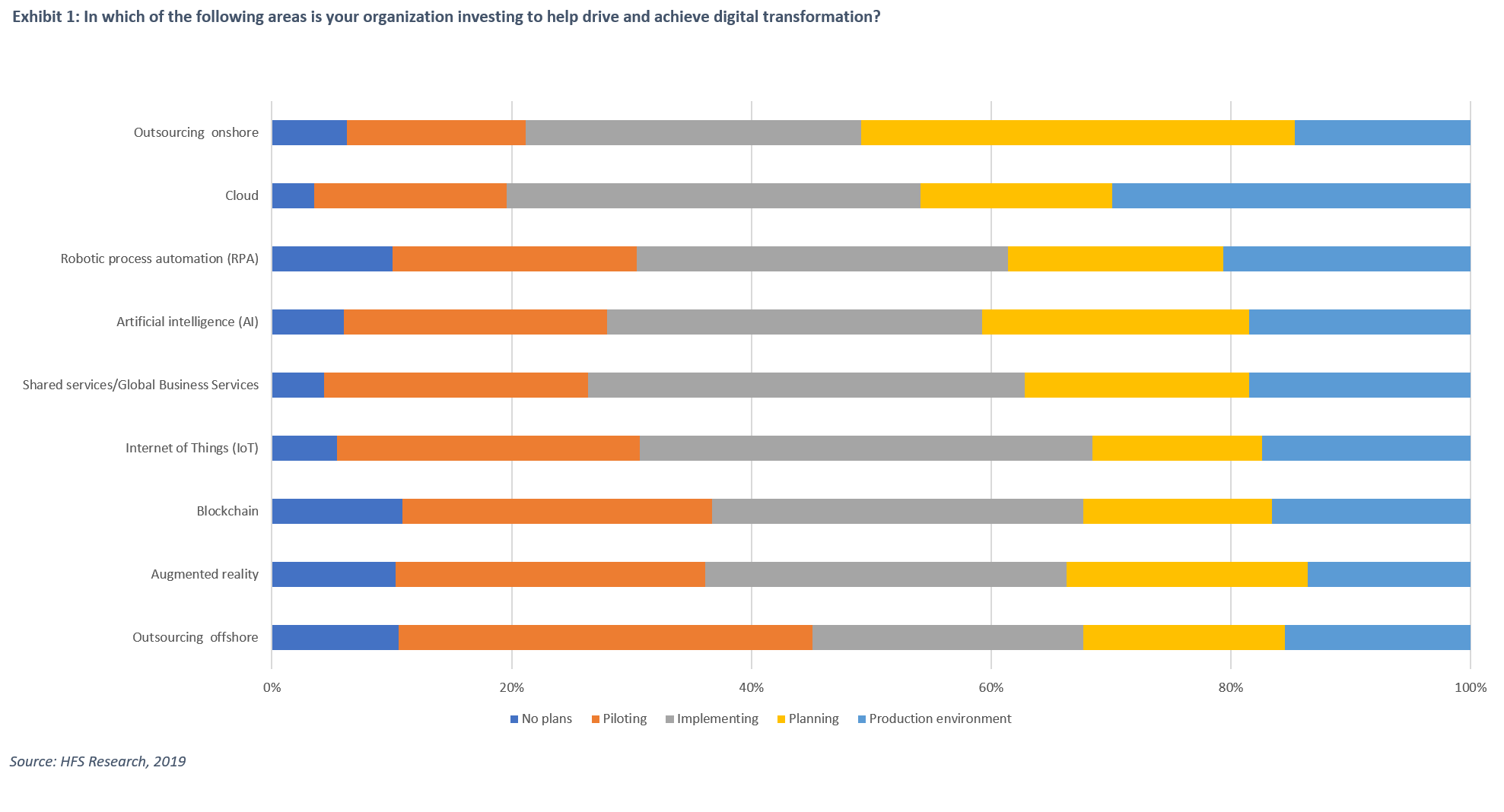
Firms are widely boasting and exploring exciting IoT use cases surrounding the likes of workplace safety and live-time insurance. The IoT has clearly succeeded so far, even with its limitations, and it is at the forefront of almost every enterprise’s mind (see Exhibit 1). Ninety-five percent (95%) of enterprises have plans to invest and develop IoT; however, a quarter of respondents remain in the pilot phase. Many IoT projects to-date have stalled at the pilot phase, and if enterprises aren’t ready when 5G becomes the game-changer in IoT, many more projects will come crumbling down.
5G promises to connect even more devices at even higher speeds offering industries near-instant data collection and transfer throughout increasingly massive device networks
The HFS IoT Services Blueprint report for 2018 outlined a range of hurdles facing enterprises hoping to leverage the technology. While 5G isn’t the answer to everything, it can certainly go a long way to tackling the barriers to widespread scalability. A critical difference is 5G’s higher radio frequencies than its predecessor, allowing the transfer of larger quantities of data at accelerated speeds. For the IoT, this means scaling device numbers significantly. In fact, while 4G could support around 4,000 devices per square kilometer, 5G is estimated to support approximately one million.
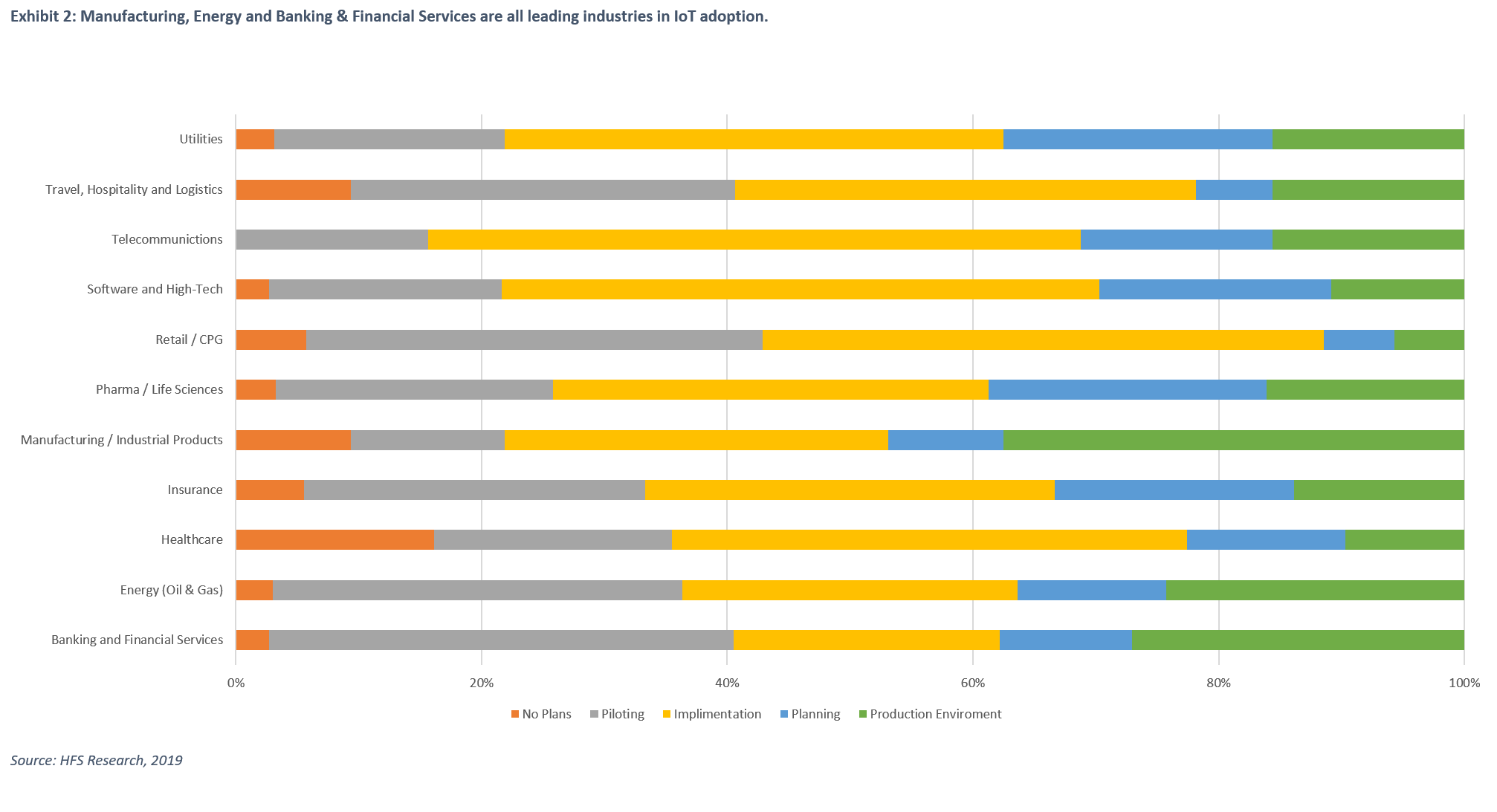
Ultimately, accurately predicting the extent of 5G’s impact on the IoT is virtually impossible; however, understanding the current market landscape provides some insight. Exhibit 2 outlines the current state of IoT in several leading industries; the likes of manufacturing, energy, and banking and financial services (BFS) are leading the charge into the production environment. One key takeaway must be that the majority of respondents across every industry have plans to adopt IoT and are actively exploring the possibilities. However, once 5G becomes a viable option, it is likely that the number of projects reaching the production environment will drastically increase as new business models and possibilities emerge. The risks of not being ready when that time comes should be clear to all.
Smart cities are only one of many applications of large-scale IoT, which, in the presence of 5G, could drive scale and investment in the technology.
Accenture explains that smart cities have truly limitless possibilities, which range from revolutionizing public transport networks to introducing the likes of smart lighting systems. Industries that have historically reported little interest in IoT technologies may very quickly change their tune. This is just a single example of a large-scale IoT project; it’s easy to see how 5G–enabled IoT could completely transform the market, and service providers and enterprise alike must be prepared.
The Bottom Line: Enterprises must begin investigating and building a knowledge base now if 5G is to underpin their large-scale IoT initiatives. But they must be realistic in their expectations; it is by no means a silver bullet and remains a while away from full-blown availability.
5G has the potential to completely unlock the IoT, driving new capabilities and generating new use cases that could see the marketplace completely transform. Enterprises will be keen to drive their IoT projects toward the production environment as quickly as possible, but they must remain realistic. 5G is coming, but no time soon: In fact, large-scale deployment is unlikely to take place until the early 2020s—and that’s only the 5G infrastructure. The IoT technology must also catch up; consider autonomous vehicles and augmented reality and how many challenges developers must overcome before products reach consumers en masse.
For now, enterprises must make sure they’re prepared for the arrival of 5G. They must develop partnerships with regulatory authorities, wireless operators, service providers, technology vendors, universities, and any other firms that may be interesting in sharing the cost burden. Effective partnerships will save pioneering enterprises critical time in the race for 5G-enabled IoT supremacy—allowing them to hit the ground running after the inevitable, long-promised boom.
Register now for immediate access of HFS' research, data and forward looking trends.
Get StartedIf you don't have an account, Register here |
With the exception of our Horizons reports, most of our research is available for free on our website. Sign up for a free account and start realizing the power of insights now.
Our premium subscription gives enterprise clients access to our complete library of proprietary research, direct access to our industry analysts, and other benefits.
Contact us at [email protected] for more information on premium access.

