 Contact Us
The HFS Point of View “The Services-as-Software™ framework: Building sovereign intelligence in the age of rented AI” is for CIOs, chief AI officers, and enterprise transformation leaders designing an AI operating model that keeps enterprise intelligence under enterprise ownership.
The biggest mistake enterprises are making today is confusing access to AI with ownership of intelligence. Every organization can rent increasingly powerful foundation models, just as every organization can rent cloud infrastructure, but renting the same intelligence as everyone else will never create lasting competitive advantage because those capabilities are available to every competitor willing to pay for them. The enterprises that thrive over the next decade will be those that continuously build intelligence of their own by transforming human expertise into digital capabilities that remain under their control, become smarter through execution, and strengthen the business every time they are used. That, in our view, is the next evolution of Services-as-Software.
Historically, we’ve described Services-as-Software from the perspective of services and software providers, focusing on how they transform human expertise into intelligent, reusable digital capabilities that can be delivered at scale instead of relying on labor-intensive services or static software products. Those same principles apply equally to enterprises, because the same approach that enables providers to industrialize expertise also enables organizations to capture their own knowledge, protect their intellectual property, and continuously build enterprise intelligence that becomes more valuable with every customer interaction, workflow, and business outcome.
Services-as-Software is the HFS approach for transforming human expertise into enterprise intelligence. It enables organizations to capture business knowledge, combine it with AI, enterprise data, governance and business context, and continuously improve how work gets done while retaining sovereignty over the intelligence that differentiates the enterprise. Unlike rented AI models, which provide access to shared intelligence, Services-as-Software enables enterprises to create intelligence that remains their own, grows through execution and becomes an enduring source of competitive advantage.
Three principles underpin the Services-as-Software approach:
Traditional software automates work, while traditional services apply human expertise to improve work. Services-as-Software does something fundamentally different because it continuously transforms that expertise into enterprise intelligence that becomes more valuable every time it is applied. Rather than existing inside individuals, documents, or disconnected applications, knowledge becomes a living enterprise asset that learns from every interaction, strengthens business context, and improves decision making over time. The outcome is not simply better software or smarter AI. It is an organization that becomes progressively more intelligent every time it operates.
This matters because the operating model that has served enterprises for the past three decades is increasingly struggling to keep pace with the speed of AI. Organizations have accumulated extraordinary expertise across finance, procurement, customer operations, healthcare, manufacturing, and hundreds of industry-specific processes, while technology providers have built increasingly sophisticated software and services firms have created enormous value implementing, operating, and improving those environments. Yet the expertise itself rarely became an enterprise asset because much of the knowledge generated through those engagements remained trapped inside applications, documents, individual practitioners, or fragmented business processes, making it difficult to retain, improve, or scale as organizations evolved.
The result is that many enterprises have become extraordinarily good at executing work without becoming significantly smarter from doing it. Every transformation program, consulting engagement, and system implementation creates new knowledge, yet much of that knowledge walks out of the door when projects end, employees leave, or technologies are replaced. What should have become a continuously improving enterprise capability instead becomes another disconnected asset that must be recreated during the next transformation initiative.
Our research estimates that more than $18 trillion of enterprise value is now trapped across the Global 2000 as a result of broken processes, poor-quality data, legacy technology, and outdated skills. That isn’t simply technical debt or process debt. It represents enterprise intelligence that organizations have never learned how to systematically capture, protect, or continuously improve, leaving enormous value locked inside businesses that desperately need greater agility to compete in an AI-driven economy.
This is precisely why Services-as-Software has evolved beyond being simply a provider delivery model. It has become an enterprise way of working that enables organizations to transform human expertise into enterprise intelligence, retain sovereignty over the knowledge that makes them unique, and continuously improve how decisions are made and work gets done.
As AI models inevitably become more capable and increasingly commoditized, the enterprises that differentiate themselves will not be those with access to the smartest AI. They will be those that built the strongest enterprise intelligence.
Services-as-Software provides the new enterprise operating model that enables enterprises to transform that expertise into enterprise intelligence, allows services firms to package decades of domain knowledge into continuously improving operating models, and gives technology providers a platform for delivering AI that learns from business execution rather than simply automating transactions.
This changes the role of every participant in the AI ecosystem:
Services-as-Software creates an entirely different economic model. Enterprises stop buying technology as isolated systems and start investing in enterprise intelligence. Services firms stop selling effort and begin monetizing reusable operating expertise. Technology providers stop competing solely on software features or model performance and instead compete on how effectively their platforms help customers create, govern, and enrich enterprise intelligence. Competitive advantage no longer comes from owning more software, hiring more people, or licensing a better model. It comes from continuously creating better enterprise intelligence.
Palantir CEO Alex Karp recently warned enterprises that every prompt, workflow, and business process shared with external AI platforms risks enriching someone else’s intelligence instead of their own. Whether one agrees with his rhetoric or not, the underlying point is difficult to dismiss. The strategic question is no longer which model an enterprise chooses. It is how much of its operating knowledge remains under its own control.
The more enterprises move from experimentation to production, the more obvious it becomes that competitive advantage no longer comes from having access to a particular model because every organization will increasingly have access to similar intelligence.
Instead, differentiation comes from how that intelligence is applied to business processes, governed across the enterprise and continuously enriched with proprietary knowledge that your competitors cannot replicate.
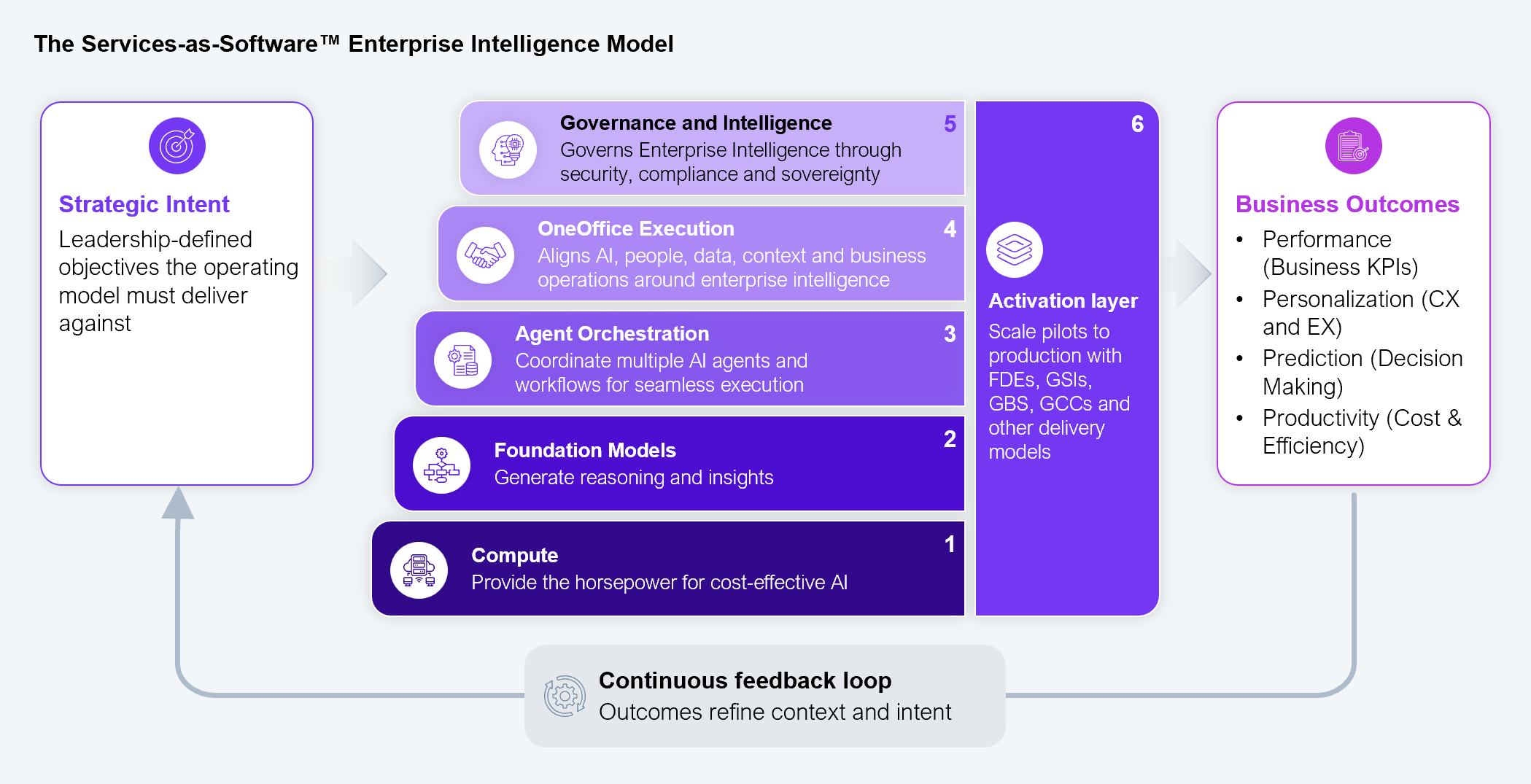
Once you begin thinking about AI as an operating model rather than simply a tech stack, it becomes clear that competitive advantage is no longer created by the models themselves. It is created by the operating capabilities that channel AI into enterprise execution, continuously build enterprise intelligence, and ultimately deliver measurable business outcomes.
Source: HFS Research, 2026
Define your strategic intent before you begin
Every operating model begins with intent because AI must never determine enterprise priorities. Leadership defines the strategic outcomes the organization wants to achieve, whether that is revenue growth, customer intimacy, operational efficiency, or innovation. The Services-as-Software Operating Model exists to continuously translate that strategic intent into business execution.
For example, a global retailer defines its strategic intent as improving customer loyalty while reducing fulfillment costs. Rather than deploying AI opportunistically across individual functions, that objective guides every layer of the Services-as-Software Operating Model, ensuring infrastructure, AI models, workflows, and OneOffice execution all align to delivering measurable improvements in customer experience, inventory optimization, and profitability.
Layers 1 and 2: Compute and Foundation Models
At the Services-as-Software model foundation sits Compute, because every AI capability ultimately depends on accelerated infrastructure running across hyperscale clouds, sovereign environments, or enterprise data centers. Sitting above are Foundation Models, which continue to improve at extraordinary speed and provide the reasoning, language, and multimodal capabilities that power enterprise AI. Those models remain essential, but they are increasingly becoming interchangeable components of the architecture rather than the architecture itself, allowing organizations to select whichever models best suit a particular workload without fundamentally changing how the enterprise operates.
For example, an automotive manufacturer deploys NVIDIA-powered compute across its private cloud and hyperscale environments while selecting different foundation models for engineering design, supply chain optimization, and customer support. Compute provides the horsepower, and foundation models provide the reasoning, but neither creates lasting differentiation because competitors can build a similar technology stack. The real advantage comes from how the enterprise applies those capabilities through its operating model.
Layer 3: Agent Orchestration
The next layer is Agent Orchestration, where multiple models, AI agents, and business workflows are coordinated into a single operating environment. As enterprises increasingly deploy specialized models and autonomous agents, this layer becomes the control plane that governs workflow execution, policy, security, and model selection, allowing organizations to evolve their AI estate without becoming permanently dependent on a single provider.
For example, a customer complaint triggers one agent to verify identity, another to retrieve account history, a third to recommend a resolution, and a fourth to complete the transaction, all coordinated automatically under a single governance framework.
Layer 4: OneOffice Execution
OneOffice Execution is where enterprise strategy becomes enterprise action because this is the layer where AI finally understands the context in which the business operates. Foundation models can reason, summarize, and generate extraordinary outputs, but they have no inherent understanding of an organization’s customers, operating policies, regulatory obligations, commercial priorities or risk appetite. Those elements of context are what allow intelligence to become execution, which is why we believe OneOffice Execution becomes the most strategically important layer in the Services-as-Software framework.
This is where AI, people, enterprise data, and business operations converge into a single execution model that continuously aligns strategic intent with operational delivery. Rather than allowing AI to operate inside disconnected functions or individual applications, OneOffice Execution connects the entire enterprise by orchestrating agents, workflows, business rules, governance, and enterprise context across every customer interaction and operational process. Every decision is therefore made with an understanding of how it contributes to broader business objectives, while every process continuously enriches the enterprise intelligence that makes the organization more competitive over time.
Context becomes the defining capability of this layer because enterprises do not compete on access to AI. They compete on how well AI understands their business. Every organization has unique operating policies, customer relationships, regulatory requirements, commercial priorities, and decades of institutional knowledge that no foundation model can infer on its own. OneOffice Execution continuously injects that business context into every AI interaction, ensuring the intelligence being generated is relevant to the enterprise rather than generic to the model. This is also where enterprise intelligence begins to compound because every workflow, customer interaction, and operational decision feeds new knowledge back into the organization instead of enriching the external platforms, providing the underlying AI. Forward deployed engineers (FDEs) become the architects of this environment because their role extends far beyond building prompts or configuring AI agents. They work alongside business leaders to understand how work is actually performed, capture institutional knowledge, codify business policies, design AI-native operating workflows, and continuously refine how AI executes across the enterprise. Their responsibility is to transform human expertise into reusable operating capabilities that improve through execution, ensuring the organization becomes progressively more intelligent every time the business runs.
This is fundamentally different from both traditional software and traditional services. Traditional software automates transactions inside predefined processes, while traditional services rely on people to interpret context and apply expertise. OneOffice Execution brings those two worlds together by allowing AI to execute work with the same business understanding that previously existed only inside experienced practitioners. The result is not simply faster execution, but an enterprise operating model that continuously learns, adapts and improves while retaining sovereignty over the intelligence it creates.
Consider an insurance provider: historically, claims processing, underwriting, fraud detection, and customer service have been operating as separate functions, each supported by different systems, data and teams. Through OneOffice Execution, AI no longer optimizes those activities independently. Instead, it coordinates the entire customer journey by combining policy information, customer history, fraud indicators, underwriting rules, regulatory obligations and settlement decisions into a single contextual operating model. Every claim reaches a faster, more consistent, and more accurate outcome, while every interaction simultaneously strengthens the enterprise intelligence that informs every future underwriting decision, customer conversation, and fraud investigation. The organization is therefore not simply processing claims more efficiently; it is continuously becoming a smarter insurer.
Layer 5: Governance and Intelligence
As AI becomes embedded across the enterprise, Governance and Intelligence becomes the capability that ensures enterprise intelligence remains trusted, secure, explainable, and continuously improving.
Enterprise intelligence is the accumulated institutional knowledge, business context, operating logic, and domain expertise continuously created through business execution, governed by the enterprise and owned as a strategic asset.
Every workflow, customer interaction, and operational decision governed through OneOffice Execution contributes to enterprise intelligence, while governance ensures that intelligence remains trusted, secure, compliant, and uniquely owned by the enterprise.
Unlike traditional governance, which focuses primarily on managing risk and enforcing policy, Governance and Intelligence continuously strengthens the enterprise’s operating model. Security, compliance, digital sovereignty, explainability, and human oversight are embedded directly into AI execution, ensuring that enterprise intelligence evolves responsibly while remaining protected from external platforms. Every governed interaction enriches the organization’s institutional knowledge, business context, and operating logic, allowing AI to become progressively more accurate, more contextual, and more valuable over time.
This transforms governance from a control function into a strategic capability. Foundation models may provide reasoning, but Governance and Intelligence ensure that reasoning is continuously refined through enterprise knowledge, protected through robust governance, and converted into a proprietary strategic asset that competitors cannot simply license or replicate.
Consider a global pharmaceutical company that continuously governs AI-driven clinical research, regulatory submissions, and manufacturing decisions through OneOffice Execution. Every governed interaction strengthens its enterprise intelligence while ensuring regulatory compliance, data sovereignty, and patient safety, allowing the organization to innovate faster without compromising trust or control.
Layer 6: Activation
Most enterprises already know how to pilot AI. Very few know how to operationalize it at enterprise scale. That is the role of the Activation layer: bridging the gap between experimentation and production by combining FDEs, global capability centers, business leaders, and services partners to industrialize AI across the enterprise. It is where isolated pilots become repeatable operating capability.
A successful AI pilot is only the beginning. A global logistics company, for example, uses the Activation layer to transform an AI scheduling pilot into a global operating capability by combining FDEs, global capability centers, business leaders, and services partners to standardize workflows, governance, training, and adoption across more than 50 countries. The result is not simply wider deployment of AI, but a continuously improving operating model that becomes smarter with every shipment.
Business Outcomes is not simply the final layer of the Services-as-Software operating model because they provide the evidence that the operating model itself is learning. Traditional software measures success by whether a transaction was completed or a process was automated, while Services-as-Software measures success by whether every outcome improves the enterprise intelligence that drives the next decision. Every customer interaction, operational workflow, and business result feeds back into the operating model, refining business context, strengthening governance, enriching enterprise intelligence, and continuously improving future execution.
This creates a fundamentally different way of operating because the organization is no longer just executing work more efficiently. It is learning from execution itself. Success is therefore measured not only by faster cycle times, lower costs, or higher productivity, but by whether the enterprise becomes progressively smarter every time the business runs. Over time, that learning compounds into a strategic asset that competitors cannot simply replicate by licensing the same foundation models.
For example, a healthcare provider reduces patient waiting times by 40%, improves clinical outcomes, and lowers operating costs because its Services-as-Software operating model continuously learns from every diagnosis, treatment pathway, and patient interaction. Clinical decisions become more consistent, care pathways become more personalized, and operational bottlenecks are identified earlier because every patient journey strengthens the enterprise intelligence guiding the next one. The result is not simply better healthcare delivery. It is a healthcare organization that becomes progressively more intelligent every day it operates.
The Continuous Feedback loop: Where the operating model continuously learns
Unlike traditional operating models, which optimize static processes, the Services-as-Software Operating Model continuously improves itself. Every business outcome feeds back into the operating model, refining enterprise context, improving governance, and strengthening enterprise intelligence. Success is therefore measured not only by today’s performance but by how much smarter the enterprise becomes tomorrow.
For example, a manufacturer deploys AI to optimize production scheduling across dozens of factories. As production outcomes improve, data on quality, machine performance, supply chain disruptions, and customer demand continually feeds back into the operating model. Those insights refine business context, improve agent decision-making, and strengthen enterprise intelligence, allowing every production cycle to perform better than the last.
Source: HFS Research, 2026
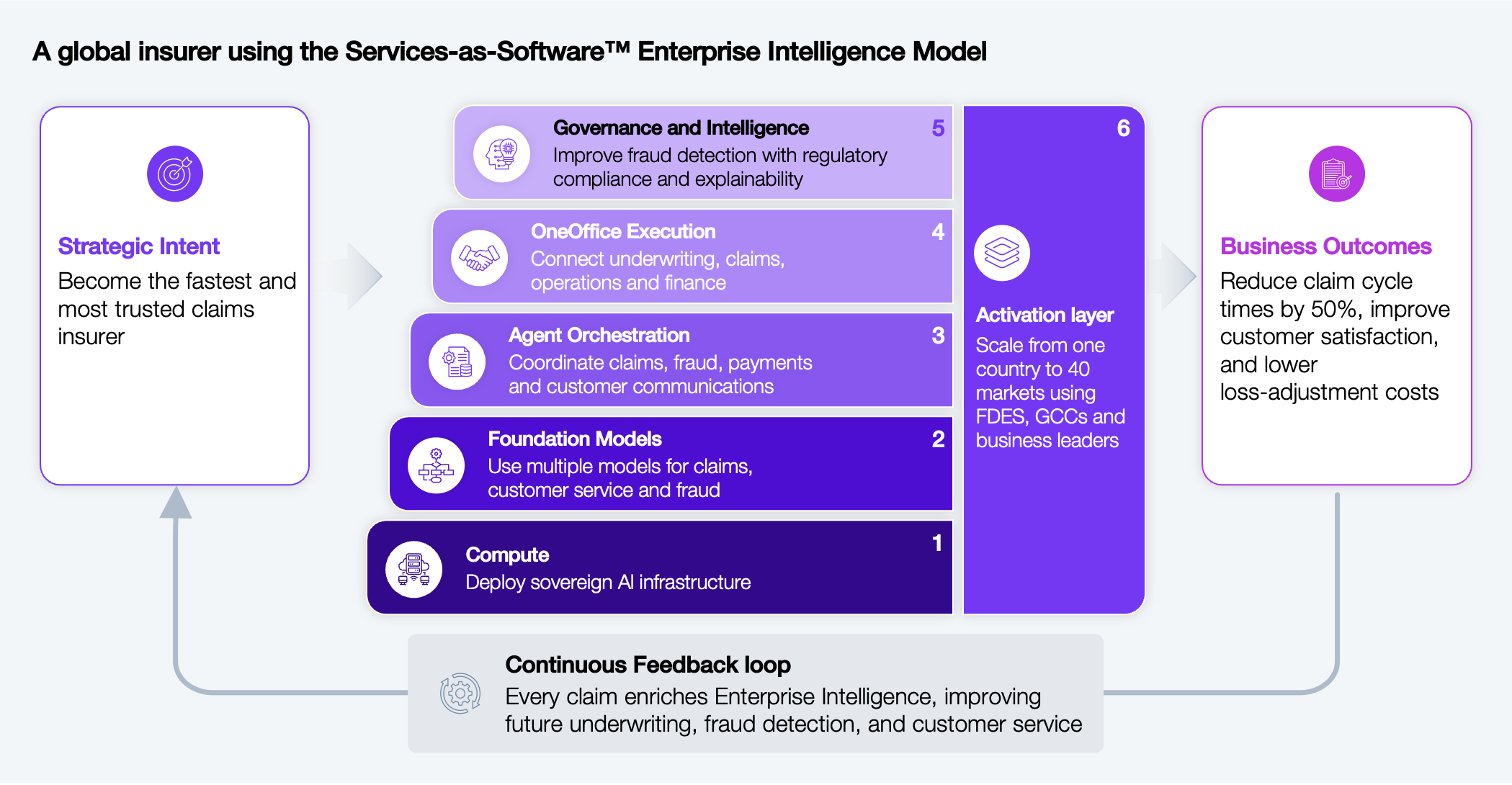
This example illustrates how the Services-as-Software Operating Model transforms a strategic business objective into measurable business outcomes.
No individual layer creates a competitive advantage on its own. Competitive advantage emerges because every layer works together as a continuously learning operating model, where every business outcome strengthens the enterprise intelligence that drives the next cycle of execution.
The insurer begins with a clear leadership mandate to become the fastest and most trusted claims provider, and every layer of the operating model aligns around delivering that objective. Compute provides the AI infrastructure, foundation models supply specialized reasoning for claims, fraud, and customer service, while agent orchestration coordinates work seamlessly across the claim’s lifecycle. OneOffice Execution then brings together underwriting, claims, operations, and finance into a single execution model, ensuring AI is embedded into the way the business actually operates rather than sitting inside disconnected applications.
As every claim is processed, Governance and Intelligence ensures decisions remain secure, compliant, and explainable while continuously enriching the enterprise’s own knowledge of claims handling, fraud patterns, and customer behavior. The Activation layer scales that operating model from a successful pilot in one country to a global capability across forty markets by combining FDEs, GCCs, and business leaders into a single transformation effort. The result is faster claims processing, lower operating costs, and higher customer satisfaction, while every claim feeds back into the operating model, continuously strengthening enterprise intelligence and improving the performance of every future decision.
The first generation of enterprise AI was built around renting intelligence from increasingly capable foundation models because organizations wanted rapid access to extraordinary new capabilities. That was the right strategy for experimentation, but it is becoming the wrong strategy for long-term differentiation because foundation models are steadily becoming commodities while enterprise intelligence is emerging as the strategic asset that competitors cannot simply buy.
The next generation of enterprise AI will therefore not be defined by who has access to the smartest model. It will be defined by who builds the strongest Services-as-Software operating model, who transforms human expertise into enterprise intelligence, who retains sovereignty over the knowledge that makes their business unique, and who continuously learns from every customer interaction, workflow, and business outcome.
The cloud era taught enterprises how to share infrastructure because infrastructure eventually became a utility. The AI era will teach enterprises how to build enterprise intelligence because intelligence is rapidly becoming the defining asset of the modern enterprise. Organizations that simply consume AI will always depend on someone else’s roadmap. Organizations that continuously build enterprise intelligence through Services-as-Software will own the business context, operating knowledge, and institutional expertise that become increasingly difficult for competitors to replicate.
Every enterprise can rent intelligence, but very few will build enterprise intelligence. That distinction will determine who leads the AI economy.
Register now for immediate access of HFS' research, data and forward looking trends.
Get Started

If you don't have an account, Register here |
With the exception of our Horizons reports, most of our research is available for free on our website. Sign up for a free account and start realizing the power of insights now.
Our premium subscription gives enterprise clients access to our complete library of proprietary research, direct access to our industry analysts, and other benefits.
Contact us at [email protected] for more information on premium access.

