This Services-as-Software playbook is for pharma manufacturing leaders and CIOs turning deviation, CAPA, and batch release work into a revenue accelerator.
Eighteen trillion dollars in value sits idle across enterprises due to self-inflicted debts: processes, talent, data, and technology. Services-as-Software (SaS) is an approach to addressing these debts durably. This playbook will bring to life the concept of SaS by showing how pharmaceutical manufacturing leaders and CIOs can materially benefit from it by addressing knowledge work that invariably delays product to market and associated revenues.
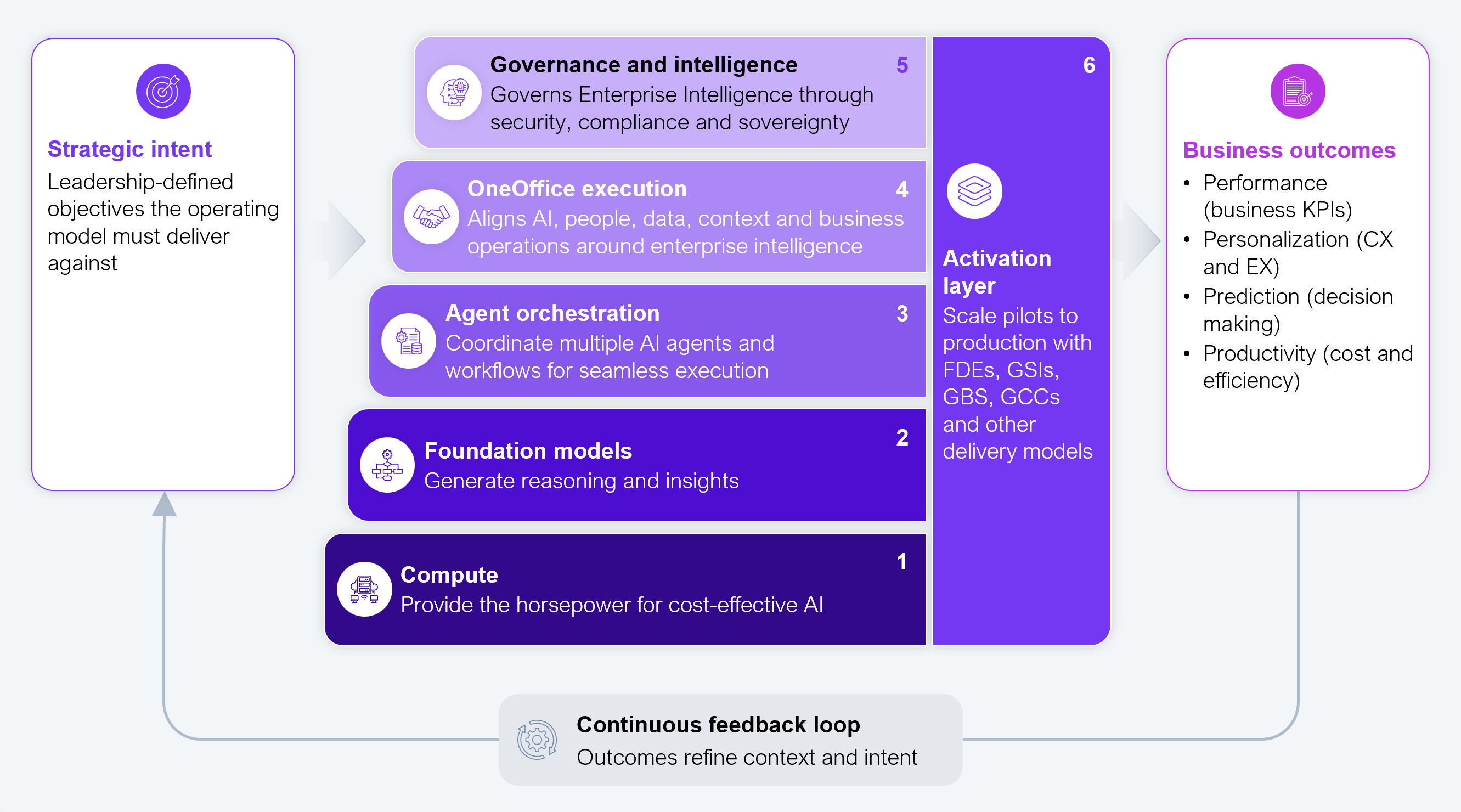
SaS is an HFS operating framework that translates business models from people-led delivery to IP-led delivery. It is about orchestrating outcomes rather than sourcing processes and about telemetry-driven value realization rather than strategic contract-tracking KPIs. By bringing together knowledge, operating logic, and business expertise, it enables sovereign enterprise intelligence, helping organizations learn and improve from execution with every cycle. Exhibit 1 illustrates how SaS fits within an enterprise intelligence model.
Source: HFS Research, 2026
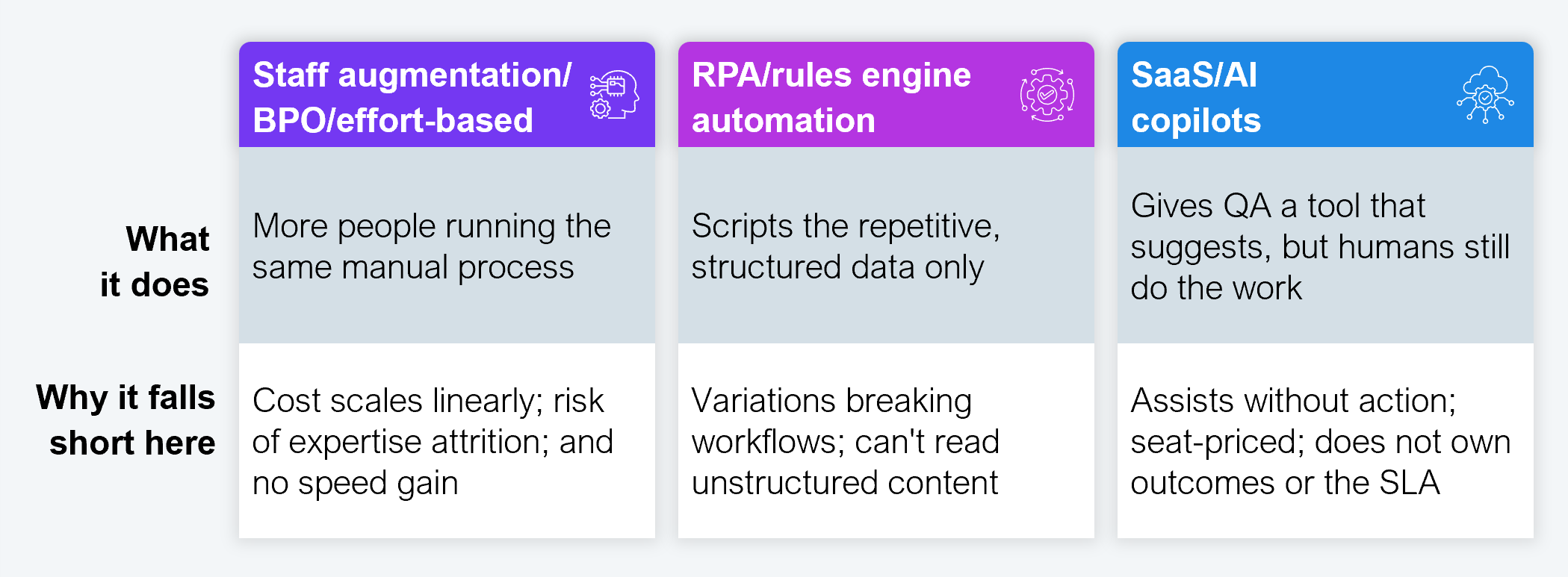
AI maximizes value when the operating and commercial models around it are connected and meaningfully aligned with the enterprise objective. There is sufficient evidence across industries that bolting AI onto existing processes yields marginal gains. SaS re-architects the work so that software leads execution and experts govern, a far cry from contemporary models (see Table 1).
Source: HFS Research, 2026
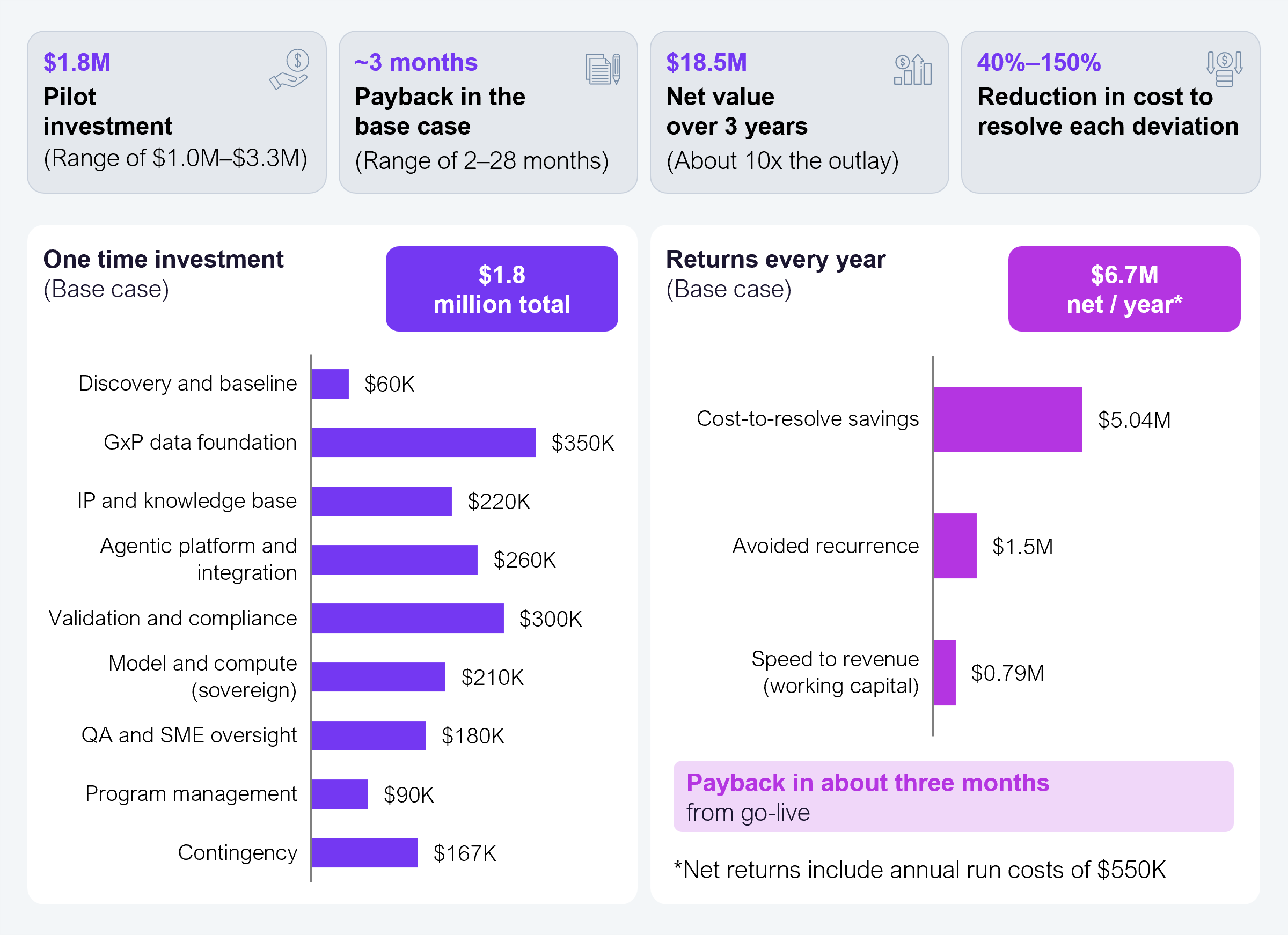
SaS is a delivery model with the highest capacity to maximize the potential of AI. It can overcome challenges by turning a tactical or operational problem into a catalyst for an enhanced operating construct. Its application in pharma manufacturing can yield three key quantifiable benefits in a short time (see Exhibit 2):
Lower cost to resolve: Every deviation and investigation consumes quality assurance (QA) and subject matter expert (SME) hours across drafting, rework, and review. That effort grows linearly (one-for-one) with volume, so more deviations simply mean more people. With SaS, AI agents draft the investigation, perform root cause analysis (RCA), propose corrective and preventive action (CAPA), and review the batch record in advance. At the same time, a Qualified Person signs off by exception. The same work gets done with a fraction of the human effort and far less rework, so the cost to resolve each deviation falls sharply and stops climbing with volume. In a beachhead pilot, the return on investment is worth roughly $5 million a year.
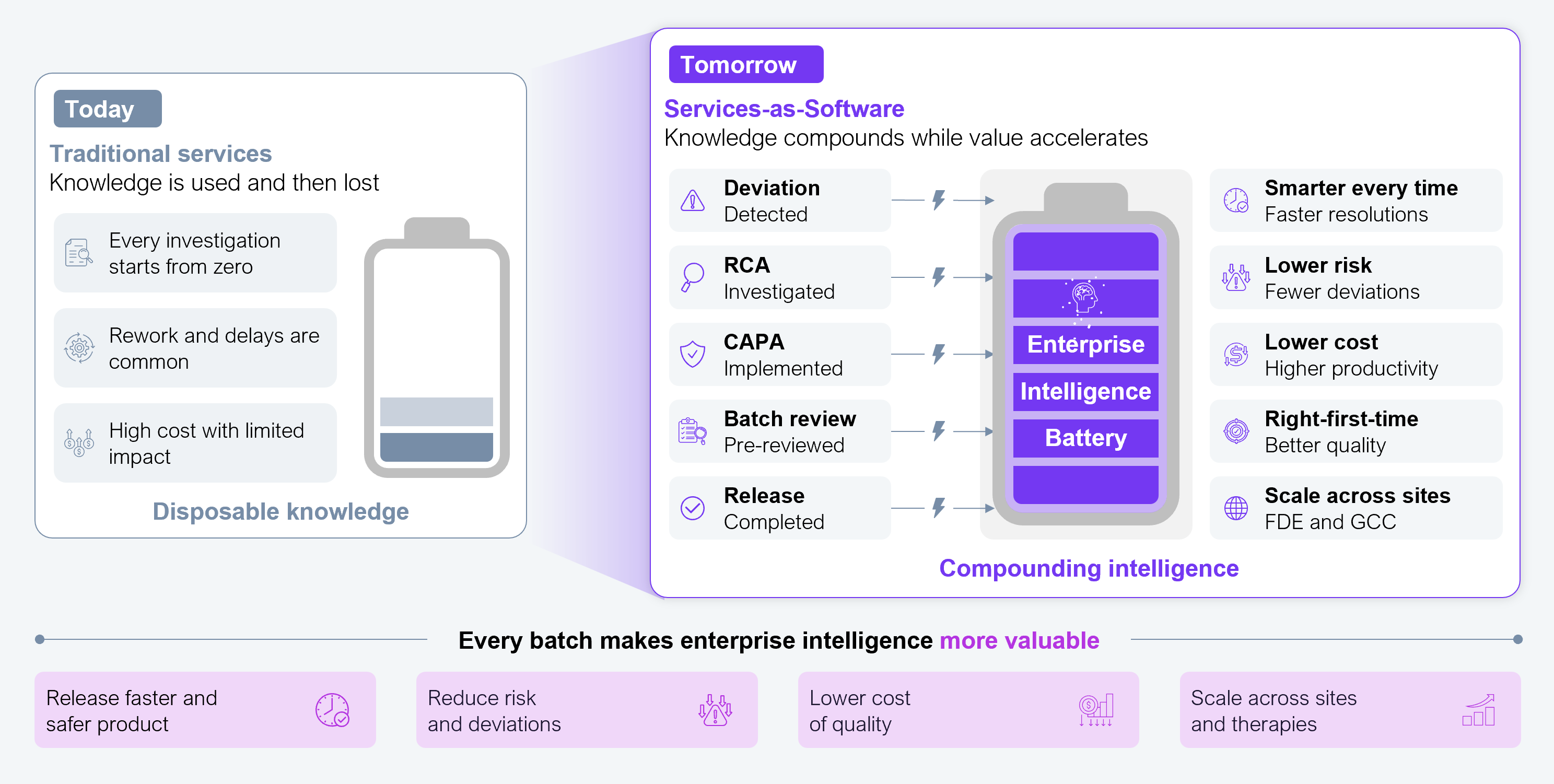
Prevention and reduced deviations in the first place: This is the benefit that makes it SaS rather than plain rules-based automation. Every investigation SaS runs is fed into a governed knowledge base, so recurring failure modes are recognized earlier and designed out rather than rediscovered from scratch each time. Over time, the repeat deviation rate falls, which means fewer investigations to run, fewer batches at risk, and less firefighting for the quality team. Unlike a labor model, where hard-won knowledge depends on people at risk of attrition, this advantage compounds with every batch the plant runs. With the beachhead pilot, avoiding recurrence will save roughly $1.5 million annually, which is expected to increase as the knowledge base deepens.
Speed to revenue: Deviations and batch record review sit directly on the critical path to release. So when SaS closes them out in days rather than weeks, the product reaches the market sooner, and less cash sits quarantined in-process inventory. The immediate, hard dollar effect is working capital, because a batch waiting on an investigation is cash that cannot be used and revenue that cannot be recognized. With the beachhead pilot, the ongoing financing benefit of carrying less quarantined inventory is roughly $0.8 million a year. That figure is deliberately conservative because earlier release also pulls revenue recognition forward and protects against missed market windows, which are worth far more than the carrying cost alone.
Source: HFS Research, 2026
Pharma manufacturing is the gold standard for producing human-safe products. Still, the supporting knowledge work is slow and expensive, particularly for deviation investigations, RCA, CAPA, batch record review, and release. This work is manual, expert-dependent, and paper-heavy, driving significant negative financial outcomes, as explained below:
It is important to recognize that the bottleneck lies in the manual process and the human expertise embedded in it rather than in the technology. That is exactly what AI can break with SaS, as it enables agents to reason and execute the investigation end-to-end, with QA only by exception. It can handle unstructured, variable work, is priced on closed deviation and released batches, and owns the outcome.
Manufacturing quality is the ideal beachhead for enabling SaS, as the work is repeatable and data-rich, the cost of quality is enormous, and the bottleneck is knowledge work (see Exhibit 3). It is also the sweet spot where agentic AI, not copilots or scripts, can deliver a step-change and material financial impact.
Source: HFS Research, 2026
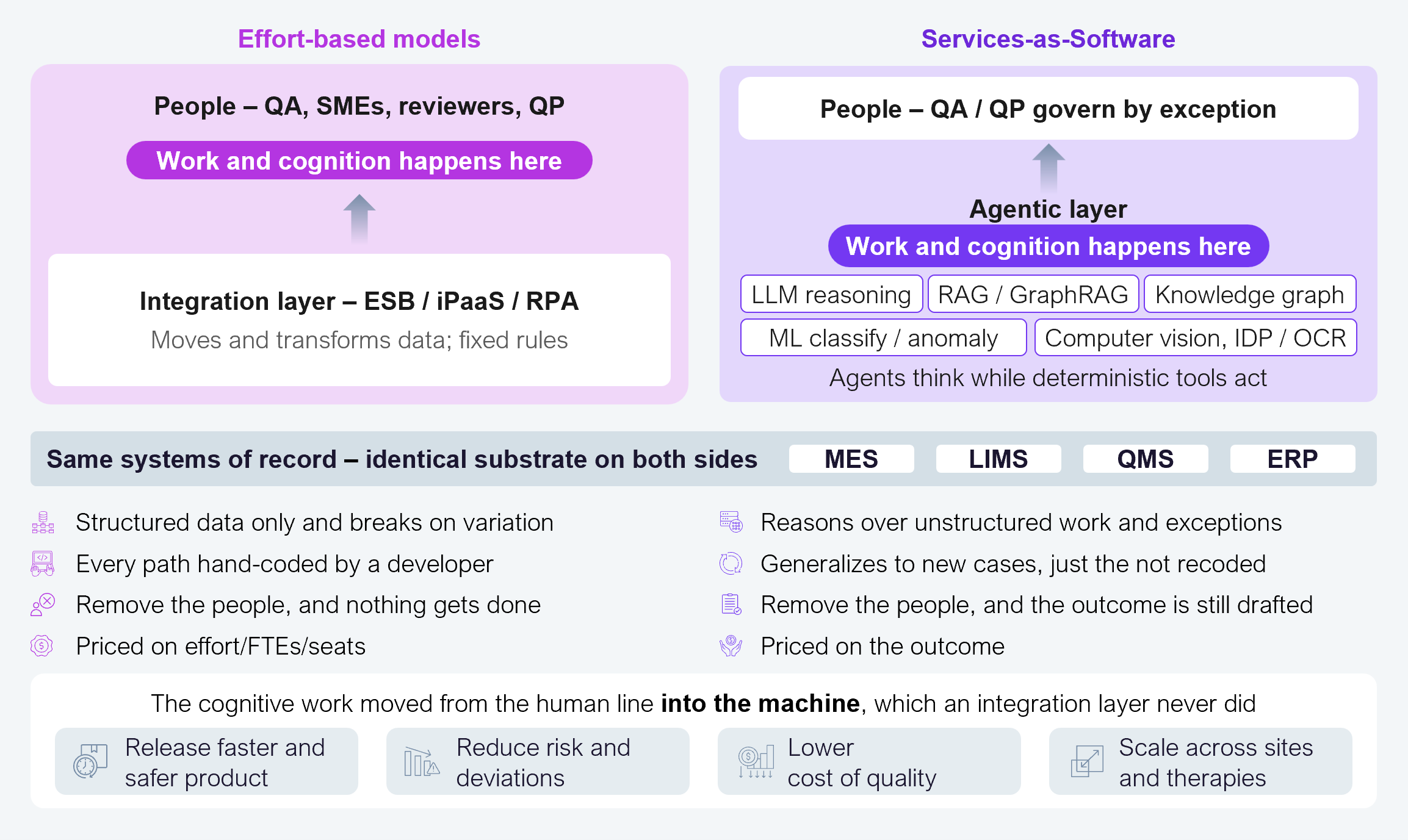
A large, branded manufacturer is running a batch of an injectable drug on its sterile filling line. At 02:14, during filling, an environmental-monitoring signal and a line anomaly raise a concern about sterility assurance. Under the Good Manufacturing Practice (GMP), this is a deviation and is classified as critical because it involves sterility, automatically blocking the batch’s release until the deviation is resolved. This is a typical scenario that manufacturers experience every day, yet efforts to date have done little to move the needle. The following chart shows how SaS goes beyond traditional outcome-based efforts to accelerate product-to-market safely and translate that into higher revenues.
Source: HFS Research, 2026
Effort-based model delivery as it works today
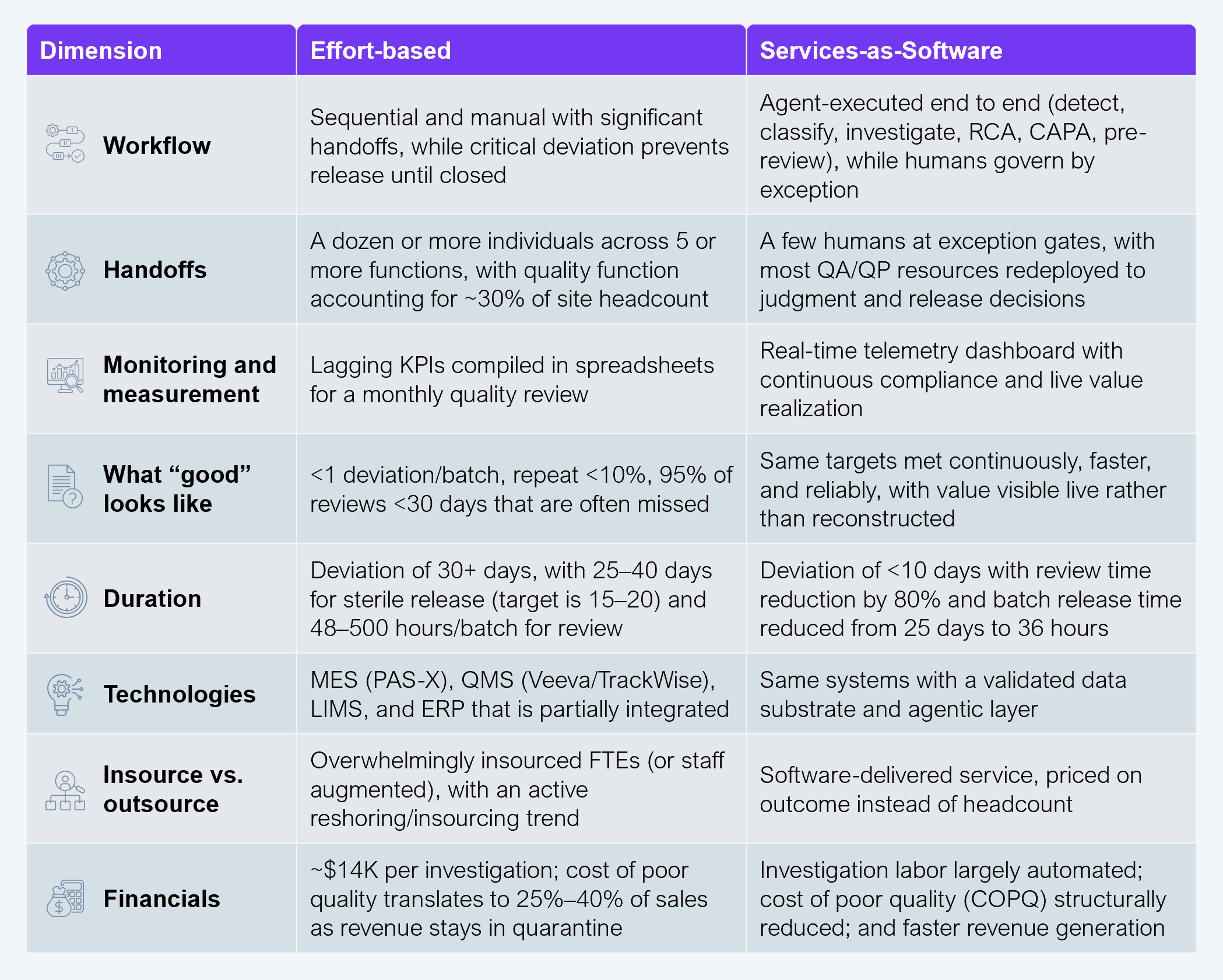
The operator manually documents the event, and the shift supervisor reviews and signs the batch record section before it is sent to quality. A deviation is opened in the quality management system (Veeva Vault QMS or TrackWise), QA classifies it as critical, and the batch is quarantined. Then the human relay begins with a QA investigator manually reviewing historical deviations, SOPs, and batch data across the manufacturing execution system (Körber PAS-X, an MES used by more than half of the top 30 pharmas), laboratory information management system (LIMS), and a partially integrated enterprise resource planning system (ERP). Such manual reconciliations and data-integrity gaps across the systems lead to release delays.
SMEs from microbiology, engineering, and validation are convened for RCA, resulting in a CAPA draft and assignment. QA reviews and approves the executed batch record, and it must be reviewed line by line. The industry average is roughly 48 hours of review per batch: a single complex review is reported to take as many as 500 hours. Complex sterile records typically take 7–10 days.Across the critical deviation and the release, the batch is typically touched by a dozen or more individuals spanning five or more functions, including the operator, supervisor, quality personnel (QC, QA investigator, QA approver, QA manager), three or more SMEs, CAPA owner, and the releasing Qualified Person.
Consequently, the end-to-end release of a sterile product takes 25–40 days, against the 15–20 day target, and each failure investigation costs around $14,000, mostly in senior personnel time, and potentially millions in lost revenues. Quality activities already consume roughly 30% of a typical site’s headcount, and at a branded sterile site, this work is currently overwhelmingly insourced.
The measurements follow a lagging approach, with KPIs (deviation rate per batch, repeat deviation rate, right first time, on-time release, review cycle time) compiled for a monthly quality review. “Good” is defined as less than 1 deviation per batch, a repeat rate under 10%, and 95% of reviews closed within 30 days. These are targets that many sites miss, resulting in a financial impact because the batch and the associated revenue remain in quarantine while being reviewed.
How SaS could work and will work
An agentic layer sitting on a validated (GAMP 5, 21 CFR Part 11) data substrate that unifies MES, LIMS, QMS, and ERP detects and classifies deviations the moment environmental signals and line anomalies are triggered, requiring no manual logging or reconciliation. An investigation immediately beings: the agent retrieves all comparable historical deviations, CAPAs, and SOPs from a governed knowledge graph, drafts the RCA, and proposes a CAPA with the highest historical success rate for this failure mode. In parallel, the agent pre-reviews the executed batch record end-to-end, auto-populates fields, and surfaces only genuine discrepancies.
The microbiology SME and the Qualified Person then review the agent’s work at defined exception gates to make release decisions, with a complete audit trail rather than assembling all relevant content. Human effort shifts from clerical cross-checking to high-level strategic review. Consequently, batch-record review time drops by up to 80%, deviation closure time compresses from 30-plus days to under 10 days, and 200–400 QA hours a month are freed at the plant. A validated electronic batch record system at a sterile facility can reduce release turnaround from 25 days to 36 hours, freeing quarantined batches and revenue much sooner.
Measurement is done in real time, with a live telemetry dashboard that continuously shows the deviation status, cycle time, right first time, and value realized. The commercial model can be changed as the site now pays for outcomes, including closed deviations, released batches, and right first time, instead of headcount, such as QA FTEs or a staff-augmentation contract (see Table 2). The delivery moves from an insourced headcount to a software-delivered service that owns the outcome.
Source: HFS Research, 2026
Consider three forces that could reduce global pharma revenues by more than $1 trillion through 2035: the unprecedented 12% decline in US public health funding, CMS’s growing authority to negotiate prices with pharmaceutical companies under the Inflation Reduction Act (2022), and the convergence of the loss of exclusivity and the patent cliff. Against this backdrop, pharma is exploring every single way to reduce inefficiencies, cut costs, and accelerate revenue growth, and this playbook shows them how.
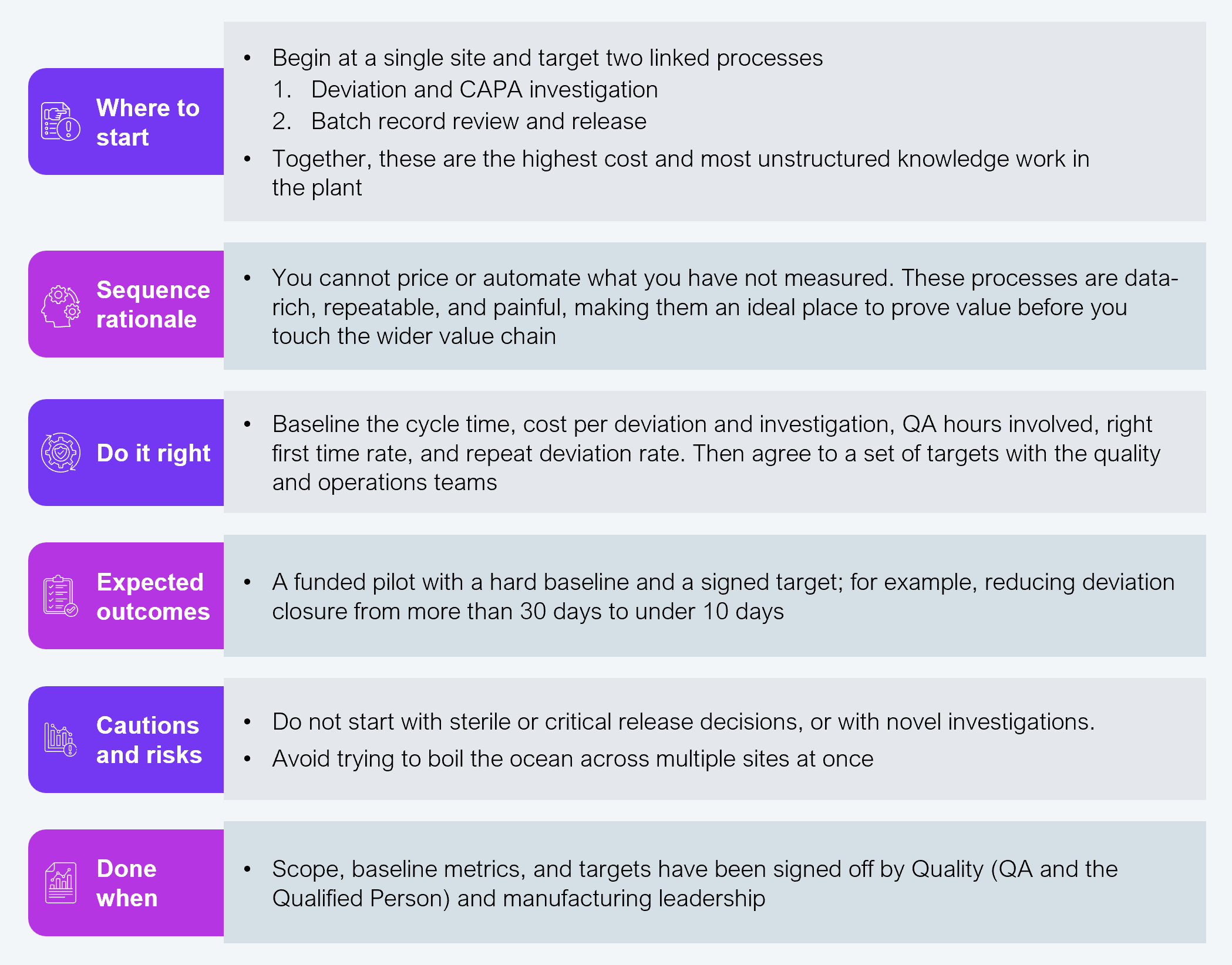
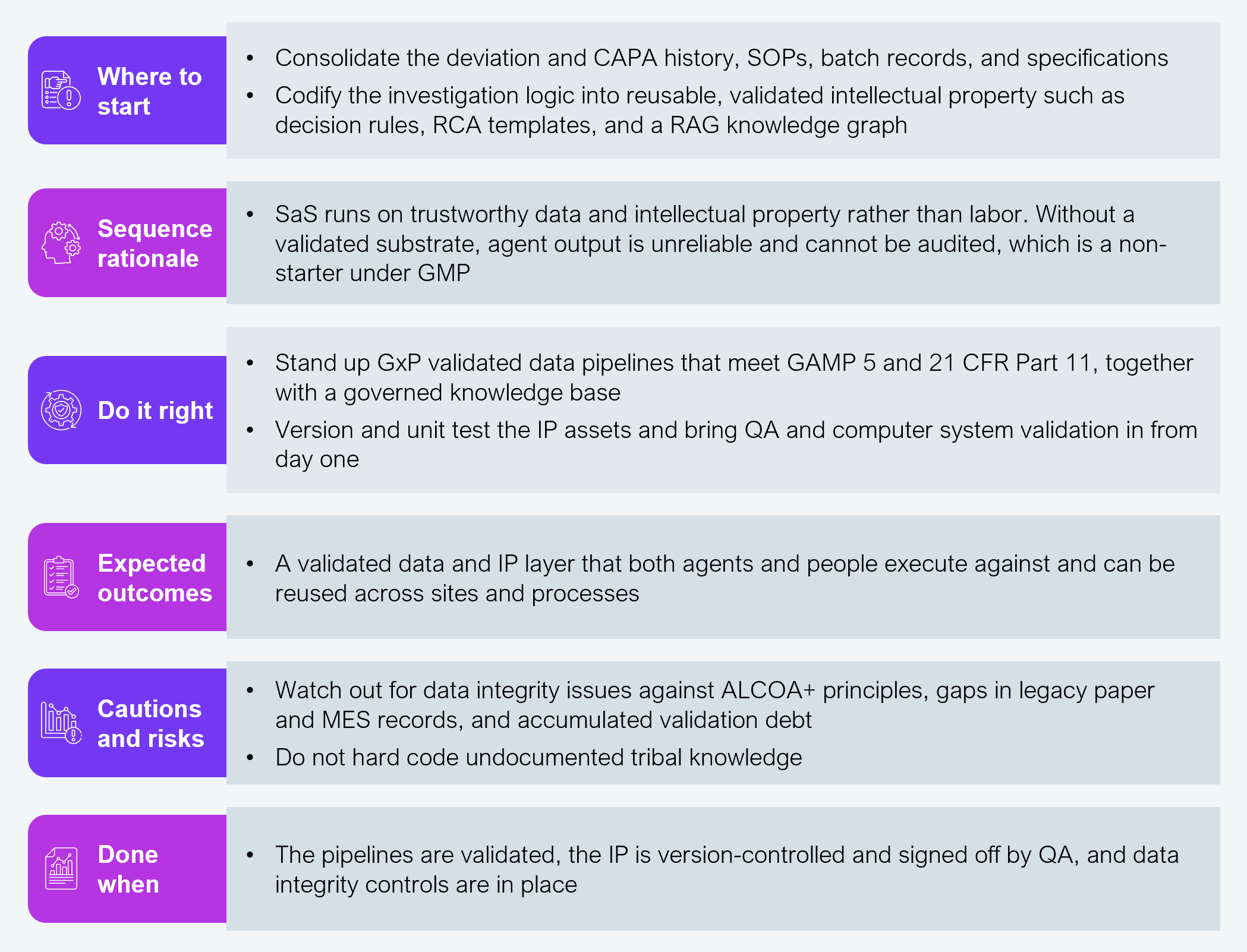
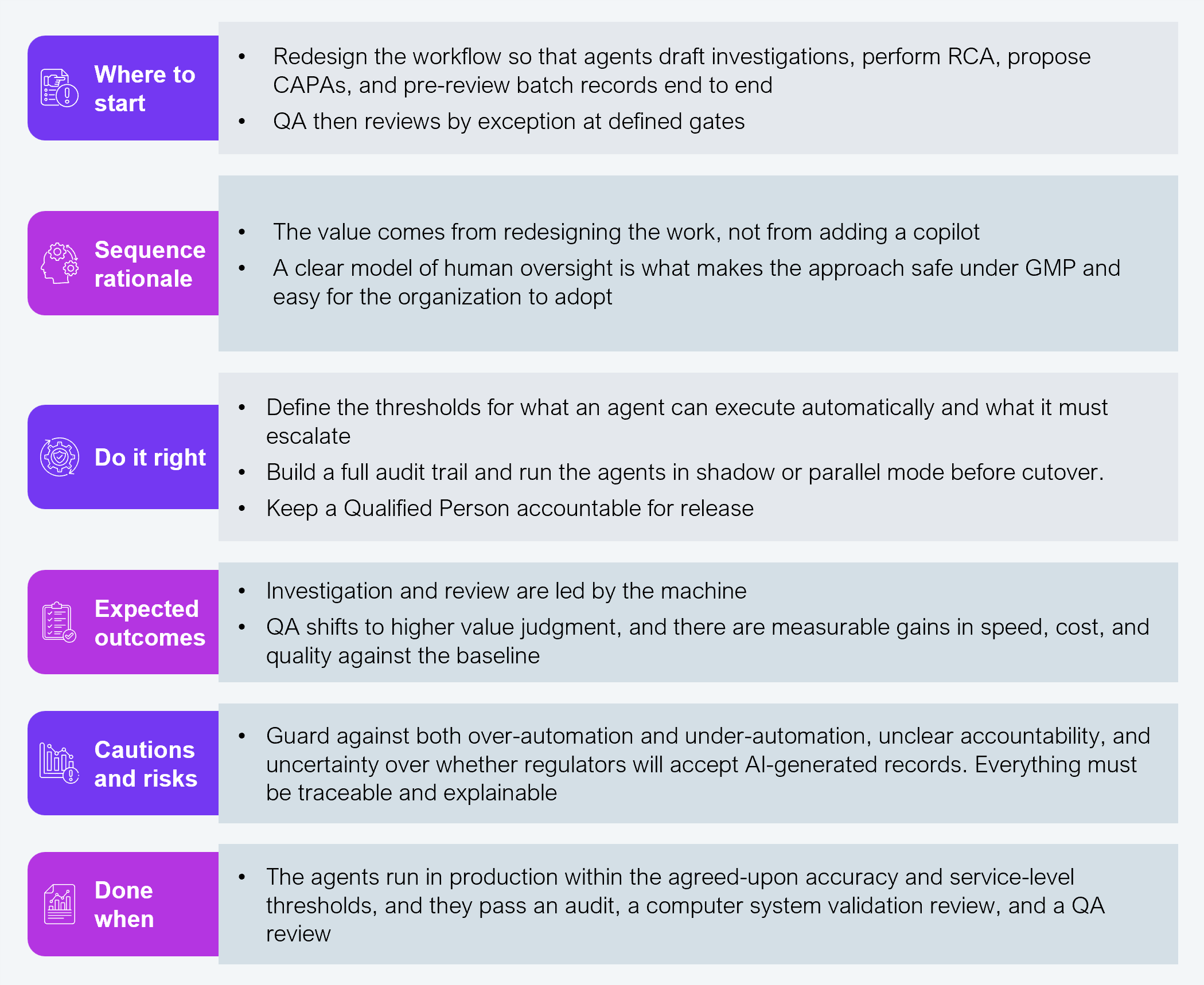
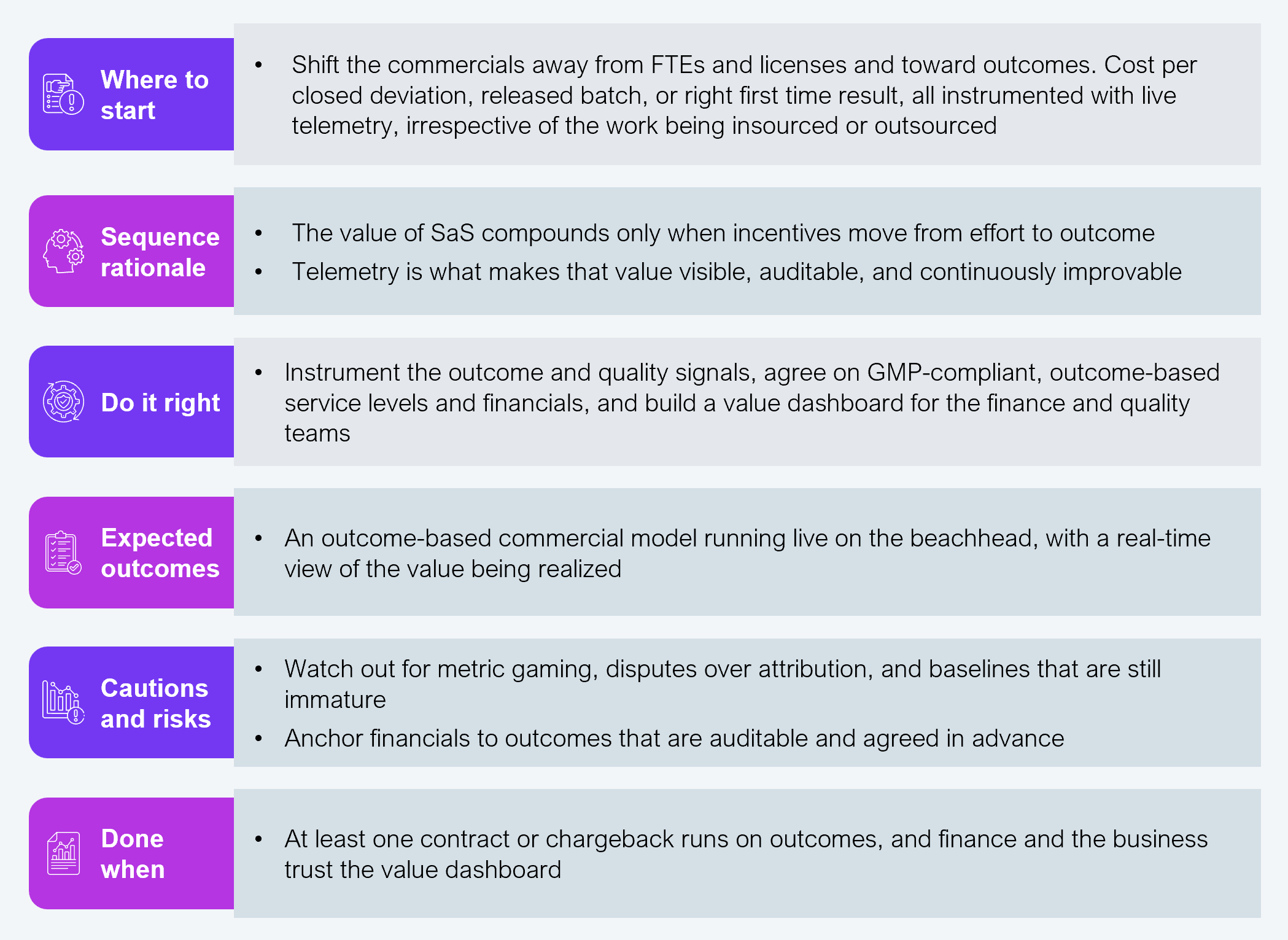
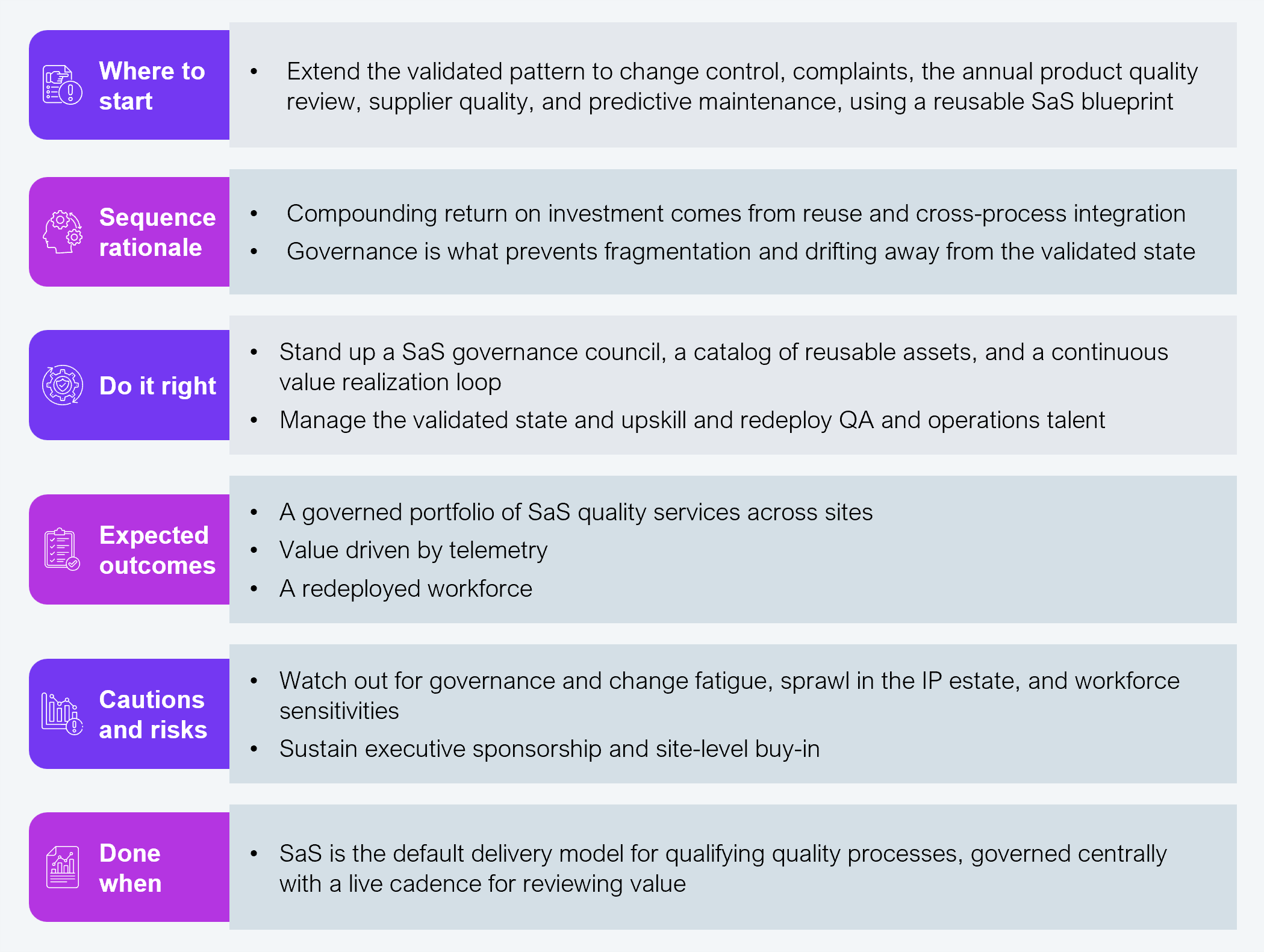
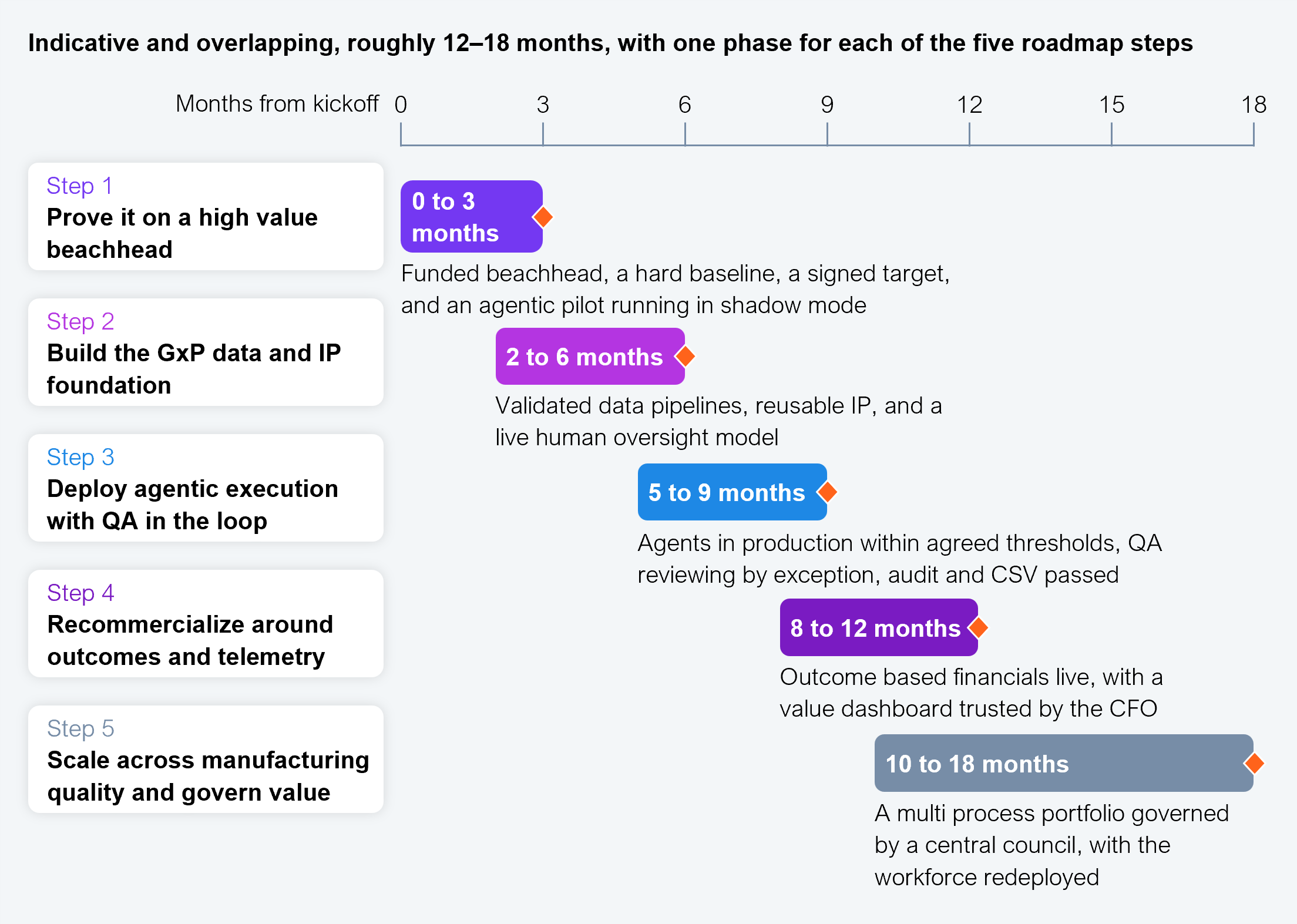
Manufacturer leaders and CIOs must plan on chunking the delivery in line through the five steps described. Each step will help move the ball forward, ensuring value realization along the way (see Exhibit 5).
Source: HFS Research, 2026
The following list includes relevant HFS perspectives on health plan operations in a shifting market. Watch for our series on executing Services-as-Software within a health plan and on selecting the right partner for success.
Register now for immediate access of HFS' research, data and forward looking trends.
Get StartedIf you don't have an account, Register here |
With the exception of our Horizons reports, most of our research is available for free on our website. Sign up for a free account and start realizing the power of insights now.
Our premium subscription gives enterprise clients access to our complete library of proprietary research, direct access to our industry analysts, and other benefits.
Contact us at [email protected] for more information on premium access.